A Complete Guide to Solar Street Light Technology and Benefits
Dec 18, 2025
Driven by global carbon neutrality goals, sustainable infrastructure development has become central to urban and rural progress. Solar street lights, as key facilities combining environmental benefits with practical value, are transitioning from niche alternatives to mainstream lighting solutions. This guide unveils the technical aspects of solar street lights, delves into their economic value and environmental impact, and provides comprehensive reference for municipal decision-makers, engineering procurement teams, and readers focused on green development.
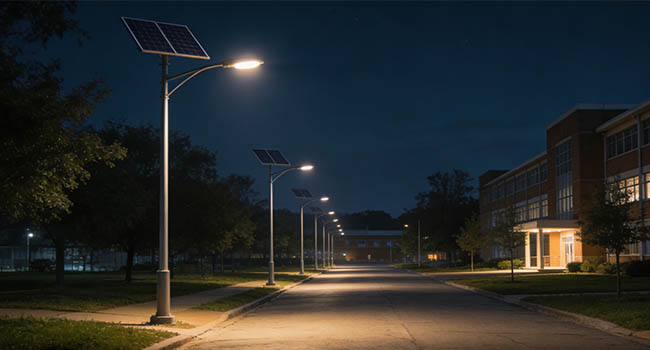
What Are Solar Street Lights?
Solar street lights constitute a fully autonomous lighting system powered exclusively by solar energy, operating independently without grid connection. Its core components comprise four major modules: photovoltaic (PV) panels capture sunlight and convert it into electricity; storage batteries accumulate daytime-generated power for nighttime use; LED light sources provide efficient illumination as the core lighting element; and intelligent controllers coordinate all components to manage charging/discharging cycles and lighting operations.
Working Principle
The operational flow of solar street lights can be simplified into four key steps: During daylight hours, photovoltaic panels convert solar energy into direct current (DC) via the photovoltaic effect. The controller directs this electricity into the battery for storage while preventing overcharging. When ambient light falls below a preset threshold, the controller initiates the discharge process. Finally, the battery releases stored energy to power the LED light source until dawn or the battery reaches its minimum charge level.
Technological Advancements in Solar Street Lighting
Innovations in Photovoltaic Technology for Better Efficiency
Photovoltaic panels serve as the energy core of solar street lights, with technological advancements directly determining the performance ceiling of the lighting system. Traditional photovoltaic cells absorb sunlight only from the front surface. New-generation technologies enhance conversion efficiency by 15%-20% through structural optimization. Double-glass bifacial panels capture light from both sides, boosting power generation by an additional 20%-30% in reflective environments. Thin-film and high-power-density modules further optimize space utilization.
The Evolution of LED Lights and Their Sustainability Edge
LED adoption has revolutionized solar street light illumination logic, offering significant advantages over traditional fixtures. With a theoretical lifespan exceeding 50,000 hours—five times longer than high-pressure sodium lamps and fifty times longer than incandescent bulbs—LEDs consume only one-third the energy of high-pressure sodium lamps and one-tenth that of incandescent bulbs at equivalent brightness. Equipped with adaptive control systems, they dynamically adjust brightness as needed while optimizing the light spectrum to reduce blue light emissions and light pollution, enhancing their environmental credentials.
Battery Advancements: From Lead-Acid to Lithium-Ion and Beyond
Energy storage batteries directly impact system stability and lifespan. Traditional lead-acid batteries suffer from low energy density, short lifespan, bulkiness, and poor environmental performance, with charge/discharge efficiency at only 70%-80%. Mainstream lithium-ion batteries now achieve energy densities of 100-260 Wh/kg, lifespans extended to 8-12 years, compact and eco-friendly designs, and 90%-95% charge/discharge efficiency. Integrated BMS systems further enhance safety, while solid-state batteries are being piloted as next-generation technology.
Smart Technology Integration
Modern solar street lights have evolved into “smart lamp posts,” equipped with sensors for human presence detection and environmental monitoring to enable precise lighting and data collection. Remote management and fault monitoring are achieved via 4G/5G or LoRa networks, facilitating data-driven preventive maintenance. Some lamp posts also integrate charging stations and WiFi hotspots, becoming vital components of smart cities that expand public service capabilities.
Why Are Solar Street Lights a Cost-Effective Choice?
Initial Costs
While the upfront purchase cost of solar street lights is higher than traditional lights due to components like photovoltaic panels and batteries, their hidden costs are lower: no wiring trenching or grid connection fees are required, and installation is simpler. Overall, the initial total investment is moderate. With the scaling of photovoltaic technology, component costs continue to decline. Combined with government subsidies and tax incentives, the initial investment is steadily decreasing.
Long-Term Electricity Costs
This represents the core economic advantage of solar street lights. Once installed, they operate entirely on free solar power, eliminating all electricity expenses. Traditional street lights incur ongoing grid electricity fees, resulting in substantial cumulative costs over time. Solar street lights completely eliminate this expense. When deployed at scale, the total savings far exceed the initial additional investment, delivering significant economic returns.
Maintenance Costs
Solar led street lights incur far lower maintenance costs than traditional counterparts. Their LED light sources, lithium batteries, and photovoltaic panels boast extended lifespans, eliminating frequent replacements. Additionally, they avoid issues like cable aging and short circuits, reducing the need for routine inspections. Intelligent systems enable real-time fault monitoring for targeted repairs, resulting in annual maintenance costs averaging only 1/5 to 1/3 of traditional lights. Large-scale deployment yields substantial annual savings.
Environmental Impact
Carbon Reduction
Solar street lights operate without greenhouse gas emissions, whereas traditional lighting relies on thermal power generation that indirectly produces substantial carbon emissions. A single 100W traditional light emits approximately 0.26 tons of carbon annually. Solar street lights generate only minimal carbon emissions during production, offset within 2-3 years through emissions reduction. Large-scale deployment projects yield substantial annual carbon savings with significant ecological benefits.
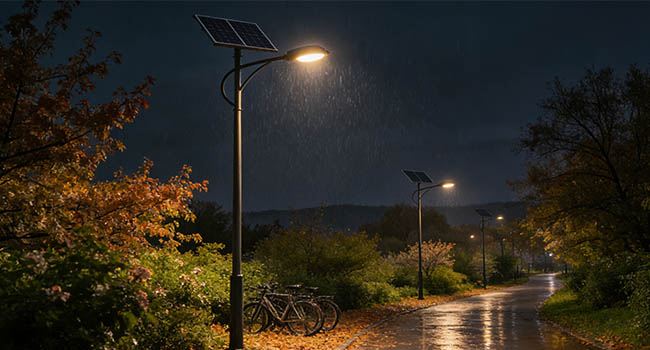
Energy Conservation
As a renewable energy source, solar power eliminates the need for fossil fuel consumption. With annual sunshine hours exceeding 2,000 in most regions of China, solar street lights are fully powered by sunlight. Large-scale adoption reduces dependence on non-renewable energy sources like coal and natural gas, alleviates peak grid load pressures, and enhances overall energy system stability.
Ecological Conservation
Solar street lights excel in ecological conservation through key features: lithium-ion batteries replace heavy-metal-containing lead-acid batteries, reducing toxic pollution; photovoltaic panels and LEDs achieve over 90% recyclability. Directional lighting design minimizes light pollution, protecting astronomical observation environments and preserving animal/plant circadian rhythms. Installation requires no trenching for cables, avoiding damage to soil, vegetation, and underground utilities while reducing ecological disturbance.
The rise of solar street lights stems from the convergence of technological advancement, economic rationality, and environmental awareness. With their “autonomous operation, intelligent controllability, and green, low-carbon” advantages, they have become a core choice for upgrading urban and rural infrastructure. Their continuous technological innovation, outstanding cost-effectiveness, and significant environmental value make them suitable for diverse lighting scenarios. As technology matures and financing models evolve, solar street lights are poised to become the mainstream of future lighting infrastructure. Now is the optimal time to embrace this economical, eco-friendly, and intelligent solution.
related
-
 Off-Grid Road Safety: The Cost-Benefit Analysis of Solar Road Studs in Provincial ProjectsJun. 24, 2026
 -
 The Ultimate Checklist for Inspecting Road Studs Before Installation in Infrastructure ProjectsJun. 04, 2026
 -
 All-in-One vs. Split Solar Street Lights: Which is Better for the Philippine Climate?May. 26, 2026