Common Challenges in Solar Street Light Projects and How to Overcome Them
Feb 09, 2026
With the widespread adoption of new energy sources, solar street lights have found extensive application in municipal areas, industrial parks, and rural roads. However, many projects encounter issues such as unstable lighting, cost overruns, and shortened lifespans due to inadequate preliminary planning, improper equipment selection, and non-standard construction practices. This article identifies core pain points throughout the project life cycle and provides actionable solutions to ensure stable, efficient, and long-term operation.
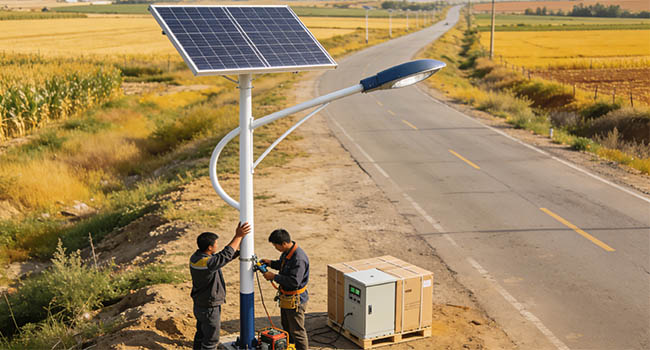
Site Assessment and Planning Challenges
Hidden Shading Issues
A site that appears unobstructed at midday in summer can easily become shaded by buildings or trees during critical charging hours in winter. Localized shading significantly reduces PV panel power generation, leading to chronic undercharging of the system. This results in insufficient nighttime illumination duration, unstable brightness levels, and in severe cases, failure to activate properly.
The best practice is to conduct site shadow surveys during winter, when the sun's altitude angle is lowest and shading conditions most closely resemble the year's worst scenarios. Utilize professional PV shadow analysis tools to simulate sunlight and shading patterns across different seasons and times of day, enabling precise determination of optimal panel installation locations. Furthermore, incorporating a 10%-20% power generation margin in system configuration ensures reliable operation even with minor shading, preventing equipment lifespan reduction due to undercharging.
Soil Conditions and Foundation Risks
While surface soil may appear normal, complex geological conditions such as bedrock, soft soil, or high water tables may exist underground. These hidden issues drastically increase foundation construction difficulty, requiring additional equipment for rock breaking and soil reinforcement, prolonging project timelines, and causing cost overruns. Failure to conduct detailed geological surveys upfront often leads to safety hazards like foundation settlement or lamppost tilting later on, potentially necessitating rework and reconstruction, further escalating project costs.
To address this, professional geotechnical surveys must be commissioned before initiating street light projects to clarify underground conditions. Budgets should allocate 10%-15% contingency funds for unexpected geological issues. Simultaneously, adapt foundation designs based on survey results: use anchor foundations in rocky areas, enlarged foundations with reinforcement in soft soil zones, and implement drainage protection in high water table regions—mitigating foundation risks at their source.
Municipal Utility Lines and Construction Access
Solar street light projects often involve excavation near underground utilities. Complex utility networks in certain areas, combined with unmarked aging lines and inaccurate location records, pose high risks of damaging water, power, or communication lines during digging. This leads to work stoppages, financial compensation, and even safety incidents. Additionally, narrow rural roads, weight restrictions on industrial park bridges, and limited construction hours on municipal roads significantly impact equipment transportation and progress, leading to project delays.
To address this, coordinate in advance with all utility providers (municipal, water, power, telecommunications) to obtain detailed pipeline maps. Clearly identify pipeline locations, burial depths, and safety clearances to designate no-dig zones. Simultaneously, pre-plan construction transportation routes to verify bridge load-bearing capacity and road width meet equipment transport requirements. Coordinate with relevant authorities to establish optimal construction time frames, avoiding last-minute plan changes to ensure efficient project advancement.
Equipment Selection and Quality Issues
Mismatched equipment, substandard quality, and unsuitability for regional climates are primary causes of high failure rates and shortened lifespans in solar street light systems. These factors also drive persistently high operational and maintenance costs in project later stages.
Component Compatibility Issues
Solar street light systems consist of four core components: photovoltaic panels, controllers, batteries, and lamp heads. If component parameters are mismatched—such as when panel power output does not align with battery capacity, or controller output current is incompatible with lamp head power requirements—it can lead to insufficient charging, abnormal discharging, or even equipment burnout.
In actual projects, many clients procure components from different brands or with varying specifications to reduce initial costs. This practice frequently leads to system integration failures and significantly increases long-term maintenance expenses. To address this issue, prioritize purchasing complete solar street light systems to ensure all components originate from the same brand and are fully compatible. Prior to installation, each lamp must undergo individual debugging to verify voltage, current, and control logic functionality. Simulate the entire charging and discharging cycle to confirm no compatibility issues exist before proceeding with installation.
Counterfeit Products and Quality Risks
The current solar street light market is rife with substandard products. Some manufacturers produce goods with falsely labeled power ratings, refurbished batteries, and inferior controllers to capture market share. While these lights offer low initial procurement costs, they exhibit short lifespans and high failure rates. For instance, falsely rated solar panels may deliver less than 60% of their stated power output, while refurbished batteries experience significant capacity degradation within about one year. Frequent equipment replacements subsequently increase the project's total lifecycle costs.
As core system components, photovoltaic panels, batteries, and controllers directly determine project stability and must undergo rigorous quality control. During procurement, verify manufacturer credentials, product test reports, and successful case studies from similar projects. Reject low-cost products lacking certifications or test documentation. Upon component delivery, conduct sampling inspections and commission third-party agencies to verify critical parameters against project specifications. Clearly define warranty terms in procurement contracts, specifying warranty periods for each component and fault compensation standards.
Insufficient Climate Adaptability
Significant regional climate variations exist. Equipment selection that disregards local climate characteristics can cause abrupt performance degradation, accelerated damage, and reduced project lifespan. In frigid regions where winter temperatures drop below -20°C, standard lead-acid batteries may lose half their capacity or even crack due to freezing. In rainy, high-humidity areas, inadequate equipment sealing can lead to internal short circuits. Coastal areas experience frequent typhoons; insufficient wind resistance ratings may cause lamp posts to tilt or break. In windy and sandy regions, dust accumulation on photovoltaic panels reduces power generation efficiency.
To address these issues, equipment selection must align with regional climate characteristics. In cold regions, choose low-temperature freeze-resistant lithium batteries to ensure stable capacity in sub-zero conditions. For high-humidity, rainy areas, select solar street lights with IP67 or higher waterproof ratings and ensure proper interface sealing. In coastal areas, select light poles with wind resistance ratings ≥12 and reinforce foundations. In windy and sandy regions, use dust-resistant photovoltaic panels combined with regular cleaning protocols to ensure equipment adapts to regional climates and operates stably long-term.
Installation and Technical Construction Challenges
Weather and Schedule Delays
Solar street light construction involves foundation pouring and high-altitude installation, demanding favorable weather conditions. Rain, snow, extreme heat, and strong winds can all impact construction progress and quality. High winds pose safety hazards during elevated pole installation; forced construction risks pole collapse and personnel injury. Additionally, winter installations suffer from reduced daylight hours and lower solar intensity, decreasing photovoltaic panel charging efficiency. This impedes system commissioning and project acceptance, potentially delaying payment recovery.
To address this issue, construction schedules should incorporate a 7-15 day weather buffer period to avoid concentrated periods of adverse conditions, prioritizing spring or autumn for installation. Simultaneously, construction contracts must clearly stipulate clauses regarding weather-related delays, defining responsibility allocation and schedule extension criteria to prevent disputes between the client and contractor arising from weather-related issues.
Unprofessional Construction Leads To Malfunctions
Solar street light systems operate on direct current, demanding strict adherence to polarity, wiring, and waterproofing standards. However, some projects cut construction costs by hiring general electricians instead of specialized renewable energy teams. This often results in reversed wiring, unsealed connections, and improper cable routing—causing system short circuits, equipment burnouts, and difficult repairs. Additionally, non-compliant pole verticality and foundation strength create safety hazards like pole tilting or detachment. Improper photovoltaic panel angles reduce power generation efficiency, failing to meet lighting requirements.
To resolve these issues, it is essential to engage professional teams with new energy construction qualifications. Prior to construction, personnel must undergo systematic training to clarify construction specifications, wiring requirements, and waterproofing standards. Implement phased acceptance inspections during construction: verify foundation strength after pouring, check polarity, wiring layout, and waterproofing after wiring completion, and assess vertical alignment after pole installation. This ensures each construction phase meets standards and mitigates potential hazards.
System Performance and Reliability Issues
Battery Failures and Charging Problems
Batteries are the most failure-prone component in solar street light systems, with their lifespan directly determining long-term project performance. Common failures include insufficient capacity, cold damage, overcharging/overdischarging, bulging, and leakage. These issues often stem from improper selection and non-standard charging management. Prolonged cloudy or rainy weather reduces PV panel output, causing chronic undercharging of the system. Batteries fail to reach full charge, and repeated undercharging significantly shortens their lifespan. Substandard controllers cannot achieve precise charge management, leading to overcharging and over-discharging that accelerates battery degradation. Failure to reserve capacity redundancy during selection leaves the system unable to cope with unexpected rainy periods, resulting in prolonged undercharging of batteries.
To address this issue, solar street light selection must account for the project area's daily sunlight duration and rainy weather frequency, incorporating 20%-30% battery capacity redundancy. In northern regions, choose low-temperature freeze-resistant batteries; in humid southern areas, select leak-proof, well-sealed batteries. Additionally, deploy high-quality smart controllers to enable overcharge, over-discharge, overcurrent, and low-temperature protection. Conduct regular battery status monitoring, perform capacity tests every 3-6 months, and promptly replace aged or faulty batteries to ensure stable system charging.
Substandard Lighting Performance
Substandard lighting performance is a common cause for solar street light project rejection during acceptance inspections. This manifests as insufficient brightness, uneven illumination coverage, and inadequate nighttime lighting duration. These issues typically stem from inadequate luminous design in the early stages, improper equipment selection, and unreasonable installation heights. Many projects fail to calculate required illuminance levels and coverage areas based on road width and pedestrian traffic, instead arbitrarily selecting luminaire power and installation height.
This leads to insufficient luminaire power failing to meet brightness requirements, or mismatched beam angles causing uneven coverage and dark spots in certain areas. Additionally, insufficient PV panel power generation and inadequate battery capacity can prevent nighttime illumination from meeting design standards.
To resolve this issue, professional photometric design must be conducted during the preliminary phase. This involves calculating luminaire power, beam angle, and installation height based on road width, pedestrian traffic, and lighting standards to ensure uniform coverage and adequate brightness. After installation, measure actual illuminance levels and coverage. If standards are not met, promptly adjust luminaire angles or replace with appropriately rated fixtures. Simultaneously optimize system configuration to ensure solar panel generation capacity and battery storage meet nighttime illumination duration requirements, preventing lighting effectiveness from being compromised by insufficient power supply.
The successful implementation and long-term operation of solar street light projects require comprehensive management throughout the entire lifecycle: preliminary site planning, mid-stage equipment selection, and post-installation construction and maintenance. This approach precisely mitigates various hidden risks. Only through scientific site surveys, rational equipment selection, standardized construction, and meticulous operation and maintenance can core issues like unstable lighting, cost overruns, and shortened lifespan be effectively resolved. This ensures solar street lights truly leverage their energy-saving advantages, providing stable and reliable illumination for municipal, industrial park, and rural road lighting.
related
-
Off-Grid Road Safety: The Cost-Benefit Analysis of Solar Road Studs in Provincial ProjectsJun. 24, 2026
-
 The Ultimate Checklist for Inspecting Road Studs Before Installation in Infrastructure ProjectsJun. 04, 2026
 -
 All-in-One vs. Split Solar Street Lights: Which is Better for the Philippine Climate?May. 26, 2026