How to Select Solar Street Lights for Areas Prone to Typhoons?
Apr 07, 2026
In regions frequently hit by typhoons, the summer and fall seasons are often marked by strong winds, heavy rains, and high levels of salt spray. As a result, solar street lights in these areas must withstand far greater challenges than those in ordinary regions. Applying standard selection criteria in such areas can easily lead to street lights toppling over, water ingress, and corrosion, causing lighting outages that not only compromise traffic safety but also increase maintenance and operational costs. This article focuses on the core requirements for typhoon resistance, breaking down the key selection criteria and best practices for typhoon-resistant solar street lights to help municipal authorities, engineering firms, and procurement teams quickly identify suitable solar street lights for coastal regions.
Core Prerequisites for Selecting Solar Street Lights in Typhoon-Prone Areas
Define the Application Scenario
Traffic volume, lighting requirements, and the severity of typhoon impacts vary significantly across different road scenarios, necessitating tailored selection criteria. Urban arterial roads require high-brightness, typhoon-resistant solar street lights with wind resistance of ≥12 on the Beaufort scale. Rural roads require moderate brightness, and solar street lights with wind resistance of 10–12 on the Beaufort scale are sufficient; coastal highways require high-brightness solar street lights with high salt fog protection, with wind resistance of no less than 12 on the Beaufort scale. Scenic area roads balance aesthetics with basic wind resistance, so selecting suitable road solar street lights is sufficient.
Please refer to the table below for specific compatibility requirements:
|
Application Scenario |
Brightness Requirement |
Recommended Wind Resistance Level |
Core Adaptation Points |
|
Urban Main Roads |
High brightness (≥1000 lm), uniform lighting |
≥ Level 12 |
Thickened light pole, high waterproof rating, long-endurance battery |
|
Rural Roads |
Medium brightness (500–800 lm), basic lighting |
Level 10–12 |
Lightweight adaptation, cost-effective priority, basic anti-corrosion |
|
Coastal Highways |
High brightness (≥1000 lm), salt-fog resistant |
≥ Level 12 |
Dual anti-corrosion process, high salt-spray protection, thickened materials |
|
Scenic Area Roads |
Medium brightness (600–900 lm), aesthetic matching |
Level 10–12 |
Coordinated appearance, basic wind resistance, waterproof compliance |
Distinguish Between Primary and Secondary Priorities
When selecting solar street lights for areas prone to typhoons, it is essential to clearly identify core requirements and secondary needs to avoid “neglecting one aspect while focusing on another.” The core requirements are always “wind resistance, water resistance, and corrosion resistance.” These three attributes directly determine the stability and service life of wind- and water-resistant solar street lights and form the foundation of the selection process. Secondary requirements include energy efficiency and battery life. Since typhoons are often accompanied by prolonged periods of rain, insufficient battery life can cause solar street lights to lose their core functionality; therefore, these requirements must be prioritized only after the core requirements are met.
Clarify Compliance Requirements
Before procurement, verify that the solar street lights comply with local municipal lighting standards and wind resistance grade specifications. This is key to avoiding costly rework later on. In regions along the southeastern coast prone to severe typhoons, products must pass wind resistance testing for Category 12 or higher and provide waterproofing and corrosion resistance reports to ensure the selection of qualified solar street lights capable of withstanding Category 12 typhoons. In areas of southern China less affected by typhoons, products rated for wind resistance levels 10–12 may be selected, provided they meet or exceed local municipal requirements; the cost of rectifying non-compliant products later is extremely high.
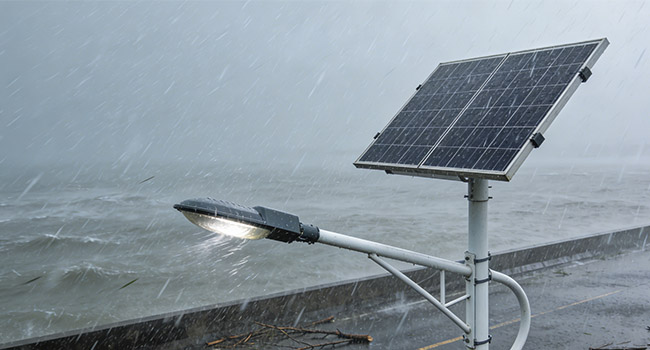
5 Core Criteria for Selecting Typhoon-Resistant Solar Street Lights
Light Pole
The light pole serves as the core support structure; during typhoons, the full force of the impact is borne by the pole. Its material, wall thickness, manufacturing process, and structure directly determine whether the street light will topple. In regions prone to typhoons, prioritize thickened Q235 or Q355 steel, which offers superior wind resistance capable of withstanding Category 12 and higher typhoons. This prevents the bending and breaking common in standard thin-walled steel pipes—a key advantage of solar street lights with thickened Q355 lamp posts.
Pole wall thickness is tailored to road types and features a dual anti-corrosion treatment of “hot-dip galvanizing + electrostatic powder coating,” meeting the corrosion protection requirements for solar street lights in high-salt-fog areas. The conical structure and thickened flange further enhance wind resistance and stability.
|
Material Type |
Wind Resistance |
Applicable Scenarios |
Advantages & Disadvantages |
|
Q235/Q355 Thickened Steel |
Strong (resistant to typhoons of Level 12 and above) |
Various roads in typhoon-prone areas |
Advantages: High strength, good toughness, corrosion-resistant; Disadvantages: Slightly higher cost |
|
Ordinary Thin-Wall Steel Pipe |
Weak (only resistant to Level 8–10 light winds) |
Rural roads in non-typhoon areas |
Advantages: Low cost, lightweight; Disadvantages: Easy to bend and break, short lifespan |
Lampshades and Lamp Bodies
During typhoons, which are accompanied by heavy rain and flying debris, the lampshade and lamp body serve as the outer protective layers; inadequate protection can lead to damage and water ingress. High-transparency PC lampshades should be prioritized, as they are impact-resistant and shatterproof, with a light transmittance close to that of ordinary glass. This is a core feature of impact-resistant solar street lights with PC lampshades, making them well-suited for typhoon conditions.
The lamp body’s IP rating must not be lower than IP65. It is essential to clearly define the IP rating requirements for solar street lights during typhoons. In coastal areas prone to severe typhoons, an IP67 rating is recommended. A sealed design combined with waterproof gaskets effectively blocks rainwater while keeping the lamp body lightweight to avoid overloading the lamp post or compromising stability.
Solar Panels
Solar panels are the core power source; if they detach or break during a typhoon, the street lights will be unable to charge. Mounting brackets should be made of stainless steel with adjustable angles, and anti-loosening bolts should be installed at connection points to prevent detachment caused by strong winds. The panel should feature tempered glass with an aluminum alloy frame for impact and collision resistance. It should be installed at an angle of 30–45° relative to the horizontal plane to balance wind resistance and light collection efficiency. This 30–45° installation angle is a key adaptation for solar street lights, as vertical installation would result in excessive wind resistance.
Battery
During typhoons with continuous rain, the battery’s endurance and waterproof performance determine the continuity of lighting. Underground batteries paired with IP68-rated waterproof enclosures are the preferred choice—a key advantage of underground solar street lights. This configuration prevents water immersion during heavy rain, protects against debris impact, and shields against high-salt fog corrosion, meeting the IP68 waterproof standard for solar street light batteries. Select deep-cycle lithium batteries, which withstand extreme temperatures and offer long-lasting endurance. These can meet the 3–7-day battery life requirements of solar street lights, ensuring a long service life and reducing future replacement costs.
Control System
The control system serves as the “brain” of the street light; waterproofing, lightning protection, and intelligent safety features are essential. The sealed design, combined with a waterproof gasket, prevents short circuits caused by rainwater. Paired with a lightning-protected controller, it mitigates the risk of lightning strikes during typhoons, ensuring the stable operation of typhoon-resistant solar street lights. It features overcharge, over-discharge, and short-circuit protection to extend component lifespan. We recommend controllers with remote monitoring capabilities, which facilitate post-typhoon troubleshooting, reduce maintenance costs, and further enhance the practicality of road solar street lights.
Common Selection Mistakes in Typhoon-Prone Areas
Misconception 1: Focusing Only on Price and Neglecting Wind-Resistant Materials
Some purchasers, in an effort to cut costs, blindly choose low-cost, thin-walled lamp posts and standard glass lampshades. While this may seem cost-effective, it actually poses significant risks. Such solar street lights have poor wind resistance and are highly prone to toppling and shattering during typhoons. They pose a significant hazard in typhoon-prone areas, and the subsequent O&M costs far exceed the initial savings. Do not sacrifice long-term benefits for short-term gains; prioritize wind-resistant materials that meet standards and select qualified typhoon-resistant solar street lights.
Misconception 2: Blindly Pursuing High Brightness While Ignoring Lamp Weight
Brightness is a core function, but in typhoon-prone regions, lamp weight must not be overlooked. High-brightness lamp bodies are typically heavier, which increases the load on the lamp post and can easily cause it to tilt or topple; conversely, lamp bodies that are too light lack stability and are prone to being blown off course by typhoons. It is essential to balance brightness and weight, selecting solar street lights with specifications suitable for coastal regions to avoid compromising performance.
Misconception 3: Neglecting Waterproofing and Corrosion Protection, Leading to Premature Failure
Coastal typhoon regions have high air humidity and salt fog concentrations. Waterproofing and corrosion resistance directly determine the lifespan of street lights and are core requirements for the anti-corrosion process of solar street lights in high-salt-fog areas. If these requirements are ignored, the product will rust, allow water ingress, or short-circuit within 1–2 years of use, necessitating complete replacement and resulting in waste. When selecting models, it is essential to thoroughly verify the waterproof rating and anti-corrosion process to avoid common pitfalls in solar street light selection.
Pitfall 4: Insufficient Battery Life, Leading to No Lighting During Typhoons
Some purchasers focus solely on brightness and appearance while neglecting battery endurance, resulting in depleted power during continuous rain and overcast conditions during typhoons, leaving the street lights unable to illuminate. Based on the duration of rainy periods during the local typhoon season, select deep-cycle lithium batteries with a 3–7-day runtime to meet the solar street light’s battery endurance requirements. This prevents the awkward situation of “power available but no light” and ensures the street lights operate normally during typhoons.
Post-Typhoon Solar street light Maintenance Tips
Inspect the lamp posts and tighten loose components
After a typhoon, first conduct a comprehensive inspection of the lamp posts to check for tilting or loosening. Correct minor tilting immediately, and contact professionals to address severe tilting. Pay special attention to the bolts on the base flange of the lamp post; tighten them promptly to ensure the post is securely anchored to the ground and prevent subsequent toppling. This is a core aspect of post-typhoon solar street light maintenance and helps extend the service life of typhoon-resistant solar street lights.
Clean the solar panels and inspect the lampshades
During typhoons, debris and dust can easily accumulate on the surface of the solar panels, affecting light transmission. These should be cleaned promptly with a soft cloth. At the same time, check the lampshades for damage and inspect the sealing gaskets for signs of aging. Replace any damaged parts immediately, and replace aged gaskets with new ones to prevent water ingress and short circuits. This ensures the normal operation of the impact-resistant PC lampshade solar street lights and reduces the risk of malfunctions.
Inspect the battery and controller; test lighting functions
Check the battery box for water ingress or leaks; if water is present, wipe it dry immediately and check for short circuits. Test the controller’s operational status; turn on the street light to test the lighting function. Replace any damaged components promptly. Use remote monitoring to confirm that all components are operating normally, ensuring the stable operation of the underground battery-powered solar street light and its control system, and enabling rapid restoration of lighting.
Regularly inspect the anti-corrosion coating to extend service life
Regularly inspect the anti-corrosion coating on the lamp post. Promptly touch up any peeling or flaking areas to prevent rust and corrosion, meeting the anti-corrosion requirements for solar street lights in high-salt-fog regions. Simultaneously, check the sealing performance of the battery box and regularly replace aged waterproof gaskets. Through regular maintenance, extend the service life of the street lights, reduce replacement costs, and ensure long-term, stable operation of solar street lights in coastal areas.
When selecting solar street lights for roads in typhoon-prone areas, the focus should be on three core aspects: wind resistance, water resistance, and corrosion resistance. By considering the specific application scenarios and regulatory requirements, one can avoid common selection pitfalls and precisely match the specifications of each core component. Only through scientific selection, standardized installation, and regular maintenance following typhoons can solar street lights withstand the test of severe weather and reliably perform their lighting functions. This not only ensures road traffic safety but also reduces long-term operation and maintenance costs, providing a reliable guarantee for road lighting in typhoon-prone areas.
related
-
Off-Grid Road Safety: The Cost-Benefit Analysis of Solar Road Studs in Provincial ProjectsJun. 24, 2026
-
 The Ultimate Checklist for Inspecting Road Studs Before Installation in Infrastructure ProjectsJun. 04, 2026
 -
 All-in-One vs. Split Solar Street Lights: Which is Better for the Philippine Climate?May. 26, 2026