Solar Street Light Design: Customizing a System to Meet Your Specific Requirements
Apr 02, 2026
In the field of outdoor lighting, solar street lights have become the preferred solution for public spaces such as roads, walkways, and parking lots due to their energy efficiency, environmental friendliness, and the fact that they do not require the installation of power grids. However, not all solar street lights are suitable for every scenario; the “one-size-fits-all” design of generic products often leads to issues such as insufficient illumination, unstable runtime, and wasted costs.The essence of customized solar street light design lies in breaking away from this rigid approach by precisely matching each core component to the project’s specific context, requirements, and budget. This article will break down the key points of customized design across three core dimensions—solar panel configuration, battery technology, and lighting fixtures and controls—to help you build a high-efficiency solar street light system tailored to your needs.
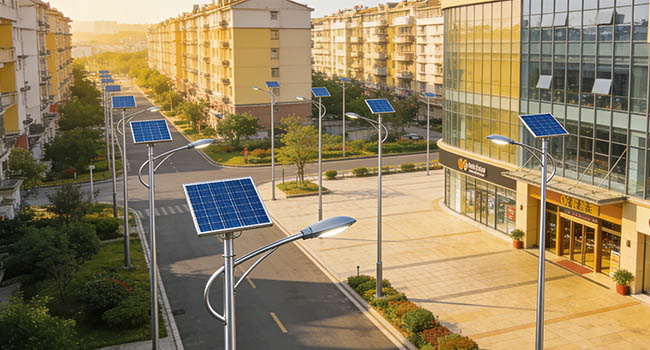
The Importance of Customization in Solar Street Light Design
Scenario Adaptation
Lighting requirements and environmental conditions vary drastically across different application scenarios. Main thoroughfares require high-intensity, wide-area illumination, whereas community walkways do not need excessive brightness. Customized design allows for adjusting component configurations based on the specific purpose and geographical location of the site, ensuring that solar street lights perfectly adapt to the on-site environment and avoiding the awkward situations of “excessive brightness” or “insufficient illumination.” This is one of the core values of solar street light customization, enabling each system to precisely align with its actual usage scenario and deliver optimal lighting performance.
Optimal Energy Efficiency
Off-the-shelf solar street lights often suffer from issues of “over-configuration” or “under-configuration.” High-specification products designed for extreme conditions result in wasted costs when used on ordinary walkways. Conversely, low-specification products used on main roads frequently malfunction due to insufficient power generation and limited battery life.
Customized solar street lights can precisely calculate the energy consumption requirements of a specific scenario and match components that are perfectly suited to those needs. This ensures effective lighting while avoiding waste of energy and resources, achieving “on-demand power supply.” By balancing energy consumption and efficiency through customization, these systems significantly improve energy utilization and reduce unnecessary resource consumption.
Long-Term Cost-Effectiveness
The core costs of solar street lights lie in post-installation maintenance and component replacement. Customized systems, tailored to specific site requirements, experience less component wear and tear. They eliminate the need for frequent replacement of core components such as batteries and solar panels, effectively extending the system’s lifespan and reducing long-term maintenance costs.Compared to generic solar street lights, customized products offer greater long-term cost-effectiveness. Their precise component matching reduces the likelihood of malfunctions and maintenance frequency, saving project owners significant operational costs—a key long-term benefit of custom solar street lights.
Compliance and Safety
Different regions have specific regulatory requirements for outdoor lighting, such as illuminance levels on main thoroughfares and light pollution control in public spaces. Customized designs can adjust lighting parameters according to local regulations and standards, ensuring project compliance and avoiding the risk of corrective actions due to non-compliance.Customizing solar street lights not only ensures optimal lighting performance but also helps projects strictly adhere to local lighting regulations, eliminating safety hazards. This ensures that the solar street light system meets both industry standards and practical operational and safety requirements.
Solar Panel Configuration
Customization Principles
The power generation of solar street lights is closely related to the tilt angle, which is primarily determined by two factors: the latitude of the project site and seasonal variations in sunlight. During the customization process, on-site sunlight data must first be surveyed and analyzed in conjunction with seasonal patterns to select the most suitable solar panel configuration. This ensures stable power generation throughout the year and meets lighting requirements. This is a fundamental step in ensuring energy supply during the customization of solar street lights and directly impacts the overall performance of the system.
Tilt Comparison
The tilt angle of solar panels can be manually adjusted according to seasonal changes to adapt to variations in the sun’s altitude. This is suitable for regions with distinct seasons and significant differences in sunlight intensity between winter and summer. It improves sunlight utilization in winter, balances annual power generation, and offers greater adaptability. The drawback is that manual adjustments are required periodically, resulting in slightly higher maintenance costs; failure to adjust in a timely manner can affect power generation.
Tracking Tilt This system uses motor-driven mechanisms to track the sun’s path in real time, maintaining the optimal angle of incidence at all times. It is suitable for regions with limited sunlight resources and projects with extremely high power generation requirements. It delivers the highest power output, maximizes the utilization of sunlight resources, and meets high-energy-consumption lighting demands. The drawbacks include the highest cost, complex structure, and the need for regular maintenance of the motor system; its failure rate is higher than that of the other two configurations. This is a key factor that must be weighed against actual conditions when customizing solar street lights.
Battery Technology Selection
Customization Principles
Battery customization must address two core requirements: first, “sufficiency,” meaning the capacity must meet the lighting duration and backup power needs during cloudy or rainy weather; second, “compatibility,” meaning the battery type must be suitable for the environmental conditions and usage requirements of the specific application. Before customization, it is essential to determine the daily lighting duration of the solar street light, the average number of rainy days in the local area, and the power rating of the luminaire. This information is used to calculate the required battery capacity, which is a critical prerequisite for ensuring stable battery life in solar street light customization and directly determines the continuity of the system’s nighttime illumination.
Battery Comparison
Lead-acid batteries feature mature technology and high capacity, but have average low-temperature performance and a larger size. They are suitable for scenarios with limited budgets, shorter lighting durations, and fewer rainy days. They have a service life of 3–5 years and are relatively low-cost. Lithium batteries are compact, lightweight, offer stable runtime, have excellent low-temperature performance, and high charge/discharge efficiency. They are suitable for long-term use, extended lighting durations, and environments with frequent rainy weather. They have a service life of 8–10 years and are moderately to high-cost.When customizing solar street lights, the choice of battery type must consider the application environment, budget, and usage duration. Different battery types have their own advantages and disadvantages, so they must be precisely matched to actual needs.
Capacity Design
Customizing battery capacity should follow the principle of “calculating based on demand + reserving redundancy” to avoid under- or over-configuration. The base capacity is determined by multiplying the luminaire’s power by the daily operating hours to calculate daily energy consumption, then factoring in the solar panel’s power output. A 3–7-day operational reserve should be included for cloudy or rainy weather—7 days for high-rainfall areas and 3 days for low-rainfall areas—At the same time, excessive capacity should be avoided to prevent increased costs and reduced charge/discharge efficiency. This design logic is central to balancing runtime and cost in solar street light customization, ensuring system operation during adverse weather while avoiding waste of resources and funds.
Maintenance and Optimization
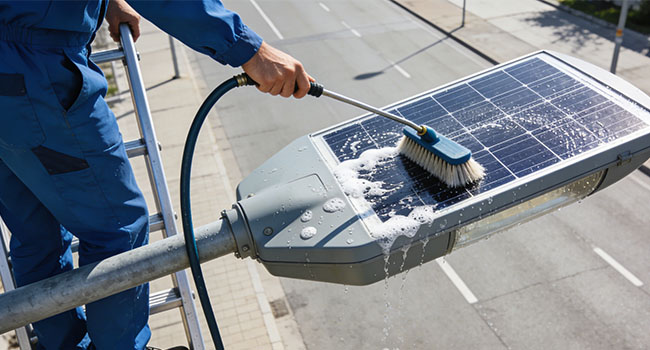
The post-installation maintenance of customized battery configurations directly impacts the lifespan of the solar street light system. Lead-acid batteries require regular checks of the electrolyte level and must be protected from overcharging or over-discharging; maintenance should be performed 1–2 times per year. Lithium batteries do not require frequent maintenance, but they must be protected from high temperatures, freezing conditions, direct sunlight, or freezing; battery connections should be checked periodically for looseness.A scientifically sound maintenance plan is a crucial component of customizing solar street light systems. Proper maintenance extends battery lifespan, ensures long-term stable system operation, and reduces overall operational and maintenance costs.
Optimization of Lighting Fixtures and Controls
Lighting Levels
Different scenarios require varying levels of illuminance. Appropriate illuminance levels (lux) must be determined based on intended use and standards: 30–50 lux for main roads, 10–20 lux for sidewalks, 20–30 lux for parking lots, and 15–25 lux for plazas. Precisely setting illuminance levels is key to ensuring both user experience and compliance when customizing solar street lights. Main roads require uniform and safe lighting; sidewalks require soft, glare-free lighting; parking lots require full coverage with no blind spots; and plazas require uniform lighting without light pollution. The design logic is to first determine the illuminance level, then select the power rating, and adjust the number of lights based on height and spacing to ensure uniform illumination with no blind spots.
Light Distribution
This affects the illumination range and uniformity and is a critical aspect of customizing solar street lights. Different light distributions correspond to different installation heights and scenarios: Type-II is suitable for 3–5-meter-wide sidewalks, Type-III for 5–8-meter-wide roads, and Type-IV for 8–12-meter-wide main roads and plazas. The design goal is to achieve uniform illumination, reduce light pollution, avoid uneven brightness and disturbances to residents, and ensure full coverage of solar street light illumination.
Smart Control
This is key to enhancing the energy efficiency of solar street lights, enabling on-demand lighting and energy conservation. Common methods include light sensing, motion sensing, and scheduling. Light sensing automatically turns the lights on and off, motion sensing controls brightness levels, and scheduling adjusts lighting according to specific time periods. The core value lies in reducing energy consumption, extending battery life, and minimizing manual intervention, thereby significantly improving the economic viability and practicality of solar street lights.
The core of customized solar street light design is a “demand-oriented” approach. Focusing on the four key elements—solar panels, batteries, lighting fixtures, and control systems—and integrating them with the specific environmental context and budget requirements, this approach achieves the goals of “tailored solutions, high energy efficiency, and cost-effectiveness.” Compared to off-the-shelf products, customized solar street lights not only improve lighting performance and system stability but also reduce long-term costs and maintenance burdens while meeting regulatory compliance requirements, truly realizing the principle of “customize once, benefit for a lifetime.”
related
-
Off-Grid Road Safety: The Cost-Benefit Analysis of Solar Road Studs in Provincial ProjectsJun. 24, 2026
-
 The Ultimate Checklist for Inspecting Road Studs Before Installation in Infrastructure ProjectsJun. 04, 2026
 -
 All-in-One vs. Split Solar Street Lights: Which is Better for the Philippine Climate?May. 26, 2026