How to Select the Optimal Wattage for Solar Street Lights?
Dec 10, 2025
Choosing the right wattage for solar street lights prevents two major hidden losses. Insufficient wattage leads to inadequate brightness, posing safety risks during nighttime travel. Conversely, excessive wattage wastes investment and shortens battery lifespan. This article provides a comprehensive wattage selection guide for solar street lights, balancing brightness, energy efficiency, and budget. It addresses the practical question of how many watts to choose for different scenarios.
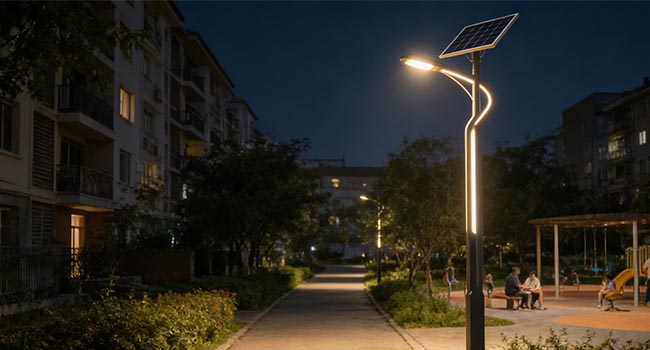
The Relationship Between Wattage and Performance in Solar Street Lights
What is Wattage?
Wattage (unit: Watt / W) is a core parameter for solar street lights, representing the luminaire's power consumption and serving as a key indicator of brightness. Simply put, under identical technical conditions, higher wattage enhances a solar light's luminous potential but also demands more from the solar panel and battery.
Power ≠ Brightness: Lumens (Lm) Are Key
Many mistakenly believe “higher power equals brighter light,” but actual brightness is fundamentally measured by lumens (Lm). Higher lumen values indicate stronger luminous intensity. For example: High-quality LED solar street lights can achieve luminous efficacy of 120-150 lumens per watt, while low-quality ones may only reach 80 lumens per watt. For the same 50W power rating, the former is over 50% brighter than the latter.
Matching Solar Panel Power to Components
Selecting the power rating for a solar street light requires simultaneous consideration of the solar panel and battery capacity. Higher power consumption demands larger solar panels for charging and higher-capacity batteries (measured in Wh) to store sufficient energy for nighttime operation. Mismatched power ratings can result in insufficient daytime charging and premature nighttime shutdowns.
Precise Power Matching for Solar Street Lights
Illumination Area and Coverage Requirements
The illumination area directly determines the minimum power requirement for solar street lights, which must be assessed holistically considering installation height and beam angle. Low-power solar street lights suffice for small areas (e.g., residential walkways) of 100-200㎡, while medium-to-high power models are needed for open spaces (e.g., plazas) exceeding 500㎡.
Lighting pole installation height: 3-5m is suitable for low-pole scenarios, 6-8m is the standard height, 9m and above is considered high-pole lighting. For every 1m increase in height, it is recommended to increase the light power by 10-20%. Narrow beams (30-60°) offer strong focus, suitable for elongated roads. Wide beams (90-120°) provide broader coverage but require higher-wattage solar lights to ensure edge brightness.
Required Brightness Level (Lumen Requirements)
Different scenarios demand varying brightness levels for solar street lights. Refer to the internationally recognized Lux standard, which measures illuminance per unit area. Residential Areas (Community Pathways, Alleys): 10-30 Lux suffices for basic navigation, compatible with low-power units.
Community Settings (Parks, Green Belts): 30-50 Lux balances safety and comfort, suitable for medium-power solar street lights. Commercial/transportation settings (parking lots, side roads) require 50-80 Lux to support vehicle and pedestrian activity, necessitating medium-to-high power solar lights. Main roads/industrial settings (highways, ports) demand 80-200 Lux for high-intensity illumination, requiring high-power solar lights.
Operating Duration and Dimming Modes
For daily operation of 6-8 hours, low-power solar lights suffice. For 10-12 hours, balance power output with battery capacity. For over 12 hours, medium-to-high power + high-capacity batteries are recommended. Solar lights with motion sensors can use low-power standby + high-power trigger mode, saving 30-50% energy compared to constant-on mode, allowing appropriate power reduction.
Local Sunlight Conditions
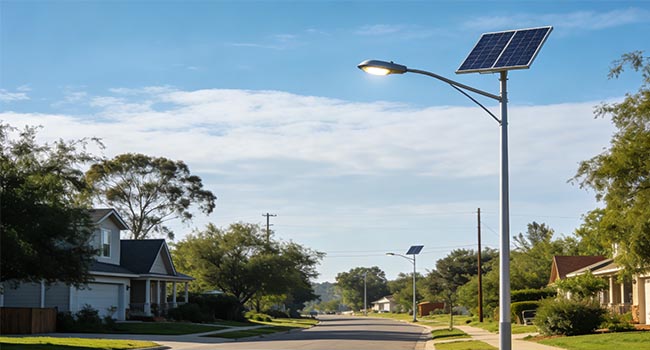
Sunlight duration and intensity vary significantly across regions, directly impacting solar panel charging efficiency. In high-irradiance areas with ample sunlight, smaller solar panels can be used for solar street lights of the same power rating, or slightly lower-power models can be chosen to reduce costs. In low-irradiance areas with shorter daylight hours, solar street light power should be increased by 20-30%, or larger solar panels should be paired with the system. Winter sunlight decreases by 30-40%, necessitating power redundancy to prevent insufficient winter runtime.
Budget and Long-Term Efficiency
High-power solar street lights have higher upfront costs but deliver ample brightness, making them suitable for long-term use with superior ROI (Return on Investment). Low-power options offer lower initial costs but carry the risk of insufficient brightness, potentially requiring future upgrades that increase total costs.
The core recommendation is to prioritize high-efficiency LED solar street lights (120 lumens/watt or higher). Replace high-power, low-efficiency models with low-power, high-efficiency alternatives to balance cost and energy efficiency.
Scenario-Based Solar Street Light Power Selection Reference Table
|
Application Scenario |
Mounting Height |
Recommended Lux (Lux) |
Suitable Power Range |
Suggested Operating Time |
|
Residential pathways, alleys, sidewalks |
3–5 m |
10–30 lux |
10W–30W |
6–8 h |
|
Community parks, green belts, courtyards |
5–6 m |
30–50 lux |
30W–50W |
8–10 h |
|
Parking lots, residential side roads, pedestrian streets |
6–8 m |
50–80 lux |
50W–100W |
10–12 h |
|
Urban main roads, secondary roads |
8–12 m |
80–150 lux |
100W–200W |
12 h+ |
|
Industrial zones, ports, highways |
10–15 m |
100–200 lux |
200W–300W |
12 h+ |
Note: For solar street lights with dimming functionality, power requirements can be reduced by 30-50% from the above specifications. In areas with low sunlight, it is recommended to increase power by 20-30%.
Accurately Determining Solar Street Light Power
Step 1: Calculate the Illuminated Area
Formula: Illuminated Area (㎡) = Length (m) × Width (m). Example: A residential side street is 50m long and 6m wide. Illuminated Area = 50×6=300㎡. Match the solar street light power based on this area.
Step 2: Determine Total Lumens Required
Formula: Total Lumens (Lumens) = Illuminated Area × Target Lux Value. Example: Target brightness 50 Lux, Total Lumens = 300 × 50 = 15,000 Lumens. Select solar street lights with corresponding lumens based on this value.
Step 3: Convert Lumens to Solar Street Light Power
Formula: Recommended Solar Street Light Power (W) ≈ Total Lumens ÷ Luminaire Luminous Efficiency (LPW). Example: Selecting an LED solar street light with 120 lumens per watt efficiency, Power = 15,000 ÷ 120 ≈ 125W. Actual options range from 100W to 150W.
Step 4: Adjust Solar Street Light Power Based on Sunlight Conditions
Add 20-30% power for low-sunlight areas. Example: 125W × 1.2 = 150W. Final selection: 150W solar street light.
Step 5: Verify Solar Street Light Battery Compatibility
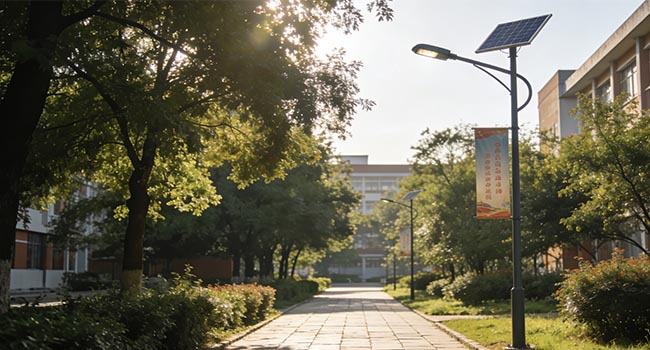
Formula: Battery capacity requirement (Wh) ≥ Power (W) × Operating time (h) × 1.2 (safety factor). Example: 150W × 10h × 1.2 = 1800Wh. Select a lithium battery with capacity ≥ 1800Wh to ensure stable operation.
Avoiding Common Solar Street Light Power Selection Mistakes
Misconception 1: Higher Power Is Always Better
Blindly choosing high-power solar street lights not only increases upfront costs but also causes excessive battery discharge, shortening lifespan. Excessive brightness may also lead to light pollution.
Misconception 2: Lower Power Saves Money
Insufficient power leads to inadequate brightness, failing to meet lighting standards. This may necessitate future replacements, ultimately increasing total costs.
Misconception 3: Ignoring the Impact of Dimming Features on Power Requirements
Solar lights with motion sensors or timed dimming consume significantly less power than their rated wattage. There is no need to select high-power models for constant-on operation.
Misconception 4: Selecting Power Without Considering Local Sunlight Conditions
Solar lights of the same power rating may operate for 12 hours under high sunlight but only 6 hours under low sunlight. Power ratings must be adjusted accordingly.
Misconception 5: Selecting Solar Lights Based Solely on Power Rating Without Considering Lumens
Low-quality LED solar lights have poor luminous efficacy. Even those labeled with high power ratings may produce less actual brightness than lower-power, high-quality solar light products. Prioritize lumens when selecting.
Selecting the right power rating for solar street lights hinges on balancing four key factors: lighting requirements, sunlight conditions, component compatibility, and budget. Start by using scenario-based reference tables for quick selection, then validate your choice through step-by-step calculations while avoiding common pitfalls. This approach ensures you choose the most suitable power rating.
related
-
 Off-Grid Road Safety: The Cost-Benefit Analysis of Solar Road Studs in Provincial ProjectsJun. 24, 2026
 -
 The Ultimate Checklist for Inspecting Road Studs Before Installation in Infrastructure ProjectsJun. 04, 2026
 -
 All-in-One vs. Split Solar Street Lights: Which is Better for the Philippine Climate?May. 26, 2026