How Do Solar Street Lights Withstand Extreme Weather Conditions?
Dec 08, 2025
As global climate anomalies intensify, extreme weather events—including scorching heatwaves, torrential downpours, blizzards, and typhoons—pose severe challenges to outdoor solar street lights. Conventional solar street lights often suffer component damage, interrupted power supply, drastically reduced lifespan, and even safety hazards under extreme conditions. Data reveals that solar street lights without specialized protection experience failure rates exceeding 60% in extreme climate regions, severely compromising road lighting safety and operational efficiency. This article provides an in-depth analysis of solar street light technologies for withstanding extreme weather, alongside practical selection and maintenance guidelines to help users avoid common pitfalls.
Core Technology Breakdown of Solar Street Lights
High-Temperature Resistance
Summer surface temperatures often exceed 60°C (140°F), where extreme heat reduces photovoltaic panel efficiency and causes thermal runaway degradation in batteries. Professional solar street lights employ triple-layer protection against heat: Photovoltaic panels utilize low-temperature-coefficient cells with a coefficient not exceeding -0.34%/℃. Combined with anti-glare heat-dissipating coatings, this reduces surface temperatures by 8 to 12℃ while boosting power generation efficiency by over 10%.
Batteries incorporate a sealed thermal insulation box with dual-channel heat dissipation, housing lithium iron phosphate batteries that withstand temperatures up to 65°C and deliver over 3,000 charge cycles, effectively preventing high-temperature swelling. Controllers feature MCU temperature control chips that automatically trigger overload shutdown protection when temperatures exceed 55°C, resuming operation once temperatures drop below 40°C to prevent circuit burnout.
Heavy Rain / Flood Resistance
Heavy downpours or sudden flooding often cause water ingress and short circuits in street lights. Professional protection focuses on three key dimensions: “sealing + drainage + early warning.” The solar street light body adheres to IP65 + sealing standards, with EPDM rubber sealing rings installed at interfaces. The base incorporates concealed drainage holes to prevent rainwater accumulation.
Wiring uses national-standard waterproof cables with IP67 water resistance. Cables are routed at elevated positions, no less than 1.5 meters above ground, preventing waterlogging of connection points. Battery compartments feature isolated sealing designs with built-in moisture sensors. Upon detecting excessive humidity, they automatically send warning signals to the operation platform, enabling proactive hazard identification.
Heavy Snow / Extreme Cold Resistance
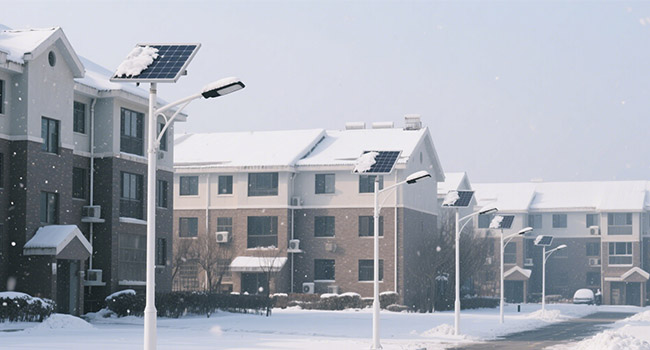
Heavy snow and extreme cold can cause snow accumulation and ice buildup on photovoltaic panels, reducing battery discharge capacity. Protection technology focuses on three core areas. The photovoltaic panels are optimized with an inclination angle of 30 to 45 degrees, utilizing gravity to allow snow to slide off naturally. The surface is coated with a self-cleaning nano-coating to reduce snow adhesion. Additionally, the solar street lights use frost-resistant tempered glass with low-temperature impact resistance down to -60°C, preventing damage from freezing and cracking.
For low-temperature endurance, batteries with cold-discharge capabilities are selected, maintaining at least 80% discharge capacity at -40°C. Battery compartments are insulated with polyurethane layers and paired with smart charge/discharge controllers that automatically adjust thresholds to prevent over-discharge below -20°C. Structural design incorporates Q235 high-strength steel poles with wall thickness ≥3.5mm. Brackets feature triangular reinforcement capable of withstanding snow loads ≥20cm (approx. 0.25kN/m²), preventing breakage or detachment.
|
Protection Part |
Technical Design |
Wind-Resistance Specification |
|
Lamp Pole |
Streamlined hollow structure; base weight increased to over 50 kg; embedded depth not less than 1.2 m |
Wind resistance ≥ Level 12 |
|
Component Mounting |
Anti-drop clips + stainless steel bolts; bolt spec M12×50; bracket thickened to 4 mm |
Withstands wind pull at 35 m/s |
|
Cable Protection |
Wear-resistant tensile cables; breaking strength ≥15 kN; connected with elastic fasteners |
Withstands Level-12 typhoon pull without deformation |
Typhoon/Strong Wind Resistance
Dust and Corrosion Resistance
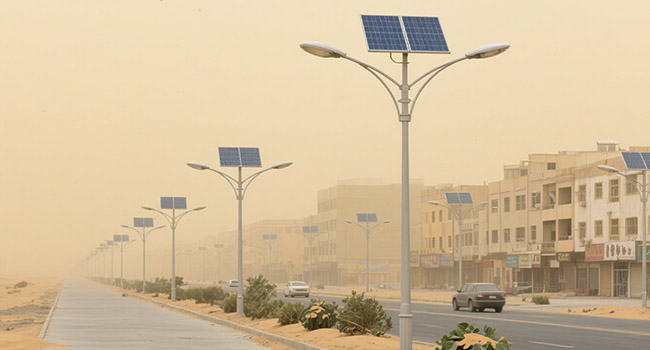
Dust accumulation and coastal saline-alkali soil corrosion can easily cause component clogging and metal part rusting. Protective technologies have been specifically optimized to address these challenges. Photovoltaic panels feature a self-cleaning coating that reduces dust adhesion by 60%. Sealed frame designs prevent sand and dust from entering the solar street light components and scratching the solar cells.
LED street light poles and brackets undergo hot-dip galvanization with a minimum coating thickness of 85μm, further coated with fluorocarbon anti-corrosion paint. This adaptation for coastal saline-alkali and industrial corrosive environments extends service life to over 15 years. Interfaces utilize dual-purpose dustproof and waterproof connectors with IP66 protection rating. Regular cleaning channels are reserved to prevent dust accumulation from affecting electrical connections.
Solar Street Light Selection Guide for Extreme Climate Regions
Prioritize Core Parameters
Solar street lights must meet IP65+ protection standards for waterproofing and dust resistance. Coastal areas or regions prone to heavy rainfall should upgrade to IP67+. Wind resistance ratings should be selected based on the application scenario: coastal typhoon zones require no less than Level 12, while inland high-wind areas require no less than Level 10. Temperature tolerance must span -40°C to 65°C to withstand both extreme cold and heat.
Select Premium Components
Photovoltaic panels for solar street lights should be high-efficiency, weather-resistant products with conversion efficiency no less than 18%. They must feature self-cleaning and anti-freeze coatings to enhance power generation stability in extreme conditions. Prioritize lithium iron phosphate batteries for their superior low-temperature performance and extended cycle life. Avoid lead-acid batteries prone to degradation in cold temperatures to ensure long-term endurance.
Verify Structural Design
Solar light poles must be constructed from high-strength steel with thickened tubing and enlarged base counterweights to enhance overall load-bearing capacity and wind resistance. Battery compartments should feature sealed designs with dual-layer insulation and heat dissipation protection for extreme temperature environments. Secure components with anti-detachment clips, stainless steel bolts, and reinforced brackets to prevent damage from strong winds or heavy snow.
Optimized Smart Systems
Premium solar street lights incorporate adaptive charge/discharge controllers that automatically adjust operating parameters based on ambient temperature and light intensity, optimizing power generation and endurance efficiency. Equipped with fault warning capabilities, they continuously monitor waterproofing status, circuit connections, and component performance, providing immediate alerts upon anomalies to reduce maintenance costs.
3 Key Points to Extend street light Lifespan
Regular Cleaning
Photovoltaic panels require monthly dust removal. Snow and ice must be cleared within 24 hours after heavy snowfall. Use a soft scraper during cleaning to avoid scratching the surface coating. Clean solar street light connectors and drainage holes quarterly to prevent clogging by sand, dust, or debris, ensuring proper waterproofing and heat dissipation.
Regular Protection Inspections
Sealing components (seal rings, waterproof connectors) should be inspected every six months. Replace any aged or damaged parts promptly to prevent water/dust ingress. Cables and fasteners require monthly checks for wear and loose bolts. Tighten or replace components immediately to eliminate safety hazards.
Seasonal Special Maintenance
Before the high-temperature season, focus on checking whether the heat dissipation channels of solar street lights are unobstructed. Clean accumulated dust from heat dissipation holes to ensure effective component cooling. Before the severe cold season, inspect the integrity of the battery insulation layer and test low-temperature discharge performance to proactively identify endurance risks. After heavy rains or typhoons, conduct a comprehensive inspection of the waterproof sealing status and fixed structures of street lights. Promptly address issues such as water ingress or loosening to prevent fault escalation.
Premium solar street lights, equipped with targeted protective technologies, high-quality core components, and intelligent adaptation systems, can confidently withstand various extreme weather conditions. Selecting products with high protection ratings, robust structures, and extreme-weather resilience significantly reduces failure rates and operational costs, ensuring long-term stable road illumination. For lighting selection needs in extreme climate regions, consult professional solar street light manufacturers like Sang for customized solutions, enabling solar street lights to deliver reliable illumination even in harsh environments.
related
-
 Off-Grid Road Safety: The Cost-Benefit Analysis of Solar Road Studs in Provincial ProjectsJun. 24, 2026
 -
 The Ultimate Checklist for Inspecting Road Studs Before Installation in Infrastructure ProjectsJun. 04, 2026
 -
 All-in-One vs. Split Solar Street Lights: Which is Better for the Philippine Climate?May. 26, 2026