The Ultimate Checklist for Inspecting Road Studs Before Installation in Infrastructure Projects
Jun 04, 2026
Road studs are essential road safety devices used for lane guidance, hazard warnings, and nighttime visibility enhancement. They play a critical role in ensuring safe traffic movement under all weather and lighting conditions. However, in many infrastructure projects, road studs often suffer from manufacturing defects, transportation damage, poor material quality, or inadequate performance standards before installation. These issues can lead to premature failures such as cracking, reflector degradation, detachment, water ingress, and structural damage after installation.
Many project managers mistakenly treat road studs as minor auxiliary materials and skip pre-installation quality inspections. As a result, substandard products with poor workmanship, inferior materials, or transportation-related damage enter the project site. Installing defective road studs can result in costly rework, increased maintenance expenses, project delays, audit issues, and even safety hazards that expose contractors and project owners to compliance risks.
For project managers, implementing a standardized road stud inspection process before installation is one of the most effective ways to control project risks, improve construction quality, and reduce long-term maintenance costs. By identifying quality issues before installation, project teams can ensure regulatory compliance, extend product service life, and increase project acceptance rates.
This guide provides a comprehensive and practical road stud inspection checklist that project managers can directly apply to infrastructure projects before installation.
Step 1: Verify Supplier Qualifications and Certification Documents
Document verification is the first and most critical stage of road stud quality control. It is also one of the most commonly overlooked procedures in infrastructure projects. Proper certification and documentation provide evidence that road studs meet industry standards and are legally approved for engineering applications.
Verify Essential Product Certifications
All road studs intended for infrastructure projects should possess recognized industry certifications. Products without valid certifications, expired certificates, or fraudulent documentation should never be accepted.
Key certifications include:
ISO Quality Management System Certification
CE Certification
ASTM Compliance Certification
EN1463 Road Stud Standard
Among these standards, EN1463 is widely regarded as one of the most important benchmarks for international infrastructure projects and high-speed highway applications. It defines performance requirements related to retroreflectivity, structural strength, and weather resistance.
Review Material Traceability and Batch Inspection Reports
Project managers should request complete traceability documentation from suppliers to prevent unverified or mixed-batch products from entering the project.
Required documents include:
Manufacturing records
Product batch numbers
Factory quality inspection reports
Raw material test certificates
Every batch of road studs should be traceable from production to delivery to ensure consistent performance and quality.
Confirm Warranty and Performance Guarantees
Before approving delivery, project managers should carefully review warranty agreements and performance commitments.
Important items include:
Warranty period
Replacement policy for defective products
Guaranteed performance specifications
For solar road studs and high-intensity reflective road studs, additional verification should cover battery lifespan, waterproof performance, and reflector durability.
Project Manager Tip
Before approving shipment, ask suppliers the following questions:
Is this a newly manufactured batch?
Are all certifications currently valid and verifiable online?
Does the inspection report correspond specifically to this production batch?
Step 2: Conduct a Comprehensive Visual Inspection
Visual inspection is one of the fastest and most cost-effective methods for identifying defective road studs before installation. Most manufacturing defects can be detected on-site without specialized testing equipment.
Check for Visible Manufacturing Defects
Inspect road stud housings for:
Cracks
Surface damage
Deformation
Scratches
Uneven surfaces
Injection molding defects
Burrs and excess material
Although these defects may appear minor, they can significantly reduce structural strength and weather resistance.
Verify Dimensional and Weight Consistency
Road studs must meet project-specific dimensional tolerances.
Inspect:
Length
Width
Height
Overall weight consistency
Significant weight variation within the same batch often indicates reduced material content or insufficient wall thickness.
Examine Reflector Alignment Accuracy
Misaligned reflectors can create blind spots and reduce visibility performance.
Ensure that reflectors are:
Properly centered
Securely attached
Free from displacement
Evenly aligned
Visual Inspection Acceptance Criteria
|
Inspection Item |
Pass Criteria |
Failure Criteria |
|
Housing Condition |
Smooth surface, no cracks or deformation |
Visible cracks, dents, or damage |
|
Dimensions |
Within project and EN1463 tolerances |
Outside specified tolerance limits |
|
Reflector Alignment |
Properly aligned and secure |
Loose, tilted, or displaced |
|
Product Weight |
Consistent across the batch |
Significant variation between units |
Step 3: Material Quality and Structural Strength Testing
The material of the road stud directly determines its durability, compressive strength, and service life. The quality inspection focus differs significantly depending on the material, requiring categorized and targeted testing to prevent substandard materials and reduced performance.
Aluminum Alloy Road Stud Quality Inspection
Aluminum road studs are primarily used on high-speed, heavy-load sections. The key testing indicators are three core aspects: First, the casting process—the shell must be free of casting defects such as sand holes, air pockets, and shrinkage cavities, ensuring a dense and solid overall casting; second, uniform wall thickness—no localized thinning—ensuring overall structural strength; and third, corrosion resistance—the surface oxidation and protective coating must be uniform and complete, without peeling or exposing the substrate, resisting outdoor rain and air corrosion, suitable for long-term outdoor heavy-load scenarios.
Quality Inspection of Plastic Road Studs
Plastic road studs are mostly used in urban municipal roads and lightly loaded road sections. The core testing focuses on weather resistance and impact resistance: Firstly, UV resistance; the material contains UV-resistant anti-aging components, preventing fading, embrittlement, and cracking even after long-term exposure to sunlight. Secondly, impact resistance; the material has sufficient toughness to withstand the impact of conventional vehicles. Thirdly, the material density meets standards; there are no issues of being too lightweight or soft due to cost-cutting measures.
Quality Inspection of Solar Road Studs
Solar road studs are intelligent luminous road studs, and the quality inspection standards are more stringent: First, the quality of the solar panel is checked; the surface is flat and free of scratches, with uniform light transmission and a photoelectric conversion efficiency meeting standards. Secondly, the battery parameters are verified; the capacity, range, and cycle life meet design requirements, and there are no inferior or refurbished batteries. Finally, the waterproof sealing performance is tested; the seams and wiring outlets are tightly sealed to prevent water leakage and ingress.
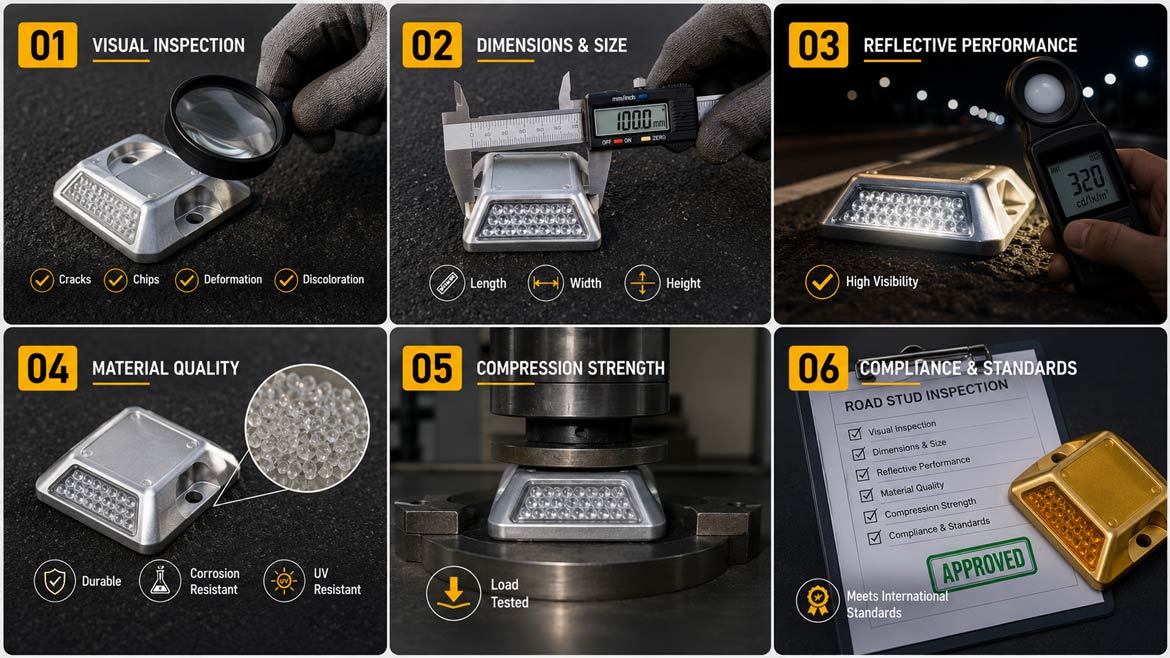
Step 4: Specific Verification of Reflective Performance
Reflective performance is a core functional indicator of road studs, directly affecting nighttime road safety and is a top priority in quality inspection, requiring strict verification item by item.
Retroreflective Performance Standards
The visibility distance and brightness uniformity of road studs must be strictly verified to meet local road engineering specifications. Qualified road studs have stable reflective brightness without unevenness, and the visibility distance on standard road sections meets the needs of driver prediction, providing sufficient visual warning for high-speed vehicles and eliminating problems such as dim reflection or localized failure.
Reflective Lens Quality Inspection
Currently, commonly used reflective lenses in engineering projects are divided into two categories: PMMA acrylic reflective sheets and glass reflective sheets. PMMA lenses have good light transmission, aging resistance, and high toughness, suitable for most municipal roads; glass lenses have higher reflective brightness, are wear-resistant and pressure-resistant, and are suitable for high-speed, heavy-load road sections. The lenses must be checked for scratches, stains, and fogging, with intact light transmission and reflective performance and no quality defects.
Color Compliance Verification
Road stud colors must strictly adhere to local road traffic regulations. White, yellow, red, and green road studs each serve specific functions, corresponding to different lane guidance and warning functions. Before entry, it is necessary to verify that the colors are pure, without fading or color bleeding, and that the classification is clear, preventing color mixing and exceeding color difference standards to ensure standardized and uniform road traffic signs.
Step 5: Load-Bearing Capacity and Impact Resistance Testing
Road studs are subjected to vehicle rolling and impact over long periods. Load-bearing capacity and impact resistance are key indicators determining their service life and are often overlooked in procurement and quality inspection.
Static Load Test
Simulating stationary vehicle rolling scenarios, the compressive strength of the road studs is tested to verify that their rated load-bearing capacity meets specifications. After testing, there should be no cracking, deformation, dents, or structural damage, ensuring structural stability under heavy vehicle pressure.
Dynamic Impact Test
Simulating high-speed rolling and repeated wheel impact scenarios of heavy vehicles, the fatigue resistance and impact resistance of the road studs are tested. After repeated rolling and compaction, qualified products maintain intact shells, functioning reflective systems without detachment or loosening, making them suitable for long-term, high-frequency traffic scenarios.
Authoritative Testing Standard Reference
All load-bearing and impact resistance tests must strictly adhere to the core standards of ASTM and EN1463, while also meeting the specific acceptance requirements of local highway management departments to ensure compliant and valid test results that meet project acceptance standards.
Expert Analysis
Many project managers focus only on appearance and price during procurement, neglecting load-bearing and impact resistance testing. While small road studs may appear simple in structure, inferior products often have loose internal structures, insufficient wall thickness, and substandard materials. Their static load-bearing and dynamic impact parameters completely fail to meet standards, leading to rapid damage from rolling and compaction after installation, a frequent cause of project rework.
Step 6: Waterproofing and Environmental Weather Resistance Confirmation
Road studs are exposed to the outdoors in all weather conditions and must withstand complex environments including rain, high and low temperatures, ultraviolet radiation, and corrosion. Environmental weather resistance directly determines the product's lifespan.
Waterproof Protection Rating (IP Rating)
Especially for solar-powered road studs, they must meet the IP68 advanced waterproof standard, resisting immersion in heavy rain and erosion from road surface water, preventing internal water ingress, short circuits, and lamp failure, making them suitable for outdoor use.
High and Low Temperature Resistance
The road studs need to be tested for high-temperature aging resistance and low-temperature freeze-thaw resistance. They should not soften, deform, or fade under high summer temperatures and exposure to sunlight; nor should they crack or fail to seal under low winter temperatures and freeze-thaw cycles, making them suitable for various climates in both northern and southern regions.
Resistance and Corrosion Resistance
Coastal roads and industrial roads have harsh environments with higher levels of salt, acids, alkalis, and ultraviolet radiation. The road studs' resistance to UV aging and corrosion needs to be verified. The anti-corrosion coating of aluminum alloy products must be intact, and the UV resistance of plastic products must meet standards to avoid rapid failure under long-term harsh environments.
Step 7: Road Studs Installation Compatibility Check
Some cat eye road studs meet quality standards, but due to incompatibility with the construction site conditions, they are prone to detachment and poor adhesion after installation. Therefore, a compatibility check must be completed before installation.
Road Material Compatibility
Distinguish between asphalt and concrete pavements. Different pavements have different smoothness, hardness, and adhesion requirements. Match the road studs to the corresponding specifications to avoid insecure installation, uneven stress, and later detachment due to incompatible pavement materials.
Adhesive Material Compatibility
Select appropriate adhesive materials according to the road type: asphalt adhesive for asphalt pavements, epoxy adhesive for concrete pavements. Prevent incompatible adhesives from causing weak adhesion, cracking, and detachment.
Construction Tool Compatibility
Check in advance whether the drilling equipment, positioning and calibration tools, and compaction tools are compatible with the specifications of the road studs. Test the equipment beforehand to ensure consistent accuracy and high efficiency during batch installation, avoiding installation deviations and rework due to incompatible tools.
Project Manager On-Site Verification Checklist
Before batch construction, it is essential to confirm that the construction site is level, free of debris and oil stains, that adhesive materials are compliant, that construction tools are properly adjusted, and that construction personnel are familiar with standardized installation procedures. Comprehensive preparation for on-site construction must be ensured.
Step 8: Sampling Inspection Before Batch Installation
Sampling inspection is the last line of defense against batch quality incidents. It effectively identifies batch-related quality issues and significantly reduces project risks.
The Core Value of Sampling Inspection
Road Studs manufacturers are prone to batch process fluctuations, material mixing, and the mixing of defective products. A single visual inspection cannot detect hidden performance defects. Through sampling performance testing, batch-related quality hazards can be accurately identified, avoiding significant losses due to overall failure and complete rework after large-scale installation.
Standard Sampling Ratio
Combining engineering specifications and industry practice standards, routine projects should sample 3%-5% of the total batch volume; for highways, key municipal projects, and projects aiming for excellence, this should be increased to 8%-10%, ensuring that the sampling data is representative and comprehensively reflects the quality of the batch products.
Real-world Performance Verification
Sample road stud must be tested on-site in simulated real traffic conditions to verify their reflectivity, compressive strength, adhesion, and waterproofing. This verifies the product's performance under actual road conditions and prevents laboratory compliance followed by on-site failure.
Acceptance and Rejection Criteria
Samples must meet all standards before being allowed for batch installation. If one or more indicators fail, double the retesting is required. If the retest still fails, the entire batch is deemed unacceptable and rejected to prevent substandard products from entering the site.
Common Misconceptions in Road Stud Quality Inspection by Project Managers
Price-Driven Approach, Neglecting Core Quality
Some project managers, in an effort to control costs, solely choose low-priced products, ignoring core indicators such as materials, performance, and certifications. Low-priced road studs generally suffer from inferior materials, rudimentary manufacturing processes, and lack of formal certifications. While this may save on procurement costs in the short term, it leads to significantly higher maintenance and rework costs later on, resulting in a net loss.
Neglecting Specific Reflective Performance Testing
Many on-site inspections only assess the appearance, omitting tests on reflectivity and visibility distance. Some road studs may appear flawless, but their reflective sheets are of poor quality, with rapid reflectivity decay, resulting in extremely poor nighttime visibility and failing to meet road safety requirements, becoming hidden safety hazards.
Neglecting On-Site Installation Compatibility
Only checking the product's quality without matching it to the on-site road surface, adhesive materials, and construction conditions leads to problems such as unstable installation, detachment, and water leakage even with high-quality road studs, causing construction quality issues.
Accepting Incomplete Supplier Information
Accepting suppliers lacking certifications, batch reports, and warranty documents, relying solely on verbal promises of quality assurance. Once quality problems arise, there is no basis for accountability or after-sales support, and this can lead to project audits and acceptance failures.
Project Manager Exclusive: Directly Download the Road Stud Acceptance Inspection Checklist
The standardized road stud acceptance checklist below can be printed and used directly by project managers for on-site batch acceptance, account verification, and quality control, ensuring standardized management of road stud installation quality throughout the project.
|
Inspection Item |
Pass / Fail |
Remarks |
|
Qualification & Certification Verification |
□ Pass □ Fail |
|
|
Product Dimensions & Appearance Inspection |
□ Pass □ Fail |
|
|
Reflectivity Performance Test |
□ Pass □ Fail |
|
|
Compressive Strength Verification |
□ Pass □ Fail |
|
|
Waterproof & Dustproof Rating Verification |
□ Pass □ Fail |
|
|
On-Site Installation Compatibility Check |
□ Pass □ Fail |
|
Project Name: ___________________________
Inspection Date: _________________________
Inspector: ______________________________
Supplier / Manufacturer: _________________
Overall Result: □ Approved □ Rejected
Comments: _______________________________________________
Although road studs are small auxiliary materials, they are a core line of defense for road traffic safety and a key detail affecting project quality, acceptance results, and total lifecycle costs. A standardized pre-installation quality inspection process covers eight core steps: qualification verification, appearance inspection, material testing, performance testing, compatibility verification, and sampling re-inspection, forming a complete quality control closed loop.
For project managers, establishing fixed road stud arrival acceptance standards, reusing standardized checklists, and selecting reputable certified manufacturers are key means to control project quality, mitigate project risks, and control operation and maintenance costs. Pre-installation meticulous quality inspection can prevent substandard products from entering the site, reduce rework and rectification, ensure the long-term stable operation of road facilities, and lay the foundation for project excellence and successful acceptance.
Action Recommendation: Before approving the next batch of road stud shipments and on-site acceptance, strictly use this checklist to ensure that the performance, durability, and safety of each product fully meet engineering and specification requirements.
Frequently Asked Questions (FAQ)
Q1: What is the standard load-bearing capacity of road studs?
Standard road studs for regular municipal roads have a load-bearing capacity of no less than 10 tons. For highways and heavy-load road sections, the load-bearing capacity must reach 15 tons or more, conforming to EN1463 and ASTM industry standards, and capable of withstanding heavy vehicle pressure for extended periods without deformation or damage.
Q2: How to quickly and efficiently inspect the quality of reflective road studs?
On-site inspection can be done in three steps:
First, visually inspect for any damage and defects in the reflective film;
Second, test the reflectivity and visibility distance in low-light conditions to confirm uniform brightness and no blind spots;
Third, randomly sample batches of products to verify that the reflectivity parameters meet design standards.
For batch projects, professional instruments should be used to test the retroreflection coefficient.
Q3: What certifications are required for engineering road studs?
General engineering certifications include ISO quality management system certification and CE certification; road-specific compliance standards include the EN1463 EU road stud standard and ASTM road material standards. Domestic projects must also comply with local traffic engineering construction specifications. All certifications must be verifiable on the official website and be valid.
Q4: How many road studs need to be sampled before batch installation?
The sampling inspection rate for routine infrastructure projects is 3%-5% of the total batch volume; for highways, key livelihood projects, and projects aiming for excellence, it is recommended to increase this to 8%-10%. If any non-conformities are found in the initial sampling inspection, double the inspection volume is required to ensure consistent batch quality.
Q5: What are the core differences between EN1463 and ASTM road stud standards?
EN1463 is the EU's specific standard for road studs, focusing on the reflectivity, structural dimensions, weather resistance, and installation compatibility of road studs. It is a globally recognized core standard for road studs. ASTM is the American standard for material testing, emphasizing material strength, load-bearing capacity, impact resistance, and aging resistance. These two standards are often combined for high-end infrastructure and international engineering projects.
Q6: What are the waterproofing requirements for solar-powered road studs?
Engineering-specific solar-powered road studs must meet the IP68 waterproof rating, allowing for long-term immersion in standing water and resistance to heavy rain. They fully meet the complex conditions of outdoor exposure and flooded roads, preventing water seepage, circuit failures, and lamp malfunctions.
Q7: What are the core reasons for frequent road stud detachment after installation?
The three main reasons are:
First, the bottom surface of the road studs is not up to standard and the flatness is insufficient;
Second, the adhesive material is not compatible with the road surface material and the adhesive process is improper;
Third, the road surface at the construction site is not cleaned properly and contains oil stains and debris, resulting in insufficient adhesion.
These problems can be completely avoided by conducting pre-construction compatibility testing.
related
-
Off-Grid Road Safety: The Cost-Benefit Analysis of Solar Road Studs in Provincial ProjectsJun. 24, 2026
-
 The Ultimate Checklist for Inspecting Road Studs Before Installation in Infrastructure ProjectsJun. 04, 2026
 -
 All-in-One vs. Split Solar Street Lights: Which is Better for the Philippine Climate?May. 26, 2026