All-in-One vs. Split Solar Street Lights: Which is Better for the Philippine Climate?
May 26, 2026
Currently, the ongoing rural electrification initiatives, government road upgrades, and urban infrastructure projects in the Philippines are driving rapid growth in the market demand for solar street lights. With advantages such as zero electricity bills, suitability for off-grid areas, and low operational and maintenance costs, solar street lights have been widely adopted in Philippine village roads, urban highways, coastal roads, rural lighting projects, and various government infrastructure projects. They are gradually replacing traditional grid-connected street lights and have become a core choice for infrastructure upgrades in the Philippines.
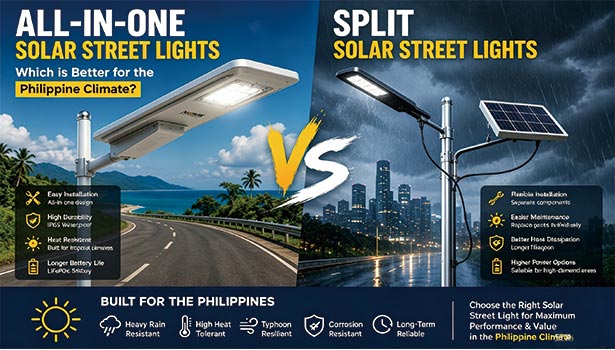
Currently, solar street lights in the Philippine market are primarily divided into two categories: integrated solar street lights and split solar street lights. The structural designs of these two products are fundamentally different, and they exhibit significant variations in heat dissipation capacity, waterproof performance, wind resistance ratings, endurance during cloudy and rainy weather, and post-installation operation and maintenance.
The Philippines has a typical tropical climate characterized by high temperatures year-round, a long rainy season, frequent typhoons, and severe coastal salt fog corrosion. These harsh outdoor conditions place extremely high demands on the stability and service life of street lights. Therefore, selecting the appropriate model based on local climate conditions is key to ensuring long-term, stable project operation and reducing total lifecycle costs. This article will comprehensively compare the performance advantages, disadvantages, and suitable applications of the two types of street lights in light of the Philippines' local climate characteristics, providing professional guidance for engineering contractors and infrastructure project procurement.
Climate Characteristics of the Philippines and Their Impact on Solar Street Lights
Characteristics of the Philippine Tropical Climate
The Philippines' tropical maritime climate poses extreme challenges for outdoor lighting equipment. The country experiences high temperatures year-round, with average annual temperatures ranging from 28°C to 34°C; extreme summer temperatures can exceed 38°C. Prolonged exposure to intense heat and sunlight is the primary cause of equipment degradation. The extended rainy season, which runs from June to November, is characterized by frequent torrential rains and overcast skies, significantly reducing the charging efficiency of solar panels.
Additionally, the Philippines experiences dozens of typhoons annually, and strong winds can easily damage the structural integrity of outdoor lighting fixtures. Furthermore, the country's high humidity levels, coupled with salt fog in coastal areas, cause continuous corrosion of the street lights' metal structures and electronic components, accelerating equipment failure.
Core Operational Challenges Facing Solar Street Lights
Due to local climatic conditions, solar street lights in the Philippines face five major operational challenges.
First, prolonged high temperatures easily cause storage batteries to overheat, accelerating battery degradation and shortening their service life.
Second, insufficient sunlight during the long rainy season leads to a significant drop in charging efficiency, resulting in insufficient battery life and frequent instances of lights going out at night.
Third, frequent torrential rains place extremely high demands on the equipment's waterproof sealing; water ingress and moisture can easily cause short circuits.
Fourth, high humidity and salt fog environments can easily cause equipment corrosion and component aging.
Fifth, strong winds from typhoons can cause solar panels to loosen, lamp posts to tilt, and equipment to detach, placing stringent demands on the structural stability of the lighting fixtures.
What Is an All in one Solar Street Light?
Structural and Design Features
An all in one solar street light is a highly integrated system that combines all core components—including solar panels, LED light sources, energy storage batteries, smart controllers, and sensor modules—within a single sealed housing. The system requires no external accessories or exposed wiring. It features a compact, minimalist design with a clean, modern appearance. It is lightweight and highly adaptable for installation, allowing it to be mounted directly on standard light poles.
Key Advantages
The greatest advantage of integrated street lights lies in their ease of deployment and low cost. The installation process is straight forward, requiring no complex wiring or component assembly. Construction is rapid, enabling quick, large-scale project implementation and significantly reducing labor costs.
Additionally, the device's high level of integration and compact size result in lower logistics and transportation costs. With an aesthetically pleasing and elegant appearance and no loose, exposed parts, it is well-suited for landscape lighting scenarios such as urban parks, communities, and residential areas. Furthermore, the high degree of Splitity lowers the barrier to daily operation and maintenance, making it suitable for the streamlined maintenance needs of grassroots municipal and village-level projects.
Major Shortcomings
Due to their compact, integrated structure, all-in-one street lights have significant limitations in adapting to tropical environments. Limited internal space prevents the installation of high-capacity batteries and large-sized solar panels, resulting in weak power configurations and energy storage capabilities, as well as short runtime during cloudy or rainy weather. The fully sealed housing is highly prone to the greenhouse effect. In the Philippines' prolonged high-temperature environment, severe internal heat buildup accelerates the aging of batteries and electronic components. Most models feature an integrated sealed design; once a single component fails, it cannot be repaired or replaced individually, requiring the entire unit to be replaced. This results in high long-term maintenance costs and fails to meet the high-power, high-brightness lighting requirements of highways.
What Are Split Solar Street Lights?
Structural and Design Features
Split solar street lights employ a Split, separated design, with the solar panel, LED lamp head, storage battery, and controller operating independently and connected via waterproof cables during assembly. Components can be freely combined and installed separately. The solar panel can be flexibly adjusted according to the angle of sunlight, and the battery can be elevated or deeply buried for protection. This design offers extremely high configuration flexibility, is not constrained by space, and allows for customization of high-power, long-lasting configurations as needed.
Key Advantages of Split Solar Street Lights
Split street lights are perfectly suited for the Philippines' harsh tropical climate. The open, independent structure provides excellent ventilation and heat dissipation, completely resolving issues of heat buildup at high temperatures. This effectively protects the battery and controller, significantly extending the equipment's service life. The system supports large-size, high-efficiency photovoltaic panels and high-capacity batteries, ensuring high charging efficiency and strong endurance during cloudy or rainy weather, capable of withstanding months-long rainy seasons.
The Split design allows for the independent replacement of individual components, making repairs convenient without requiring a complete unit replacement, thereby reducing long-term maintenance costs. Additionally, the system can be customized with wind-resistant, corrosion-resistant, and waterproof structures to adapt to complex environments such as typhoon-prone areas, coastal salt corrosion, and flood-prone low-lying areas, while also supporting the high-power, high-brightness lighting requirements of highways.
Key Weaknesses
The shortcomings of Split street lights are primarily concentrated in the initial implementation phase. With dispersed components and a cumbersome installation process, professional personnel are required for wiring, debugging, and adjusting the PV panel angle. This results in longer construction cycles, higher labor and material costs, and a higher initial investment compared to integrated street lights. Additionally, due to the external placement of PV panels, wiring, and battery components, the overall design is less sleek and aesthetically pleasing than integrated fixtures, resulting in slightly weaker landscape compatibility.
Integrated vs. Split Street Lights: Comprehensive Performance Comparison
|
Comparison Dimension |
Integrated Solar Street Light |
Split Solar Street Light |
Rainy Season Performance |
Limited battery capacity; only supports 3–5 days of continuous operation in rainy weather. During prolonged rainy seasons, brightness easily dims or the light shuts off, leading to weak stability. |
Can be equipped with large-capacity batteries; supports 7–15 days of continuous illumination during rainy weather. Perfectly suited for long rainy seasons like those in the Philippines; highly stable performance. |
Tropical Heat Resistance |
The fully sealed structure easily traps heat. The internal temperature becomes too high in high-temperature environments, which accelerates the aging of the battery and LED beads, leading to a relatively high failure rate. |
Features an open-ventilation structure with excellent heat dissipation and no heat accumulation issues. Operates stably in high-temperature environments and has a longer lifespan. |
Typhoon & Wind Resistance |
Compact structure with a concentrated center of gravity. It can only withstand conventional light breezes and is unsuitable for strong typhoons or open coastal roads; wind resistance is average. |
Supports reinforced brackets and optimized installation structures. Can be paired with thickened light poles for excellent typhoon resistance, making it suitable for coastal areas and high-speed, strong-wind environments. |
Installation Efficiency |
Plug-and-play; no complex wiring or debugging required. Simple installation and fast construction speed, making it suitable for quick project rollout. |
Dispersed components require wiring, angle adjustment, and equipment debugging. The process is cumbersome, the construction cycle is long, and it requires highly professional personnel. |
Operation & Maintenance (O&M) Difficulty |
Features a fully sealed design. If a component is damaged, the entire lamp must be replaced, making O&M troublesome and leading to higher long-term maintenance costs. |
Features a modular, independent structure. Components with single points of failure can be replaced individually, making maintenance convenient and significantly reducing long-term O&M costs. |
Comprehensive Cost |
Low initial procurement, transportation, and construction costs. However, the long-term failure rate is high, replacements are frequent, and the total lifecycle cost is higher. |
Initial construction and procurement investment is relatively high. However, performance is stable, the failure rate is low, and localized repairs are possible, giving it a significant long-term cost-performance advantage. |
Recommendations for Selection in Various Scenarios in the Philippines
Suitable Scenarios for Integrated Solar Street Lights
Integrated street lights are suitable for lightweight applications in mild environments with limited budgets and tight schedules. These include village side roads, residential roads in towns, park walkways, and small-scale municipal renovation projects in the Philippines, as well as small-scale urban lighting projects with convenient transportation and easy maintenance. They enable rapid implementation of lighting solutions at low cost.
Suitable Scenarios for Split Solar Street Lights
Split street lights are suitable for harsh environments and large-scale projects with high standards. They are primarily used for national highways, coastal roads, low-lying areas prone to flooding and heavy rainfall, large-scale government infrastructure projects, and high-power lighting projects for industry and commerce. In harsh environments such as typhoons, torrential rains, and salt corrosion, the stability and endurance of Split street lights fully meet engineering standards.
Key Considerations for Procurement in the Philippine Market
Battery Technology
Batteries are central to operational endurance. Given the Philippines' tropical climate, high-temperature-resistant lithium batteries are the preferred choice due to their heat resistance, moisture resistance, and long cycle life, making them well-suited to local conditions. Gel batteries are low-cost but have poor heat resistance and are only suitable for temporary, small-scale projects.
Water Resistance Rating
Given the local environment's high rainfall and humidity, equipment must meet at least an IP65 water resistance rating. For coastal, highway, and flood-prone areas, an IP66 rating is recommended to effectively protect against dust, heavy rain, and water ingress.
Solar Panel Efficiency
Monocrystalline silicon PV panels excel in low-light power generation and offer high conversion efficiency, performing better in cloudy and rainy weather; they are the preferred choice for projects in the Philippines. Polycrystalline silicon panels are lower in cost but have poor low-light performance and are not suitable for the rainy season.
Wind-Resistant Structural Design
To withstand typhoon conditions, thickened hot-dip galvanized light poles, reinforced brackets, and anti-vibration mounting structures must be used to ensure the equipment remains stable and does not topple or detach during extreme weather.
Supplier Project Experience
Prioritize suppliers familiar with Philippine DPWH engineering standards and possessing experience in implementing large-scale local projects. Such suppliers can provide customized optimizations for tropical high temperatures, typhoons, and salt-corrosive environments, along with comprehensive after-sales support.
Common Misconceptions in Philippine Market Procurement
Five major misconceptions are prevalent in local procurement:
- Focusing solely on low prices while neglecting equipment quality, leading to frequent malfunctions and rework later on;
- Neglecting battery life requirements during the rainy season, resulting in widespread power outages;
- Underestimating the destructive power of typhoons, leading to the selection of thin-walled lamp posts and flimsy brackets;
- Using non-heat-resistant batteries, which degrade rapidly in tropical environments;
- Purchasing equipment without proper waterproof certification, causing frequent short circuits and damage during high-humidity and heavy-rain conditions.
Reasons for the Preference for Split Street Lights in Philippine Highway Projects
The Philippine Highway Authority (PHA) generally chooses split street lights for its highway infrastructure projects, primarily because they offer greater long-term reliability, stable performance under extreme weather conditions such as high temperatures, heavy rain, and typhoons; support high-power, high-brightness lighting to meet highway traffic safety standards; modular design significantly reduces the difficulty of maintaining large road networks; and they can be customized to meet official infrastructure specifications, resulting in higher cost-effectiveness throughout their entire lifecycle and making them more suitable for large-scale, long-term infrastructure projects.
There is no absolute superiority between all in one and split solar street lights; their core suitability lies in different application scenarios. Integrated street lights offer quick installation, low cost, and an aesthetically pleasing appearance, making them suitable for village roads, communities, parks, and small-scale municipal projects in the Philippines. Split street lights feature superior heat dissipation, long battery life, strong resistance to extreme weather, and low O&M costs, making them better suited for high-demand, highly exposed, and long-term engineering projects such as highways, coastal areas, and large-scale government infrastructure.
Project selection requires a comprehensive evaluation of regional climate conditions, O&M requirements, lighting power needs, and project budgets. Only by scientifically matching the appropriate luminaire type can solar street lights achieve long-term, stable, and cost-effective performance in the Philippines'complex tropical climate.
related
-
Off-Grid Road Safety: The Cost-Benefit Analysis of Solar Road Studs in Provincial ProjectsJun. 24, 2026
-
 The Ultimate Checklist for Inspecting Road Studs Before Installation in Infrastructure ProjectsJun. 04, 2026
 -
 All-in-One vs. Split Solar Street Lights: Which is Better for the Philippine Climate?May. 26, 2026