Aluminum vs. Plastic Road Studs: Which Performs Better on Philippine National Highways
May 22, 2026
Philippine national highways have long faced complex road safety challenges, including frequent extreme tropical weather, heavy traffic of large vehicles, and inadequate nighttime lighting. These issues lead to a high incidence of traffic accidents such as lane departures and rear-end collisions, with accident rates being particularly high at night and during rainy weather. As a core road safety feature, road studs delineate lane boundaries and indicate road edges and hazardous sections around the clock, significantly improving driving visibility at night and during rainy or foggy conditions. They are an indispensable component of DPWH highway projects.
In Philippine infrastructure projects, the choice of road stud material directly determines the durability of the infrastructure, the frequency of future maintenance, and the overall project cost. It is a key factor influencing long-term road safety and the cost-effectiveness of the project. Currently, the two most commonly used road studs in Philippine highway projects are aluminum road studs and plastic road studs. These two types differ significantly in structural performance, weather resistance, load-bearing capacity, and applicable scenarios. This article will comprehensively compare the overall performance of the two types of road studs, taking into account local road conditions in the Philippines and DPWH project standards, to provide contractors, engineering companies, and procurement companies with accurate selection references.
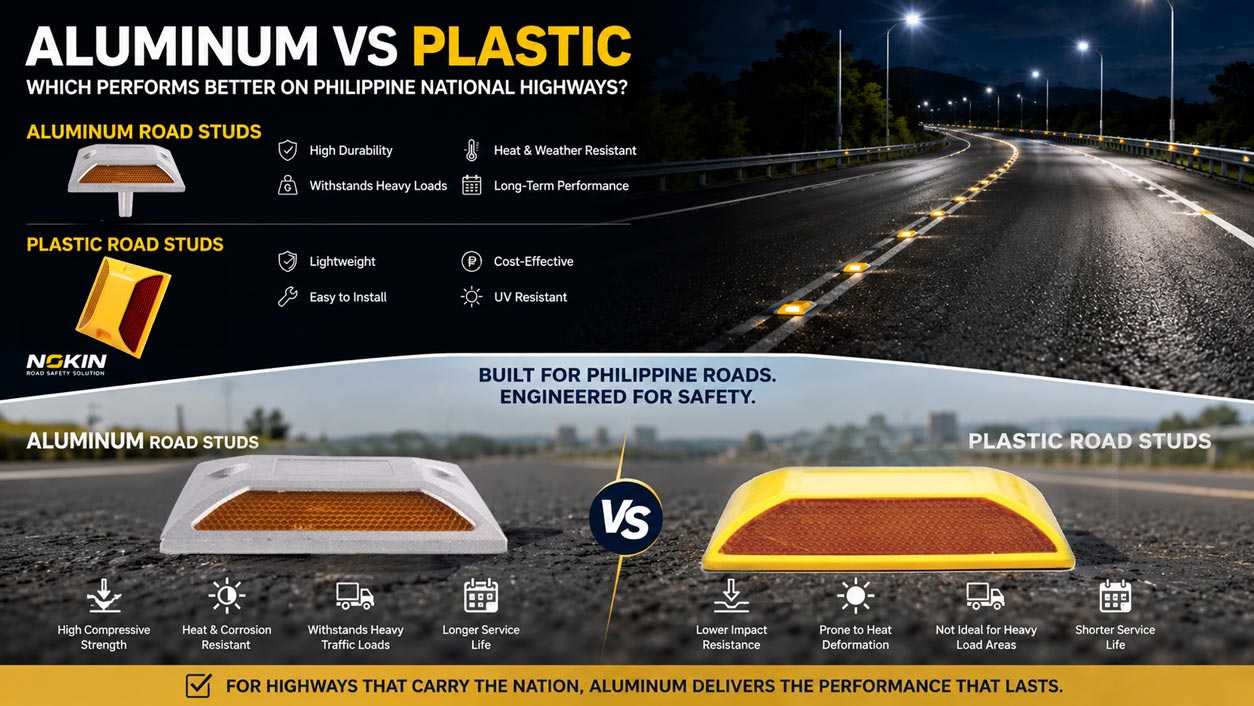
Why Is the Suitability of Road Stud Materials Critical for Philippine Projects?
The Philippines’ unique tropical climate and traffic conditions impose stringent demands on the comprehensive performance of road studs, serving as the core basis for material selection. The region faces five major adverse conditions year-round: heavy rainfall throughout the year, high air humidity, road flooding and water logging, intense UV exposure, and the high-frequency traffic pressure from heavy trucks and buses on national highways. Additionally, an average of about 20 typhoons annually further accelerates the deterioration of road infrastructure.
These complex environmental factors continuously degrade the performance of road studs: high temperatures and UV radiation can cause material aging, fading, and structural brittleness; rainwater immersion and water erosion can damage the sealing structure and reduce adhesion; and repeated crushing by heavy vehicles can easily cause deformation, cracking, and detachment of the road studs.
Inappropriate material selection directly shortens the service life of road studs, frequently leading to equipment failure, missing lane markings, and other issues, thereby increasing road safety hazards. For DPWH government projects, selecting compliant and suitable materials is a core prerequisite for meeting project acceptance standards, reducing long-term operation and maintenance costs, and ensuring engineering quality.
What Are Aluminum Road Studs?
Structural and Material Characteristics
The body of the aluminum road stud is made of high-strength aluminum alloy through a single-piece molding process, featuring high material density and a robust structure. It is paired with a high-transparency, wear-resistant polycarbonate high-intensity reflective lens, offering high reflectivity and strong wear resistance. The product is equipped with a metal anchoring system that adheres tightly to the road surface, providing excellent resistance to detachment and impact. The overall structure is sturdy and suitable for various heavy-load and high-speed road conditions.
Key Advantages
The core advantages of aluminum road studs lie in their durability and stability.
First, they possess exceptional load-bearing capacity, capable of withstanding repeated crushing by heavy vehicles over the long term without deformation or damage;
Second, they offer superior impact resistance, withstanding impacts from loose stones, intense tire pressure, and rainwater erosion during typhoons;
Third, they have a long service life, capable of stable operation for 5–8 years in the tropical environment of the Philippines;
Fourth, they exhibit outstanding resistance to cracking and deformation, maintaining high structural integrity over extended periods;
Fifth, they offer excellent weather resistance, including resistance to oxidation and corrosion, making them suitable for coastal environments with high salt fog, high temperatures, and high humidity.
Main Application Scenarios in the Philippines
Thanks to their superior comprehensive performance, aluminum road studs are widely used in high-grade, high-load road projects in the Philippines, including national trunk roads, toll highways, bridges spanning rivers and seas, mountainous curves and hazardous roads, as well as all sections with high-speed traffic. They are the preferred type of road stud for key infrastructure projects under the Department of Public Works and Highways (DPWH).
What Are Plastic Road Studs?
Structural and Material Characteristics
The main body of plastic road studs is injection-molded from ABS engineering plastic or modified eco-friendly plastic, featuring a lightweight, flexible design. The product incorporates standard reflective lenses to meet basic reflective guidance requirements. With a simple structure and light weight, it requires no complex anchoring hardware and is easy to install, making it a prime example of lightweight road safety infrastructure.
Key Advantages
The primary advantage of plastic road studs is their outstanding cost-effectiveness. The low unit cost helps effectively control initial project budgets. Additionally, the product is lightweight, easy to transport, and quick to install, requiring no complex construction processes and making it suitable for rapid deployment scenarios. The material possesses a certain degree of flexibility, making it resistant to breakage under low-speed, light-load conditions, and adaptable to various temporary road renovation and short-term traffic control projects.
Main Application Scenarios in the Philippines
Plastic road studs are only suitable for low-load, low-speed traffic scenarios. In the Philippines, they are primarily used on urban municipal roads, parking lot lane markings, residential neighborhood roads, dedicated bicycle lanes, and secondary rural roads—sections with low traffic volume, slow speeds, and no heavy-duty vehicle traffic.
Aluminum vs. Plastic Road Studs: A Comprehensive Comparison of Core Performance
Durability Comparison in Heavy-Load Conditions
Under the conditions of heavy truck traffic on Philippine national highways, the difference between the two is extremely evident. Aluminum road studs feature high structural strength and load-bearing capacity, capable of withstanding repeated crushing impacts from trucks and buses over the long term with virtually no deformation, cracking, or detachment issues, making them suitable for all-weather heavy-load traffic. In contrast, plastic road studs have limited material toughness. When subjected to high pressure over extended periods, they are prone to aging, brittleness, lens displacement, and overall denting or detachment, making them unsuitable for high-load national highway environments.
Weather Resistance Comparison in the Philippine Climate
Aluminum road studs offer significant advantages in the Philippines’ tropical climate, characterized by high temperatures, torrential rains, flooding, and intense UV radiation. Aluminum alloy inherently possesses UV resistance, anti-aging properties, and corrosion resistance, enabling it to withstand prolonged exposure to intense sunlight, rainwater immersion, and flood erosion.
It also maintains structural stability in coastal salt fog environments. Plastic road studs have poor weather resistance; prolonged exposure to high temperatures causes them to yellow and become brittle, while the reflective layer fades. Continuous rainwater immersion accelerates material aging, significantly shortening their service life, and the probability of failure under extreme weather conditions is extremely high.
Comparison of Visibility and Reflectivity
Both types of road studs can be equipped with the same high-transparency reflective lenses, and their initial nighttime reflectivity is essentially the same, meeting standard nighttime visibility requirements. However, significant differences emerge after long-term use: Aluminum road studs have a sturdy structure, with lenses that are less prone to loosening or wear, and exhibit greater reflectivity stability in rainy conditions with standing water; Plastic road studs are prone to deformation and surface wear, and their lenses are prone to detachment and blurring. Visibility is extremely poor during heavy rain at night, and they cannot guarantee effective lane guidance under severe weather conditions.
Comparison of Installation and Maintenance Costs
In terms of installation, plastic road studs are lightweight, simple to install, and easy to secure, resulting in higher installation efficiency and the ability to quickly complete large-scale installations. Aluminum road studs are heavier and require a metal anchoring system for reinforcement, entailing higher construction standards and more rigorous procedures. The contrast in maintenance is stark: plastic road studs wear out quickly and require frequent replacement, necessitating regular inspections and replenishment; aluminum road studs have a low failure rate and long service life, resulting in minimal maintenance work and significant savings in labor and operational costs.
Life Cycle Cost Comparison
In the short term, plastic road studs have a lower unit price, offering a clear advantage in initial investment costs. However, when considering the full life cycle of government infrastructure projects, aluminum road studs offer superior overall cost performance. Plastic road studs incur extremely high cumulative long-term costs due to frequent replacement, repeated construction, and ongoing maintenance; while aluminum road studs have a higher initial cost, their service life is 3–5 times longer than that of plastic road studs, and they require virtually no frequent maintenance, making them perfectly suited to the cost control requirements of DPWH’s long-term infrastructure projects.
Recommended Selection Plan for DPWH Highway Projects
Scenarios Where Aluminum Road Studs Should Be Prioritized
Aluminum road studs must be used on all national trunk roads, expressways, toll expressways, bridge sections, high-risk mountain curves, high-traffic and heavy-load sections, as well as all long-term, permanent infrastructure projects. This selection fully complies with DPWH quality standards, ensuring long-term road safety, reducing the risk of project rework, and withstanding high-intensity traffic and complex climatic conditions.
Scenarios Where Plastic Road Studs Are Recommended
Plastic road studs are recommended only for low-speed traffic sections, ordinary urban streets, residential areas and parking lots, bicycle lanes, as well as short-term temporary traffic control measures and secondary road improvement projects with limited budgets. In these scenarios, where traffic volume is low and there are no heavy-duty vehicles, the cost-effectiveness of plastic road studs can be fully leveraged without compromising core traffic safety.
Common Critical Mistakes in Procurement and Selection
Many Philippine contractors frequently make four types of errors during the selection process, which directly impact project acceptance and engineering quality.
First, focusing solely on the low unit price while ignoring the total life-cycle cost; while this may seem to save on the initial budget, maintenance and rework costs later on double;
Second, ignoring the characteristics of heavy-duty traffic on national highways and blindly selecting plastic road studs for main arterial roads, leading to rapid damage and failure of the infrastructure;
Third, using plastic road studs on expressways, national highways, and high-risk road sections, creating serious traffic safety hazards;
Fourth, neglecting compliance during procurement and selecting substandard products without test reports or DPWH certification, resulting in project acceptance failures and the need for rework and rectification.
Selection Criteria for High-Quality Road Stud Suppliers
When procuring, contractors must prioritize verifying five core qualifications and capabilities.
First, confirm that products possess complete test reports, including authoritative certifications for reflectivity, compressive load resistance, water resistance, and UV resistance;
second, verify that products are suitable for the Philippines’ tropical climate and comply with DPWH project standards; third, prioritize suppliers with a long history of exporting to the Philippines and familiarity with local project conditions;
Finally, ensure the supplier supports customized production to meet the specifications, color schemes, and performance requirements of different road sections, while also providing complete compliance documentation to ensure smooth project acceptance.
Key Reasons Why Philippine National Highway Contractors Prefer Aluminum Road Studs
An increasing number of Philippine infrastructure contractors are prioritizing aluminum road studs for national highway projects, primarily due to their superior adaptability to real-world conditions.
First, aluminum road studs are perfectly suited to the Philippines’ harsh tropical environment—including high temperatures, torrential rains, flooding, and salt fog—with weather resistance and stability far surpassing those of plastic models;
Second, they require replacement at an extremely low frequency, significantly reducing labor and financial investments in post-installation maintenance;
Third, they fully meet the quality expectations and acceptance standards of DPWH government projects, ensuring stronger compliance;
Fourth, they represent a long-term, cost-effective investment that effectively enhances project quality and reputation, helping contractors secure more government infrastructure projects.
Considering overall performance, suitability for operating conditions, and lifecycle costs, aluminum road studs and plastic road studs each have their own appropriate applications and complementary strengths and weaknesses. With their exceptional load-bearing capacity, superior weather resistance, stable reflectivity, and exceptionally long service life, aluminum road studs are the optimal choice for high-load, permanent infrastructure projects such as national highways, arterial roads, and bridges in the Philippines. They effectively ensure road safety and reduce long-term maintenance costs, meeting the high standards required by DPWH projects.
Plastic road studs, with their low cost and ease of installation, remain a cost-effective option for urban low-speed roads, temporary projects, and secondary road projects. Project stakeholders should make informed selections based on traffic speed, heavy-load conditions, project duration, and budget: for core national highways where quality is paramount, choose aluminum road studs; for secondary, light-load roads where budget is a priority, choose plastic road studs—ensuring a balance between engineering safety, regulatory compliance, and long-term economic benefits.
related
-
Off-Grid Road Safety: The Cost-Benefit Analysis of Solar Road Studs in Provincial ProjectsJun. 24, 2026
-
 The Ultimate Checklist for Inspecting Road Studs Before Installation in Infrastructure ProjectsJun. 04, 2026
 -
 All-in-One vs. Split Solar Street Lights: Which is Better for the Philippine Climate?May. 26, 2026