The Essential Guide to DPWH Blue Book Specifications for Road Studs
May 20, 2026
Road safety infrastructure in the Philippines remains significantly inadequate. According to relevant statistics, over 40% of traffic accidents occur at night. As a critical road safety feature, road studs clearly delineate lane boundaries in low-visibility conditions such as at night or during rain and fog, effectively guiding vehicle traffic and reducing the risk of accidents.The "DPWH Blue Book," published by the Department of Public Works and Highways (DPWH), serves as the official standard document for public infrastructure projects in the Philippines. It clearly stipulates core requirements regarding the materials, performance, and installation of road studs, and serves as the primary reference for contractors, engineers, and suppliers participating in government tenders and carrying out project construction.
For professionals participating in Philippine government infrastructure tenders, compliance with the Blue Book is a fundamental prerequisite for bidding. Strict adherence to these specifications not only prevents issues such as project rework, failed acceptance inspections, and fines but also effectively enhances one’s reputation within the industry, laying a solid foundation for long-term participation in Philippine infrastructure projects and the expansion of cooperation opportunities.
What Is the DPWH Blue Book?
The DPWH Blue Book is a national compilation of public infrastructure standards in the Philippines. Since its initial publication in 1995, it has undergone multiple revisions and improvements. The 2004 edition consolidated all previous amendments and serves as the current unified implementation standard for all types of public works. The Blue Book is mandated by the DPWH through a Departmental Order (with the exception of specific projects already under tender), and its core purpose is to provide unified technical guidance, quality requirements, and acceptance standards for public works nationwide, such as roads and bridges.
Core Functions of the Blue Book
The core function of the Blue Book is to standardize material selection, construction techniques, and safety product standards for public works. Its content is fully tailored to local conditions, such as the Philippines’ tropical climate and heavy road loads, effectively addressing issues previously encountered in Philippine infrastructure projects—including inconsistent standards, varying quality levels, and significant safety hazards—to ensure the safety, durability, and cost-effectiveness of infrastructure projects.
Compliance Scenarios and Value
The compliance requirements of the Blue Book apply to all types of public works in the Philippines, particularly in core infrastructure scenarios such as national highways, cross-sea and highway bridges, expressways, and urban road improvement projects. Adhering to the Blue Book’s specifications significantly increases the success rate of project approvals and acceptance inspections, as compliant projects better align with the government’s long-term infrastructure planning. This approach effectively reduces long-term maintenance costs and safety risks, making such projects more favored by the Department of Public Works and Highways (DPWH) and project owners.
Why Are Road Stud Specifications Critical in Philippine Highway Projects?
Retroreflective road studs play an irreplaceable role in enhancing nighttime traffic safety on Philippine roads. According to relevant data, the proper installation of road studs that meet DPWH standards can reduce the incidence of nighttime traffic accidents by more than 30%. The Philippines’ unique road environment poses extreme challenges to road stud performance: the country is affected by typhoons year-round, with frequent heavy rainfall and flooding;tropical heat and intense sunlight can cause materials to age rapidly; and heavy traffic from trucks and construction vehicles—some of which are overloaded—subjects the studs to repeated tire impacts and heavy pressure.
Therefore, selecting durable road studs that comply with Blue Book specifications is crucial for ensuring the long-term performance of highway projects. Non-compliant road studs are prone to rapid deterioration of reflectivity, detachment, and damage. Not only do they fail to fulfill their safety guidance function, but they may also cause traffic accidents. Additionally, they require frequent replacement and maintenance, significantly increasing project costs in the long run.
Key Requirements for Road Studs in the DPWH Blue Book
Reflectivity Standards
Visibility and Reflective Material Requirements
The Blue Book explicitly requires that road studs must be clearly visible to drivers from a distance of 150–200 meters under low-visibility conditions such as at night or in rain and fog. The core performance metric is the retro-reflectivity coefficient.To meet this requirement, road studs must utilize high-transmittance, wear-resistant polycarbonate (PC) reflective lenses that not only ensure excellent reflectivity but also withstand long-term tire friction, rain erosion, and UV exposure, thereby guaranteeing stable, long-term reflective performance. These lenses must also comply with relevant international standards and be suitable for local Philippine road conditions.
Color and Lane Application Specifications
To standardize lane guidance, the Blue Book clearly stipulates the colors and application scenarios of road studs:
White road studs: are used to indicate lane center lines, clearly demarcating opposing lanes;
Yellow road studs: are used to indicate lane edge lines, reminding drivers to avoid straying from their lanes;
Red road studs: are used to warn of no-passing zones or road ends;
Blue road studs: are used to indicate emergency lanes, facilitating rapid vehicle passage in emergencies.
Road studs of all colors must be installed strictly in accordance with specifications and must not be arbitrarily substituted.
Load Bearing Capacity
Given the prevalence of heavy-duty vehicles on Philippine roads and the issue of overloaded vehicles in some areas, the Blue Book sets strict requirements for the load-bearing capacity of road studs: Road studs used on heavy-load sections such as expressways and national highways must be able to withstand a static load of no less than 10 tons, while also withstanding repeated impacts from heavy-duty vehicle tires to prevent damage or detachment caused by insufficient load-bearing capacity.The Blue Book recommends using high-strength aluminum alloy or reinforced ABS engineering plastic for the body of the road studs to ensure their strength and durability.
Weather and Waterproof Performance
Weather Resistance Requirements
Given the characteristics of the Philippines’ tropical climate, the Blue Book requires road studs to possess excellent weather resistance, effectively withstanding intense UV exposure, heavy rainfall, high humidity, and flood immersion. This prevents material aging, discoloration, and cracking, ensuring the structural stability of the road studs and their long-term functionality.
Waterproof Sealing Standards
Waterproof sealing is critical for the stable operation of road studs in the Philippine environment. The Blue Book requires that road studs achieve a waterproof rating of IP67 or higher. They must be encapsulated using materials with excellent sealing properties to effectively prevent rainwater and moisture from penetrating the interior of the road studs. This prevents issues such as fogging of the reflective lenses, short circuits in internal circuits (for solar-powered road studs), and corrosion of the main materials, thereby ensuring the service life of the road studs.
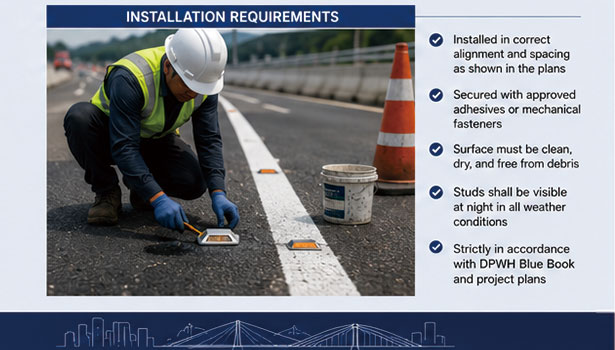
Installation and Adhesion Standards
The Blue Book clearly specifies installation methods for road studs on different road surfaces:
For asphalt surfaces, the installation area must first be thoroughly cleaned and dried; after removing dust and oil stains, a specialized adhesive should be applied to securely fix the road stud in place, and traffic should not be allowed until the adhesive has fully cured.
For concrete surfaces, the installation area must first be ground to increase surface roughness, followed by the application of adhesive for installation to ensure adequate adhesion.
It also recommends epoxy adhesives (suitable for heavy-duty sections) and asphalt-based adhesives (suitable for general sections), and explicitly warns against common installation errors such as inadequate surface cleaning, insufficient adhesive application, and opening the road to traffic before the adhesive has fully cured.
Material Quality Requirements
The Blue Book specifies the approved materials for road studs:
Aluminum alloy (for the stud body, suitable for heavy-duty sections due to its high strength, wear resistance, and corrosion resistance); polycarbonate (PC) reflective lenses (high light transmittance and wear resistance); and ABS engineering plastic (for the bodies of medium- and light-duty road studs, offering a balance of strength and toughness at a lower cost).
Additionally, to address salt fog environments in coastal areas and industrial pollution on urban roads, road stud materials must undergo anti-corrosion treatment to resist corrosion and ensure long-term, stable performance.
Common Types of Road Studs Used in DPWH Projects
Aluminum Reflective Road Studs
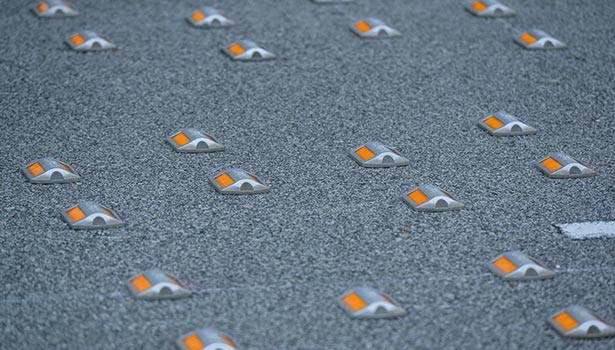
Aluminum reflective road studs are the most commonly used type in Philippine DPWH projects, particularly suitable for heavy-load, high-speed sections such as expressways and national highways. Their core advantages lie in high strength and durability, enabling them to withstand repeated crushing and impacts from heavy vehicles without breaking or deforming; after anti-corrosion treatment, they exhibit excellent corrosion resistance, adapt well to the Philippine tropical climate and coastal environments, maintain long-term stable reflectivity, and have a long service life.
Solar-Powered Road Studs
The use of solar road studs in DPWH projects is becoming increasingly widespread. They are primarily suitable for areas with low light levels and poor visibility, such as hazardous curves, mountain roads, and tunnel entrances and exits.
Powered by solar energy, solar road studs require no external power source, are easy to install, and emit light actively. Their reflective effect is more conspicuous than that of ordinary reflective road studs, providing better guidance for vehicles in low-visibility conditions; simultaneously, their waterproof and weather-resistant properties meet Blue Book requirements, making them suitable for areas with limited power supply, such as bridges and mountain roads.
Plastic Road Studs
Plastic road studs are suitable for low-speed, light-load scenarios such as urban roads and rural highways, making them a cost-effective choice for DPWH projects. Made from reinforced ABS engineering plastic, they combine strength with toughness. They are low-cost, lightweight, and easy to install, making them suitable for large-scale deployment. Their reflectivity meets the basic requirements of the Blue Book and satisfies safety guidance needs on low-speed road sections.
Common Mistakes Contractors Make When Selecting Road Studs
Contractors often make the following key mistakes when selecting road studs:
First, prioritizing low price over product quality and Blue Book compliance. Such road studs are prone to failing to meet performance standards, leading to project acceptance failures and increased maintenance costs.
Second, lacking a thorough understanding of Blue Book specifications and selecting models blindly, resulting in road studs that do not meet project requirements.
Third, using low-quality reflective materials, which cause the reflective effect to fade rapidly, thereby losing their safety guidance function;
Fourth, improper installation techniques cause road studs to fall off or shift out of place; fifth, failing to require suppliers to provide test reports and other relevant documentation during procurement makes it impossible to verify product compliance, thereby increasing project risks.
How to Verify That Road Studs Comply with Blue Book Standards?
Request Core Technical Documentation
When procuring road studs, contractors must request complete technical documentation from road stud suppliers to verify product compliance with Blue Book standards. Core documents include: product specification sheets (specifying key parameters such as material, dimensions, and reflectivity), reflectivity test reports, load test reports, water resistance test reports, and UV resistance certificates, ensuring all parameters meet Blue Book requirements.
Prioritize Suppliers with Local Experience
It is recommended to prioritize suppliers with experience in Philippine DPWH projects. Products from such suppliers have been tested in local project applications and are better aligned with Blue Book specifications and Philippine road environment requirements. Additionally, they can provide comprehensive technical support and after-sales services, such as installation guidance and quality assurance, effectively reducing project acceptance and construction risks.
Reasons Why Philippine Contractors Prefer Chinese Road Studs
Many Philippine contractors choose to source road studs from China primarily because Chinese road studs offer five significant advantages:
First, low production costs and a well-established industrial chain enable the provision of cost-effective products, helping contractors control project budgets;
Second, ample production capacity allows for rapid fulfillment of large orders, ensuring on-time delivery without disrupting project schedules;
Third, they possess OEM customization capabilities, allowing them to adjust road stud specifications and performance to meet the specific requirements of DPWH projects, ensuring product compliance;
Fourth, they have extensive export experience and are familiar with Southeast Asian infrastructure standards and Philippine road conditions, resulting in highly adaptable products;
Fifth, they can provide complete compliance documentation, helping contractors successfully pass project reviews and acceptance inspections.
The Core Value of Blue Book Compliance
Adhering to Blue Book specifications offers significant value to contractors:
First, it enhances competitiveness in government tenders; compliance is a fundamental prerequisite for bidding, preventing disqualification due to compliance issues and increasing the likelihood of winning the bid;
Second, it reduces project maintenance risks; compliant road studs offer stable performance, reducing replacement and maintenance frequency and lowering long-term costs;
Third, it enhances industry credibility; it demonstrates professional competence and a sense of responsibility to the DPWH and project owners, building a strong reputation;
Fourth, it improves road safety performance, meets government infrastructure safety requirements, and gains client recognition;
Fifth, it saves long-term operational costs for government projects, making contractors more favored by the DPWH and helping them secure more future collaboration opportunities.
Conclusion
The road stud specifications outlined in the "DPWH Blue Book" serve as a core safeguard for safety, quality, and compliance in Philippine public highway projects. These specifications are tailored to local conditions—such as the tropical climate and heavy road loads—while aligning with relevant international standards, providing practitioners with clear guidelines for implementation.
Road studs that comply with the Blue Book specifications not only effectively enhance nighttime road safety and reduce traffic accident rates but also ensure project quality and minimize long-term maintenance costs, directly impacting project approval and acceptance outcomes. It is recommended that all contractors participating in DPWH projects prioritize manufacturers with local project experience and strict compliance, install road studs strictly according to specifications to avoid common errors, and enhance their competitiveness through compliant products and professional construction, while contributing to the improvement of the Philippines' road safety infrastructure.
related
-
Off-Grid Road Safety: The Cost-Benefit Analysis of Solar Road Studs in Provincial ProjectsJun. 24, 2026
-
 The Ultimate Checklist for Inspecting Road Studs Before Installation in Infrastructure ProjectsJun. 04, 2026
 -
 All-in-One vs. Split Solar Street Lights: Which is Better for the Philippine Climate?May. 26, 2026