Can solar LED street lights operate in cloudy or rainy conditions?
Jan 12, 2026
Solar LED street lights are widely adopted across various scenarios due to their energy-saving and eco-friendly advantages. However, whether they function properly during overcast or rainy weather remains a core concern for users. This article analyzes their performance in such conditions, provides optimization solutions and selection guidelines, and precisely addresses this critical question.
How Solar Street Lights Operate
The operation of solar LED street lights fundamentally involves a “light-to-electricity-to-storage-to-light” energy conversion and cycle process. Its core working logic is as follows: photovoltaic panels receive sunlight and convert it into electrical energy through the photovoltaic effect. The converted electrical energy is processed by a charge/discharge controller and stored in the battery. When ambient light intensity falls below a set threshold (such as at dusk), the controller automatically switches operating modes. The battery then supplies power to the LED light source. When daylight returns the following morning, the system switches back to charging mode, completing the cycle.
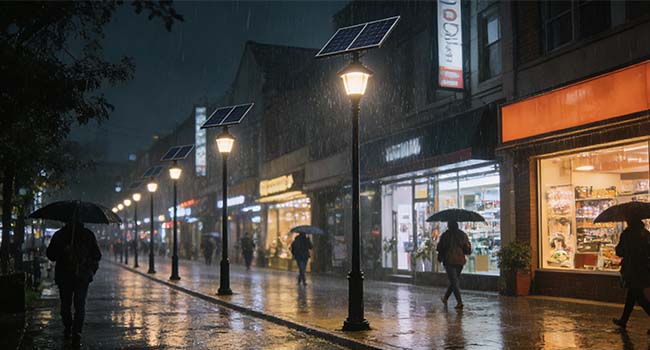
The performance compatibility of these three key components—the photovoltaic panel, battery, and electronic management system—directly determines the solar street light's operational performance under varying weather conditions. The photovoltaic panel's light-to-energy conversion efficiency impacts power generation during cloudy or rainy days, while the battery's capacity and charge/discharge performance determine endurance during prolonged inclement weather. The intelligent control system enhances energy utilization efficiency and prevents energy wastage during cloudy or rainy periods.
How Solar LED Street Lights Perform in Cloudy and Rainy Conditions
Cloudy Weather
During cloudy conditions, cloud cover reduces direct sunlight intensity but does not completely block light. Photovoltaic panels primarily generate electricity by capturing scattered light, typically producing 30%-60% of the output achieved on sunny days. For properly configured solar LED street lights, this reduction in power generation has minimal impact on normal operation.
They can meet both the high-brightness demands of municipal roads and the basic lighting needs of rural streets and alleys. This is achieved through two mechanisms: high-quality photovoltaic panels exhibit superior low-light conversion efficiency, maximizing the capture of scattered light; and the surplus energy stored during sunny days acts as a “buffer,” ensuring reliable nighttime illumination.
Rainy Weather
During rainy days, lower light intensity causes further declines in PV panel output, potentially approaching zero. At this point, solar LED street lights rely entirely on stored battery power for operation. Endurance directly depends on two core factors: battery capacity and the amount of surplus energy stored.
Typically, standard-configured solar LED street lights can support 3-7 days of continuous illumination during rainy periods, meeting basic lighting needs in most regions. Enhanced configurations featuring high-capacity batteries paired with high-efficiency photovoltaic panels extend endurance to 7-15 days. This fully addresses prolonged rainy conditions in regions with heavy rainfall or mountainous terrain, ensuring uninterrupted lighting for parking lots, rural streets, and similar environments.
Maximize Solar Street Light Efficiency in Bad Weather
Invest in Quality
The quality of solar street light core components is fundamental to enhancing rainy-day performance and ensuring lighting needs across diverse scenarios. Key considerations during procurement include:
Select high-efficiency photovoltaic panels (e.g., monocrystalline silicon panels) with low-light conversion efficiency ≥18%. These panels demonstrate superior power generation in diffuse light environments, better adapting to rainy and foggy conditions.
Prioritize lithium iron phosphate batteries for their high charge/discharge cycle endurance and energy storage density, making them ideal for sustained, repeated charging/discharging cycles that ensure stable solar street light endurance. Select intelligent charge/discharge controllers with MPPT functionality to track maximum power output from photovoltaic panels in real time, maximizing energy utilization and meeting extended lighting demands in municipal roadways and similar applications.
Regular Maintenance
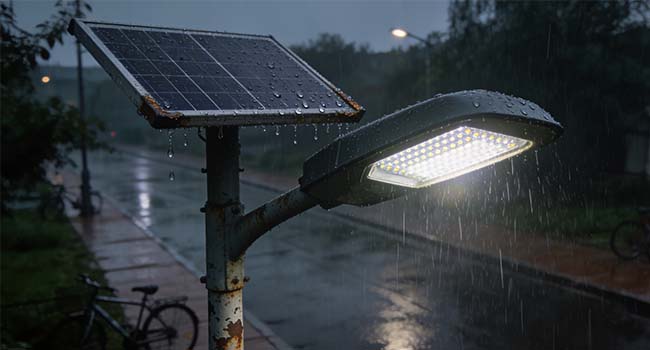
The cleanliness of photovoltaic panel surfaces directly impacts light absorption efficiency, particularly during overcast or rainy weather. Even minor dust or debris can significantly reduce light absorption capacity. Therefore, establishing a regular maintenance schedule is recommended. Clean panel surfaces every 1-3 months to remove dust, fallen leaves, bird droppings, and other contaminants. Increase cleaning frequency during rainy seasons to ensure unobstructed, spot-free surfaces that maximize scattered light capture.
Battery Capacity
The battery serves as the “core safeguard” for extended operation during cloudy and rainy days, requiring adherence to the “redundancy design” principle during configuration. Beyond meeting daily lighting needs, add an extra 30%-50% capacity to store surplus energy from sunny days. For example, if the region's longest average consecutive rainy period is 5 days and daily lighting consumes 10Ah, the battery capacity should be configured as 5×10×(1+30%)=65Ah to ensure stable operation during extreme weather.
Strategic Placement
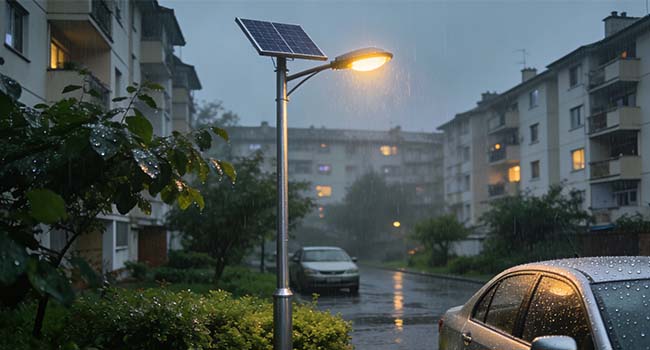
The installation location of photovoltaic panels directly impacts light collection efficiency. Even on sunny days, shading reduces power generation, with the effect being more pronounced during overcast or rainy conditions. Therefore, installation should prioritize unobstructed areas, avoiding tall buildings, large trees, or other obstacles that could block the LED street light's path. Panel installation angles should be optimized based on local latitude to maximize scattered light absorption during cloudy or rainy weather while preventing panels from facing directly into backlight conditions.
Backup Systems
For regions with frequent or prolonged rainy periods, implementing backup power systems ensures uninterrupted illumination. Options include grid-tied backup mode, connecting solar street lights to the municipal grid for automatic switching to grid power during insufficient solar generation. Alternatively, hybrid power systems can be deployed, integrating small wind turbines or other renewable energy devices to complement solar power and enhance supply stability during extreme weather.
How Can I Choose The Right Solar LED Street Light For A Specific Location?
Assess the Lighting Requirements
First, determine the street light's usage scenario and illumination standards to avoid “over-specification” or “under-specification.” Recommended brightness levels and core requirements for solar LED street lights in different scenarios are shown in the table below, ensuring precise matching to lighting needs.
|
Application Scenario |
Recommended Brightness (Lumens) |
Core Requirements |
|
Municipal Main Roads |
2,000–4,000 lm |
Stable brightness with long continuous lighting duration (typically 8–12 hours) |
|
Rural Streets & Lanes |
800–1,500 lm |
Cost-effective performance with adaptability to complex weather conditions |
|
Parking Lots / Courtyards |
1,500–2,500 lm |
Uniform illumination with adjustable brightness based on actual demand |
Evaluate Sunlight Availability
Determine the local average annual sunshine duration, maximum consecutive rainy days, and rainy season months. This information is crucial for establishing panel capacity and directly impacts solar street light endurance. For instance, regions with heavy rainfall may experience 7-10 consecutive rainy days, requiring larger batteries and panels to ensure uninterrupted lighting. Conversely, areas with cold winters but fewer rainy days can use standard configurations to meet basic operational needs.
Determine Lighting Duration and Dimming Requirements
Define the daily lighting duration for street lights while considering dimming functionality. Intelligent dimming (e.g., high brightness in the first half of the night, reduced brightness in the latter half) significantly reduces energy consumption and extends endurance during rainy periods. Daily energy consumption can decrease by approximately 30%, and under the same battery capacity, endurance during rainy days can increase by 40%.
Matching Solar Panel and Battery Capacity
Based on the preceding requirements analysis, calculate the required panel and battery capacity using the following core formulas:
1.Battery Capacity (Ah) = Daily Lighting Energy Consumption (Ah) × Maximum Consecutive Rainy Days × Redundancy Factor (1.3–1.5).2.Panel Power (W) = Daily Lighting Energy Consumption (Wh) ÷ Average Annual Daily Sunshine Hours (h) × Redundancy Factor (1.3–1.5). It is recommended that professional manufacturers perform precise calculations based on specific data to avoid selection errors.
Prioritize High-Efficiency LED Light Sources
LED light source efficiency directly impacts energy consumption. Select high-efficiency products with an efficacy ≥130 lm/W. Compared to standard LED, high-efficiency LED consume less energy, extending illumination time with the same battery capacity and indirectly improving endurance during rainy days. Additionally, choose LED light sources with a Color Rendering Index (CRI) ≥70 to ensure clear illumination and enhance nighttime travel safety.
Prioritize Smart Control Features
Select LED street lights with the following smart control functions to maximize energy utilization during rainy weather:
MPPT (Maximum Power Point Tracking) optimizes panel power generation in real-time, boosting efficiency by 10%-20% in cloudy conditions.
Light Control + Time Control + Remote Control automatically switches lights based on ambient light levels, sets brightness schedules, and enables remote monitoring. Overcharge and over-discharge protection prevents battery damage from excessive discharge during cloudy weather, extending battery lifespan.
Balance Budget and Warranty
High-quality solar street lights have higher upfront costs but offer superior long-term reliability and energy savings, resulting in better overall value. Avoid prioritizing price over product quality during procurement. Simultaneously, pay attention to the manufacturer's warranty policy. Premium products typically offer a 25-year warranty for photovoltaic panels, 5-10 years for batteries, and 3-5 years for controllers. Comprehensive warranties reduce long-term maintenance costs and ensure stable operation during cloudy or rainy weather.
The key to ensuring stable operation of solar LED street lights during rainy weather lies in precisely matching the system configuration to local climate conditions. Selecting the right components and implementing scientific maintenance eliminates concerns about endurance, allowing their energy-saving and environmentally friendly advantages to be fully realized and adaptable to various lighting scenarios.
related
-
Off-Grid Road Safety: The Cost-Benefit Analysis of Solar Road Studs in Provincial ProjectsJun. 24, 2026
-
 The Ultimate Checklist for Inspecting Road Studs Before Installation in Infrastructure ProjectsJun. 04, 2026
 -
 All-in-One vs. Split Solar Street Lights: Which is Better for the Philippine Climate?May. 26, 2026