Can Solar Street Lights Be Customized For Specific Applications?
Mar 12, 2026
With the widespread adoption of solar lighting technology, standard solar street lights have been extensively deployed across various settings. However, their limitations become increasingly apparent in many specialized scenarios. For instance, in remote mountainous areas with insufficient sunlight, the power output of standard solar panels fails to sustain continuous nighttime illumination. Coastal regions with high salt fog exposure cause rapid corrosion and damage to ordinary lamp bodies. Meanwhile, scenic area lighting demands both adequate brightness and harmonious integration with the landscape—all scenarios where standardized products struggle to deliver.
This raises a crucial question: Can solar street lights be customized for specific applications? The answer is unequivocally yes. Solar street lights offer high customization potential, enabling tailored designs across electrical, mechanical, and aesthetic dimensions to meet diverse lighting requirements, environmental conditions, and budget constraints. This approach perfectly aligns with specialized project needs. This article will thoroughly dissect the core elements, application scenarios, advantages, and implementation steps of customization.
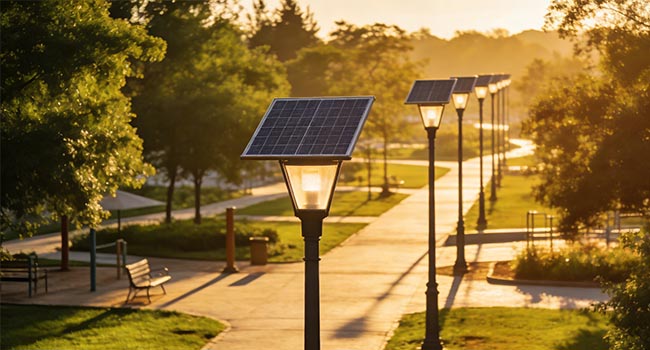
What Exactly Is “Customization” in Solar Street Lights?
Core Differences Between Custom and Standard Models
Standard solar street lights are mass-produced, universal products with fixed core parameters—such as solar panel power, pole height, and LED wattage—suited only for basic lighting in conventional settings. Their advantages lie in low cost and short delivery cycles. Customized solar street lights, however, are tailored solutions for specific projects. Their core principle is demand-driven design, abandoning uniform parameters. Key components are adjusted to address scene characteristics, usage requirements, and environmental constraints, ensuring optimal performance and adaptability. This achieves true alignment with the usage environment and lighting needs.
Core Objectives of Customization
Customization fundamentally adapts solar street lights to the environment rather than forcing the environment to accommodate the lights. Its core objectives manifest in four key areas: First, adapting to harsh environments by effectively withstanding extreme natural conditions like high temperatures, severe cold, high salt fog, and strong winds and sand, significantly extending the overall lifespan of the lights. Second, matching lighting requirements by achieving precise illumination based on scene-specific demands for brightness, lighting duration, and control methods, avoiding energy waste and insufficient lighting.
Third, controlling project budgets by selecting component specifications based on actual needs, avoiding over- or under-provisioning to balance lighting performance with project investment costs. Fourth, meeting compliance requirements by adapting to local lighting standards, environmental regulations, and project acceptance criteria to ensure smooth project implementation and approval.
Detailed Explanation of Customizable Core Components for Solar Street Lights
Custom Solar Panels
As the energy source for street lights, panel customization focuses on adapting to local sunlight conditions, enabling adjustments across multiple parameters. Power ranges typically span 10W-300W, allowing flexible selection based on average daily sunlight hours and load power. High-power panels above 150W are suitable for remote, low-light mountainous areas, while 50-100W panels adequately meet urban road requirements.
Dimensions can be tailored to the installation space and angle on the light pole, preventing issues like insufficient mounting space or installation difficulties. Types include monocrystalline and polycrystalline silicon. Monocrystalline achieves 20%-24% conversion efficiency, ideal for low-light environments, while polycrystalline offers 15%-18% efficiency with superior cost-effectiveness for standard conditions. Installation angles are optimized based on project latitude, typically matching or exceeding the latitude by 5° to maximize solar absorption efficiency.
Battery Customization
As the energy storage core of solar street lights, battery customization prioritizes endurance and environmental adaptability. Key parameters and suitable applications vary significantly across battery types, as detailed in the comparison table below. Batteries can also be customized for temperature ranges (-40°C to 60°C) and enhanced waterproof ratings, ensuring reliable operation in extreme conditions like severe cold, high heat, or heavy rainfall, and maintaining stable performance during prolonged cloudy or rainy periods.
|
Battery Type |
Capacity Customization Range |
Advantages |
Suitable Scenarios |
|
Lithium Battery |
12Ah–200Ah |
Compact size, lightweight, long lifespan (5–8 years), good low-temperature performance |
Cold regions, installations with limited pole space |
|
Lead-Acid Battery |
20Ah–150Ah |
Lower cost, stable capacity, simple maintenance |
Budget-limited projects, normal temperature environments, conventional lighting |
|
Lithium Iron Phosphate Battery (LiFePO4) |
30Ah–200Ah |
High safety, strong heat resistance, long cycle life (8–10 years) |
High-temperature areas, locations requiring higher safety (e.g., gas stations, scenic areas) |
Custom LED Light Sources
As the core component of lighting systems, LED light sources are customized around brightness, luminous efficacy, and scene adaptability to meet diverse lighting requirements. Standard power ranges from 10W to 150W. Urban thoroughfares require 50-100W power, while residential walkways, parks, and other leisure settings only need 10-30W.
Color temperature options include 3000K warm light, 4000K neutral light, and 6000K cool light. Warm light provides a cozy, soft ambiance for residential areas and parks; neutral light offers clear, bright illumination for urban roads and industrial zones; cool light delivers strong penetration for highways and mining areas. Beam angles can be customized within the 15°-120° range. Narrow beams (15°-30°) suit long-distance highway illumination, while wide beams (60°-120°) cover expansive areas like plazas and parks. Customizable brightness modes include constant brightness, gradual fade-in/fade-out, and sensor-based dimming, balancing energy efficiency with practical lighting needs.
Customized Light Poles
As the structural support for street lights, pole customization focuses on height, material, and stability to meet installation and wind resistance requirements across diverse environments. Standard heights range from 3 to 12 meters:
Residential pathways: 3-5 meters
Urban main roads: 6-8 meters
Highways and large plazas: 8-12 meters
Materials include Q235 steel, aluminum alloy, and stainless steel. Q235 steel offers high cost-effectiveness for standard applications, aluminum alloy provides lightweight corrosion resistance for coastal areas and scenic spots, while stainless steel delivers superior rust prevention for humid or high-salt-fog environments.
Customizable pole designs include straight, tapered, or curved styles, with optional decorative elements like carved patterns or wood-effect finishes to complement scenic areas and historic towns. Pole wall thickness (3-8mm) is tailored to solar panel and luminaire weight, while wind resistance ratings (8-12 levels) accommodate typhoon-prone or high-wind regions.
Custom Control Systems
As the intelligent core of solar street lights, the control system focuses on smart management and user-friendly operation, enabling multiple intelligent upgrades. Customizable dimming modes include light sensing, time scheduling, motion detection, and remote control. Motion-activated mode achieves full brightness upon approach and dimmed illumination when unoccupied, significantly enhancing energy efficiency. Remote monitoring features include GPS positioning, real-time battery level tracking, and automatic fault alerts, reducing manual inspection requirements and simplifying long-term maintenance.
Typical Application Scenarios & Customized Solutions
Urban Road & Main Street Lighting
Core requirements for urban road and main street lighting include sufficient brightness, stable endurance, strong wind resistance, and compliance with municipal public lighting standards. Custom solutions prioritize stability and practicality. Light poles feature 6-8 meter conical designs made of Q235 steel, achieving wind resistance up to Level 10 for structural safety.
LED light sources feature 50-100W power, 4000K neutral color temperature, and a 60° beam angle to meet road illumination brightness and visibility requirements. Solar panels are configured at 80-120W paired with 100-150Ah lithium batteries, ensuring stable daily power supply.
Residential & Pedestrian Pathway Lighting
Core requirements for residential and pedestrian pathway lighting include soft illumination, energy efficiency, aesthetic design, and easy installation, prioritizing lighting comfort and environmental harmony. Pole heights range from 3-5 meters using straight or minimalist curved aluminum alloy poles, offering lightweight corrosion resistance and simplified installation.
LED light sources with 10-30W power output, 3000K warm light color temperature, and a 90° beam angle provide soft, glare-free illumination to enhance residential comfort. Solar panels rated at 20-50W, paired with 30-60Ah lithium batteries, meet basic lighting energy requirements. The control system employs a motion-sensing dimming mode: full brightness when people approach and dimmed illumination when they leave, ensuring adequate lighting while minimizing energy consumption.
Lighting for Remote Rural & Off-Grid Areas
Core requirements for solar street lights in remote rural areas include easy installation, long endurance, adaptation to low-light environments, and cost control to solve lighting challenges in areas without grid access. The lamp post height uses a simple 4-6 meter straight pole, offering high cost-effectiveness with a straightforward and convenient installation process. LED light source power: 20-50W, color temperature: 4000K neutral light, meeting basic lighting needs for rural roads.
Solar panels utilize 60-100W monocrystalline silicon panels with high conversion efficiency, suitable for low-light environments, paired with 60-100Ah lithium batteries. The control system employs light-sensing + time-control modes, enabling independent operation without grid power supply and ensuring stable operation for 5-7 consecutive days of cloudy or rainy weather.
Core Advantages of Customized Solar Street Lights
Higher Energy Efficiency, Longer Lifespan
The component parameters of customized solar street lights are highly matched to their usage scenarios, completely avoiding energy waste from over-specced systems or component overload from under-specced systems, thereby enhancing overall energy utilization efficiency. For instance, high-efficiency monocrystalline silicon solar panels are selected for remote mountainous areas with insufficient sunlight, maximizing the use of limited light resources. In coastal areas with high salt fog, corrosion-resistant custom components extend lamp lifespan from 3-5 years to 8-10 years, reducing replacement frequency and enhancing long-term value.
Precision Matching of Lighting Requirements
Different scenarios demand distinct lighting specifications—brightness, duration, beam angle, and color temperature. Custom solutions deliver true on-demand lighting, enhancing safety. Highways require high-penetration, long-range cool light illumination, while residential areas need soft, warm ambient lighting. Customization precisely addresses these differentiated needs. It also prevents excessive brightness causing light pollution or insufficient light creating safety hazards. Product parameters fully comply with local lighting standards, enhancing public area safety.
Reduced Long-Term Operational Costs
Custom solar street lights feature superior component compatibility and environmental integration, significantly lowering failure rates. Their intelligent custom features also minimize maintenance investments. Features like remote monitoring and automatic fault alerts eliminate the need for manual periodic inspections. Environmental adaptations—including corrosion resistance, freeze protection, and waterproofing—reduce component damage and replacement frequency. Long-term operational costs are 30%-50% lower than standard models, making them particularly suitable for large-scale projects and remote areas.
High Flexibility and Scalability
Custom solar street lights incorporate expandable interfaces during design, enabling flexible upgrades based on evolving scenarios and management needs without full equipment replacement. Post-installation upgrades—such as smart control systems, backup power sources, and network management capabilities—accommodate future requirements like site expansions or management enhancements. This flexibility prevents premature equipment obsolescence due to functional upgrades, maximizing product lifecycle value.
Solar street lights can be fully customized for specific application scenarios. Custom solutions represent the optimal choice for meeting unique requirements, enhancing lighting performance, and reducing long-term costs. For projects with specialized lighting needs, complex environmental conditions, or a focus on long-term cost-effectiveness, it is advisable to move beyond standardized, off-the-shelf solutions. Instead, partner with professional solar lighting manufacturers to develop tailored solutions that integrate scenario requirements, environmental characteristics, and project budgets. This approach achieves the optimal balance between lighting performance, service life, and investment costs.
related
-
Off-Grid Road Safety: The Cost-Benefit Analysis of Solar Road Studs in Provincial ProjectsJun. 24, 2026
-
 The Ultimate Checklist for Inspecting Road Studs Before Installation in Infrastructure ProjectsJun. 04, 2026
 -
 All-in-One vs. Split Solar Street Lights: Which is Better for the Philippine Climate?May. 26, 2026