How Many Years Do Solar Street Lights Last?
Apr 13, 2026
If you’re planning to invest in solar street lights, your top concern is likely: How long will they actually last? After all, as outdoor lighting equipment designed for long-term use, their lifespan directly determines your return on investment, maintenance costs, and user experience. Compared to traditional grid-connected street lights, solar street lights have become the top choice for municipal, industrial park, and rural settings thanks to their advantages of no wiring, energy efficiency, environmental friendliness, and easy maintenance. However, many people have misconceptions about their lifespan, believing that “solar equipment isn’t durable” or that “the batteries will fail quickly.”
In fact, the lifespan of solar street lights is not a fixed value but is determined by various factors, including the quality of core components, the operating environment, and routine maintenance. This article will comprehensively analyze the secrets behind the lifespan of solar street lights from four perspectives—basic understanding, causes of aging, actual lifespan, and tips for extending lifespan—to help you make a more informed investment decision.
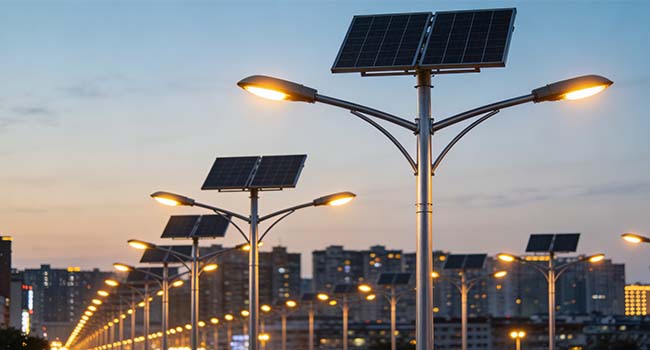
Solar Street Lights: The Basics
To understand the lifespan of solar street lights, you must first understand their “composition.” A complete solar street light system consists of more than just a pole and a bulb; it comprises four core components that work in tandem, and the lifespan of each component directly impacts the system’s overall lifespan.
Core Components of Solar Street Lights
The operating principle of solar street lights is straightforward: during the day, photovoltaic panels absorb solar energy, convert it into electricity, and store it in the battery; at night, the controller triggers the LED luminaires to illuminate, enabling self-powered operation. The core components include photovoltaic (PV) panels, rechargeable batteries, LED luminaires, and a charge controller. The PV panels are responsible for absorbing solar energy; they serve as the energy source and are among the most durable components in the entire system.
Rechargeable batteries, typically lithium-ion, store electrical energy and represent the key bottleneck affecting the system’s lifespan. LED fixtures provide illumination; they are energy-efficient, suffer minimal wear and tear, and have a long lifespan. The charge controller acts as the “brain,” managing the charging and discharging of electrical energy, preventing overcharging and over-discharging of the battery, and ensuring the safety of the components.
Solar Street Lights vs. Traditional Grid-Connected Street Lights: Clear Lifespan Advantages
Compared to traditional street lights, which require trenching and wiring and rely on the grid, the lifespan advantage of solar street lights is not only reflected in the components themselves but also in their “maintenance-free” operation. There is no need for frequent line inspections, which reduces human-caused damage and indirectly extends the overall service life. In terms of overall lifespan, solar street light systems can operate for an average of 8–15 years, while traditional grid-connected street lights, affected by line losses, have an average lifespan of only 5–10 years.
In terms of core component wear and tear, the primary degradation in solar street lights is concentrated in battery aging, with other components experiencing minimal wear. Traditional grid-connected street lights, however, differ significantly: multiple components—including wiring, transformers, and light bulbs—are prone to wear and tear, resulting in higher maintenance costs. The impact of maintenance on lifespan also varies markedly between the two.
Solar street lights require simple maintenance, involving only routine inspections, which have a minimal effect on their lifespan. Conventional grid-connected street lights, on the other hand, require frequent line inspections; even minor oversights can shorten their lifespan. Furthermore, with continuous advancements in solar technology, the efficiency and durability of solar panels and batteries have improved significantly. Today, the installation cost of high-quality solar street lights is gradually approaching that of conventional street lights, making their cost-effectiveness over the long term even more pronounced.
How Do Solar Street Lights Degrade?
Temperature
The batteries in solar street lights are highly sensitive to temperature, particularly in high-temperature environments, which can severely shorten their lifespan. In hot regions, batteries exposed to high temperatures over extended periods experience a decline in the activity of internal chemical substances, leading to a gradual reduction in capacity. In extremely cold regions, while the impact is relatively minor, it still reduces the battery’s charging and discharging efficiency, which over time can similarly accelerate aging.It is worth noting that the installation environment of the battery is critical—sealed, poorly ventilated battery enclosures can cause heat buildup, further accelerating degradation. Conversely, well-ventilated enclosures effectively dissipate heat, thereby slowing battery degradation.
Charge-Discharge Cycles
The batteries in solar street lights undergo a “charge-discharge cycle” every day: charging during the day and discharging at night. This repeated cycle gradually depletes the battery’s maximum capacity. Just like a smartphone battery, the longer it is used and the more times it is charged and discharged, the poorer its endurance becomes. However, high-quality solar street light controllers optimize the charge-discharge logic to prevent deep discharge of the battery, thereby reducing cycle-related degradation.
Calendar Aging
Many people have a misconception: “Solar street lights last longer if they aren’t used.” In reality, this is not the case, as batteries are subject to “calendar aging.” Regardless of whether they are in use, their internal structure naturally ages over time, causing their capacity to gradually decline. This is why even idle solar street lights, when put back into use after sitting unused for several years, will show a noticeable decline in battery life. However, this aging process is relatively slow and pales in comparison to the effects of high temperatures and charge-discharge cycles.
The Controller Determines the Rate of Aging
Unlike small residential solar lights, commercial-grade solar street lights are equipped with advanced charge controllers that effectively prevent overcharging and over-discharging, significantly slowing down the aging process. In contrast, low-quality consumer-grade products have controllers with limited functionality that cannot effectively protect the battery, often resulting in battery failure after just 1–2 years of use. Therefore, the quality of the components is the key factor determining the aging rate of solar street lights.
How Long Do Solar Street Lights Last?
Overall System Lifespan
Taking into account the lifespan of all core components, a high-quality commercial-grade solar street light system has an average lifespan of 8–15 years. With regular maintenance and suitable environmental conditions, some premium products can last over 15 years. In harsh environments (high temperatures, high dust levels) and with insufficient maintenance, the lifespan may be reduced to 5–8 years.
Breakdown of Core Component Lifespans
The durability of different components varies significantly. Below are the specific lifespan ranges for each core component, compiled based on real-world usage scenarios; the data is accurate and reliable. Photovoltaic (PV) panels are the most durable component in the entire system, with a lifespan of up to 25–30 years. They age extremely slowly; even after 25 years of use, they can maintain over 80% of their power generation efficiency. Lithium-ion batteries are the weakest link in the system’s lifespan, with a lifespan of 5–10 years. They are most affected by temperature and charge-discharge cycles. However, the good news is that batteries can be replaced later, which can extend the overall lifespan of the system.
LED lighting fixtures have a relatively long lifespan of 10–15 years. They are energy-efficient and wear-resistant; under normal use, they rarely need replacement and can provide stable illumination over the long term. The lifespan of charge controllers ranges from 8 to 12 years, with significant variations in quality. High-quality controllers can last as long as the entire system, while low-quality controllers may fail prematurely, affecting normal system operation.
Three Key Factors Affecting Overall Lifespan
Environmental factors: High temperatures, high humidity, dusty conditions, and areas with strong UV radiation can accelerate module aging. Regarding maintenance frequency, a lack of maintenance—such as dust accumulation on solar panels or poor battery heat dissipation—can significantly shorten the lifespan. In terms of component quality, low-quality batteries and controllers can directly halve the system’s lifespan.
How to Extend the Lifespan of Solar Street Lights
Although solar street lights are inherently durable, simple daily maintenance and proper operation can further extend their lifespan and reduce future replacement costs. The following tips are simple and easy to implement, suitable for all scenarios.
Strictly Follow the Manufacturer’s Operating Guidelines
Solar street lights from different manufacturers may have varying battery chemistries and controller software, resulting in different operating specifications. After installation, carefully read the manufacturer’s manual, configure charging and discharging parameters as required, and regularly update the controller software to prevent component damage caused by improper operation.
Maintain the Battery at an Optimal Temperature
As mentioned earlier, temperature is a key factor affecting battery life, so proper temperature control is essential. Install the battery box in a well-ventilated location and avoid sealed, stuffy environments. In high-temperature regions, add heat sinks to the exterior of the battery box; in extremely cold regions, ensure proper insulation. Avoid prolonged exposure of the battery to direct sunlight.
Clean the Solar Panels Regularly
The cleanliness of solar panels directly affects power generation efficiency, which in turn impacts battery charging performance. Low power generation efficiency can lead to insufficient battery charging, causing the battery to remain in a discharged state for extended periods and accelerating aging. Frequent daily cleaning is not necessary, as rainwater typically washes away surface dust. Conduct manual inspections 1–2 times per year to remove accumulated dust, pollen, fallen leaves, or snow from the panels. Take care to avoid scratching the panels during cleaning.
Regularly Check the System’s Condition
In addition to cleaning, it is also important to regularly inspect the condition of each component in the system. Check for loose or damaged wiring to prevent short circuits that could damage the controller. Check whether the LED lights are functioning properly and look for any flickering or dimming. Check the battery voltage; if you notice a significant drop in runtime, have the battery tested or replaced promptly.
The average lifespan of a solar street light is 8–15 years, primarily depending on battery quality and the operating environment, while the lifespan of components such as solar panels and LED fixtures far exceeds that of the system as a whole. For investors, rather than worrying about “how many years it will last,” it is better to focus on component quality. By selecting high-quality, commercial-grade solar street lights and ensuring proper installation and routine maintenance, you can maximize the system’s service life and achieve “a one-time investment with long-term benefits.”
related
-
Off-Grid Road Safety: The Cost-Benefit Analysis of Solar Road Studs in Provincial ProjectsJun. 24, 2026
-
 The Ultimate Checklist for Inspecting Road Studs Before Installation in Infrastructure ProjectsJun. 04, 2026
 -
 All-in-One vs. Split Solar Street Lights: Which is Better for the Philippine Climate?May. 26, 2026