How Solar Street Lights Help Municipalities Save on Energy Costs
Apr 09, 2026
In the day-to-day operations of municipal authorities, street lighting is an indispensable basic service; however, its reliance on the power grid results in high energy costs that continue to strain municipal budgets. As a new, green, and low-carbon lighting solution, solar street lights reduce energy consumption and expenses at the source through self-generated power, making them the preferred path for municipalities to conserve energy and reduce consumption, and providing effective support for overcoming cost challenges.
Challenges of Traditional Street Lights
High Electricity Costs
Traditional street lights rely entirely on the municipal power grid. To ensure road safety at night, most road sections require continuous lighting for 8–12 hours. This extensive lighting duration makes electricity costs a significant portion of municipal energy budgets. More concerning is that, with global energy price fluctuations, electricity rates are rising year by year, further straining municipal budgets. For municipal authorities with large populations and extensive jurisdictions, annual electricity costs for street lighting are substantial.
Grid Construction and Maintenance
For remote areas, newly developed urban districts, or rural road sections, the upfront investment required to lay power transmission lines is enormous. Not only must equipment such as cables and transformers be procured, but significant manpower is also required for trenching, laying, and commissioning the lines, resulting in massive initial infrastructure costs.
At the same time, the wiring for traditional street lights is exposed to the elements for extended periods, making it susceptible to damage from wind and rain, aging, and vandalism. Subsequent maintenance tasks—such as line inspections, fault troubleshooting, and component replacement—require ongoing investments in labor and materials, creating a dual burden of “high initial investment and high ongoing maintenance costs.”
Severe Energy Loss
Energy loss is inevitable during power transmission, particularly over long distances, where the loss rate can reach 10%–15%. This means that for every 100 kilowatt-hours of electricity consumed, 10–15 kilowatt-hours are wasted. Furthermore, traditional street lights often use outdated light sources such as high-pressure sodium lamps, which have low luminous efficiency and high power consumption. To achieve the same level of illumination, they consume 2–3 times more electricity than LED sources, further exacerbating energy waste.
Pressure to Comply with Policies
Currently, global and national policies regarding carbon reduction and green urban governance are becoming increasingly stringent. The high energy consumption and emissions of traditional street lights make it difficult to meet environmental compliance standards. Some regions have already introduced policies restricting high-energy-consumption lighting equipment. If upgrades are not implemented promptly, municipal authorities may face environmental fines, which could also impact a city’s green development rating and increase hidden compliance costs.
How Do Solar street lights Help Municipalities Save on Energy Costs?
Zero Electricity Costs
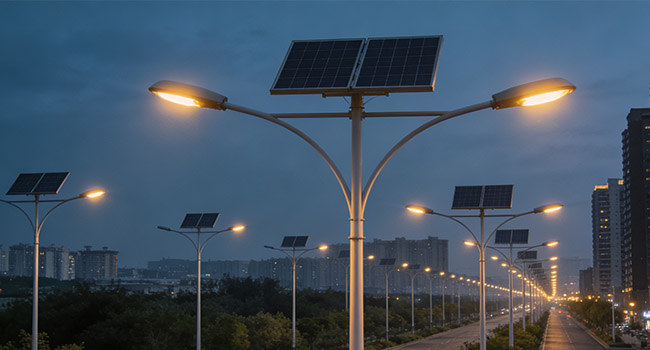
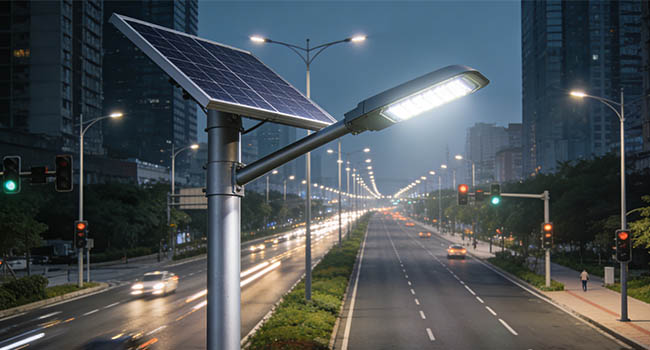
The core advantage of solar street lights lies in their “self-powered” operation. Completely independent of the municipal power grid, they eliminate the need to pay any electricity bills, cutting off the primary source of lighting costs at the source. Their operating principle is simple: solar panels absorb sunlight, converting solar energy into electricity that is stored in dedicated batteries; at night, a smart control system releases this stored energy to power the LED lights, providing illumination.
No Need for Grid Infrastructure
For remote road sections, newly planned urban areas, or regions without grid coverage, solar street lights require no installation of power transmission lines, transformers, or other infrastructure. They can be installed and used directly, significantly reducing initial construction costs. According to statistics, the cost of grid infrastructure for traditional street lights per kilometer is extremely high, whereas solar street lights only require investment in equipment procurement and installation, saving a substantial amount in infrastructure costs per kilometer.
Low Maintenance Requirements
Solar street lights feature a simple structure, and their core components—photovoltaic panels, batteries, and LED light sources—have long service lives. Specifically, photovoltaic panels can last over 25 years, batteries last 5–10 years, and LED light sources last 10–15 years. Compared to the maintenance frequency of at least once a month for traditional street lights, solar street lights require only 1–2 maintenance visits per year. Maintenance costs are only about one-tenth of those for traditional street lights, significantly reducing subsequent labor and material expenses.
Smart Control
Modern solar street lights are typically equipped with smart sensor systems, including light sensors and motion detectors, enabling intelligent control such as “automatic activation at dusk and deactivation at dawn” and “lights turn on when people approach and dim when they leave.” This smart mode not only reduces unnecessary energy consumption but also extends the service life of the battery, reduces the frequency of component replacements, and further lowers the hidden costs of long-term maintenance.
Key Considerations for Municipalities When Selecting Solar Street Lights
Quality of Core Components
Photovoltaic panels and batteries are the core components of solar street lights, and their quality directly determines the lifespan and operational stability of the lights. It is recommended to select photovoltaic panels with a high conversion efficiency (≥22%) to enhance solar energy absorption and ensure sufficient energy storage even on cloudy or rainy days. Choose lithium batteries with excellent sealing performance and a long cycle life to avoid frequent replacements later on and reduce additional expenses.
Matching Lighting Requirements
Lighting needs vary across different municipal road sections. Solar street lights of appropriate power ratings should be selected based on road type: main thoroughfares require 30–60W lights to ensure adequate brightness and coverage; side streets and parks can use 10–30W lights to balance energy efficiency and illumination; and remote rural roads can utilize 5–10W lights to meet basic lighting needs while avoiding excessive investment.
Supplier Capabilities
Select suppliers with experience in municipal projects and a good reputation, giving priority to companies that offer comprehensive after-sales support. High-quality suppliers provide services such as on-site installation, regular inspections, and prompt repairs, thereby reducing the municipal authority’s long-term maintenance burden and preventing lighting outages and additional costs caused by equipment failures.
Applying for Policy Subsidies
Before procurement, municipal authorities should research local solar-related subsidy policies in advance, prepare the necessary application materials, and submit subsidy applications promptly. Additionally, they should coordinate with suppliers to secure assistance with the subsidy application process, ensuring smooth approval and further reducing initial investment costs.
Clarifying Common Misconceptions
Misconception 1: Solar street lights provide poor illumination and cannot meet municipal requirements
Modern solar street lights are typically equipped with LED light sources, which offer high luminous efficiency and sufficient brightness. The brightness can be adjusted according to municipal requirements, fully meeting the lighting standards for various road segments, including main thoroughfares and side streets. For example, the brightness of a 30W solar LED street light is equivalent to that of a traditional 100W high-pressure sodium lamp, while providing a wider illumination range and softer light. This ensures road safety while reducing light pollution.
Misconception 2: Solar street lights cannot function properly during cloudy or rainy weather
Clarification: High-quality solar street lights are equipped with batteries capable of storing sufficient energy to meet lighting needs for 3–7 consecutive days of cloudy or rainy weather. For regions with frequent rain or overcast conditions, larger-capacity batteries or small auxiliary power sources can be selected to ensure the street lights operate normally. Currently, energy storage technology for solar street lights is highly mature and adaptable to various climates, so there is no need to worry about lighting interruptions during cloudy or rainy weather.
Misconception 3: The initial investment for solar street lights is too high
Clarification: Although the initial equipment procurement cost for solar street lights is slightly higher than that of traditional street lights, when considering the total cost of ownership, their long-term benefits far exceed those of traditional street lights. As mentioned earlier, a fleet of 1,000 solar street lights can yield substantial total cost savings over an 8-year period. The initial investment can be recouped within 1 to 3 years, making long-term use even more cost-effective. Additionally, government subsidies can further reduce the upfront investment, enhancing the cost-effectiveness of solar street lights.
With core advantages such as zero electricity bills and low maintenance costs, solar street lights effectively address the high energy consumption and high costs associated with traditional street lights, aligning with carbon reduction and green municipal policy requirements. Promoting the use of solar street lights not only significantly reduces energy costs for municipal authorities but also enhances the city’s green image, fostering a win-win situation of cost savings and green development, and injecting new momentum into the city’s sustainable development.
related
-
Off-Grid Road Safety: The Cost-Benefit Analysis of Solar Road Studs in Provincial ProjectsJun. 24, 2026
-
 The Ultimate Checklist for Inspecting Road Studs Before Installation in Infrastructure ProjectsJun. 04, 2026
 -
 All-in-One vs. Split Solar Street Lights: Which is Better for the Philippine Climate?May. 26, 2026