Development Prospects and Opportunities of the Solar Street Lighting Industry
Dec 26, 2025
Under the double driving force of global energy structure transformation and environmental protection demand upgrading, green and low-carbon has become the core orientation of infrastructure construction. With the unique advantages of cleanliness, environmental protection and convenient operation and maintenance, solar street lights are gradually replacing traditional street lights and becoming an important choice for urban and rural lighting upgrade. The development of the industry has benefited from the dual empowerment of policy support and technological innovation, and is also facing the new opportunities brought by the broad market demand, while also dealing with the many challenges at the technical and cost levels.
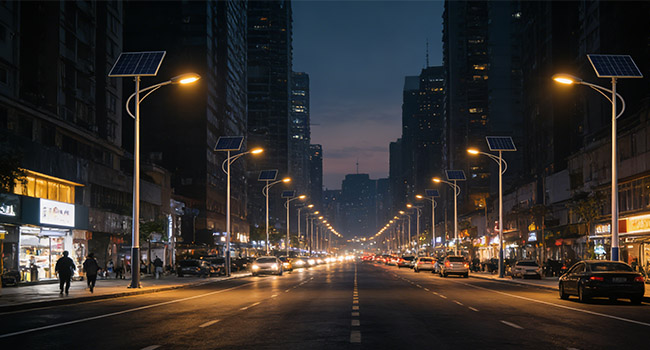
Background of solar street light industry
The concept of sustainable development is deeply rooted in people's hearts worldwide, and energy conservation and ecological protection have become important considerations for infrastructure construction in various countries. As a key public facility covering both urban and rural areas, the upgrading of the energy consumption pattern of street lights is imminent.
Compared with the traditional street lights relying on traditional power grids, high energy consumption and cumbersome laying and maintenance, solar street lights relying on photovoltaic conversion technology to achieve energy self-sufficiency, without the need for complex transmission line laying, and long-term operation and maintenance costs are low, in the wave of the global lighting facilities replacement, its substitution advantage is increasingly prominent, and the industry continues to consolidate the basic support for the development of the industry.
Solar street light industry development prospects
Policy support
Under the background of global green energy strategy, countries have introduced policies to support the promotion of solar street lights, through tax incentives, financial subsidies and other core measures to reduce procurement and operating costs. At the same time, the industry standard improvement and promotion platform to further standardize the market, policy dividends continue to enhance market confidence for the industry to provide a solid guarantee for the development of large-scale urban and rural infrastructure construction priority choice of solar street lights.
Technological innovation
Solar street light technology continues to iterate, high-efficiency solar panels, intelligent control systems, LED energy-saving light source applications significantly improve product performance. The future of solar street lights will be the integration of the Internet of Things, big data docking smart city, personalized customization, integration of additional functions in the direction of the development of technological innovation to strengthen the green energy street lights, energy saving, adaptability, operation and maintenance advantages, to broaden the market application space.
Market demand
The advancement of urbanization expands the demand for infrastructure lighting, and the concept of green city construction drives the growth of solar street light procurement. Global environmental protection awareness upgrade, its zero pollution, zero emission advantages to promote demand from “passive acceptance” to “active choice”. Although the initial investment is about 30% higher than that of traditional street lights, the cost can be recovered in 3-5 years, the long-term operation and maintenance cost is low and the environmental protection benefit is significant (1 ton of carbon reduction per year), the economic benefit potential to enhance the market recognition of solar street light industry.
|
Comparison Dimension |
Solar Street Lights |
Traditional Street Lights |
|
Initial Investment Cost |
Higher, approximately 30% higher than traditional street lights |
Lower |
|
Operating Cost |
Extremely low, mainly limited to long-term maintenance |
High, requires continuous electricity payments |
|
Cost Payback Period |
3–5 years |
No payback period; ongoing electricity expenses |
|
Annual CO₂ Emissions |
Approximately 0 tons (each light can reduce about 1 ton of CO₂ per year) |
High, dependent on fossil-fuel-based power generation |
|
Infrastructure Requirements |
No power transmission lines required; flexible installation |
Relies on the power grid; requires transmission line installation |
Core opportunities for solar street lighting industry
Global green energy transition
The worldwide pursuit of green energy and the advancement of sustainable development goals have brought unprecedented development dividends to the solar street light industry. Currently, governments have increased investment in green energy projects, solar energy as an important part of clean energy, has been the double support of policy and funding.
As one of the important scenarios of solar energy application, solar street light has naturally become the key promotion content of green energy projects. With the deepening of the global green energy transition, the market demand for solar street lights will continue to expand, and the development of the industry has ushered in a golden opportunity.
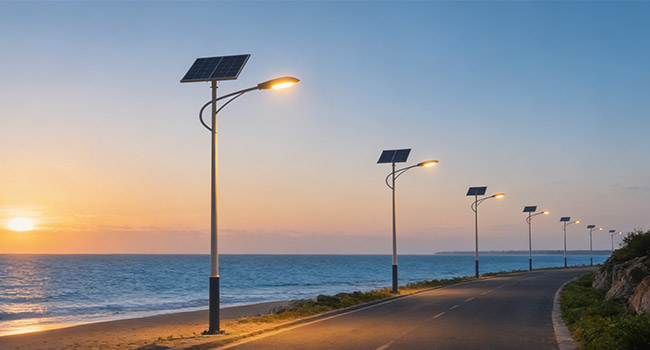
Smart city construction
With the acceleration of smart city construction, the intelligent upgrade of urban infrastructure has become an inevitable trend. As an important part of urban infrastructure, smart city solar street lights not only assume the function of lighting, but also gradually become an important node of the city's intelligent network.
In the smart city system, smart city solar street light can realize the linkage with traffic system, security system and environment monitoring system by integrating intelligent sensors, communication modules and other devices, expanding a variety of application scenarios, such as intelligent traffic guidance, security early warning, air quality monitoring and so on. This intelligent, networked development trend for the solar street light industry enterprises to provide a new direction for technological upgrading, but also greatly expand the market opportunities.
Broad growth space in Asia and Africa
Compared with developed markets in Europe and the United States, the urbanization process in Asia, Africa and other regions is relatively lagging behind, but in recent years has shown an accelerated development trend. These emerging markets have a strong demand for infrastructure construction, street lighting as a basic supporting facilities, the market gap is huge.
Due to the imperfect power grid infrastructure in some countries in Asia and Africa, the laying cost of traditional street lights is high, and the advantages of solar street lights that do not need to rely on the power grid are particularly prominent in such areas, with strong market competitiveness. It is predicted that by 2030, the installation of solar street lights in Asia and Africa will account for more than 40% of the global total, becoming the core engine of the global solar street light industry market growth.
Challenges facing the solar street light industry
The pressure of technological innovation continues to increase
With the rapid development of the solar street light market, the market competition is becoming increasingly fierce, and enterprises are facing continuous pressure of technological innovation. In order to take advantage of the market competition, enterprises need to continuously invest in R&D resources to improve the performance and quality of their products to meet the diversified needs in different scenarios.
At the same time, the rapid development of the Internet of Things, big data, artificial intelligence and other emerging technologies has also put forward higher requirements for enterprises in the solar street light industry. Enterprises need to track the development trend of emerging technologies in a timely manner, to promote the deep integration of emerging technologies and solar street light products, and to realize the intelligent upgrading of products, or else they will be easily eliminated by the market.
Cost control challenges urgently need a breakthrough
Although solar street lights have long-term economic benefits, the higher initial investment cost is still an important factor restricting their large-scale popularization. Market research data show that the initial investment cost of solar street lights is about 30% higher than that of traditional street lights, and this cost gap makes some purchasers with limited budgets shy away.How to ensure product quality under the premise of technical optimization, large-scale production, supply chain integration and other ways to reduce the initial investment cost, balancing the cost and market penetration of the relationship between the current solar street light industry needs to break through the core challenges.
Green energy transformation and smart city construction bring multiple opportunities for solar street lights. Despite the technical and cost challenges, the industry as a whole is looking up. Enterprises need to focus on technological innovation and cost optimization, grasp the emerging market dividends, and promote the high-quality development of green energy street light industry.
related
-
 Off-Grid Road Safety: The Cost-Benefit Analysis of Solar Road Studs in Provincial ProjectsJun. 24, 2026
 -
 The Ultimate Checklist for Inspecting Road Studs Before Installation in Infrastructure ProjectsJun. 04, 2026
 -
 All-in-One vs. Split Solar Street Lights: Which is Better for the Philippine Climate?May. 26, 2026