Reduce lighting pollution with street light design
Jan 04, 2026
When the city night is lit up by bright lights, behind the convenience and prosperity, light pollution is quietly becoming a threat to the ecological environment and human health of the invisible killer. Excessive and inappropriate artificial lighting not only deprives people of the right to look up at the starry sky, but also has a deep impact on biological rhythms and ecological balance.
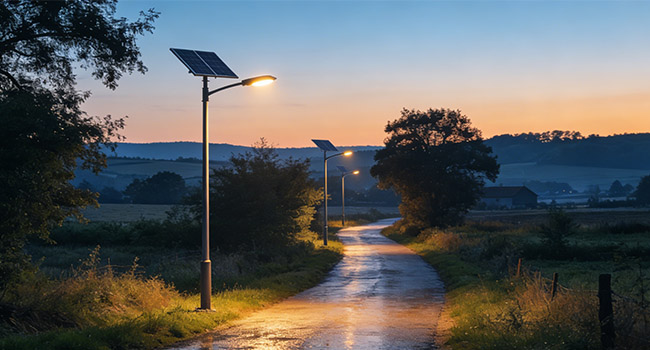
As the core component of urban public lighting, the rationality of its design directly determines the control effect of light pollution. In this paper, we will start from the definition and harm of light pollution, systematically dismantle the core strategy of reducing light pollution through scientific street light design, and provide both professional and operable reference paths for urban lighting upgrading.
Light pollution
What is light pollution?
Light pollution refers to the phenomenon that the light produced by artificial lighting exceeds the actual demand, which in turn negatively affects the ecological environment, human health and quality of life. Unlike air and water pollution, light pollution is invisible and diffuse, and its harm is often overlooked.
The main sources of urban light pollution
Among the various types of light pollution sources in the city, street lights occupy an important proportion. Traditional street lamps are generally scattered light, irradiation range out of control and other issues, a large number of light is not effectively utilized in the road lighting, but into the sky, residential areas, becoming one of the main contributors to light pollution.
In addition, commercial advertising lights, architectural landscape lights, etc. will also exacerbate light pollution, but street lights as the widest coverage, the longest duration of public lighting facilities, its optimization and upgrading of light pollution control has a key role.
The grim status of global light pollution
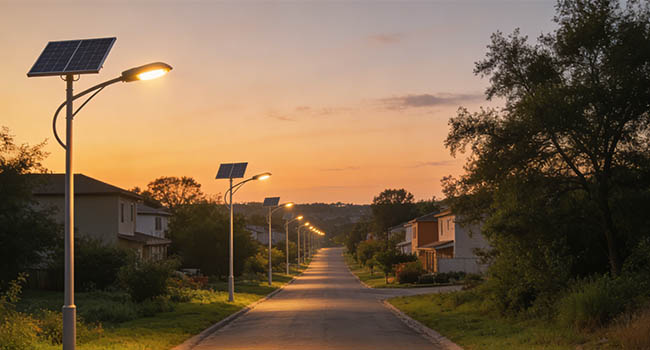
At present, light pollution has become a global environmental problem. According to relevant statistics, about 80% of the world's population lives within the scope of light pollution, North America, Europe and other developed areas of urban light pollution intensity is particularly prominent. With the acceleration of urbanization, most large and medium-sized cities are facing the trend of increasing light pollution, and the brightness of the sky continues to rise at night, which not only affects astronomical observation, but also poses a potential threat to the ecosystem and human health.
The far-reaching hazards of light pollution
Direct and potential threats to human health
Artificial light at night directly interferes with the 24-hour circadian rhythm of human beings, and by inhibiting the secretion of melatonin by the pineal gland of the brain, it triggers sleep disorders such as difficulty in falling asleep and shallow sleep. Insufficient melatonin secretion also leads to short-term health problems such as fatigue, lack of concentration, headaches, anxiety, etc. Long-term exposure may increase the risk of breast cancer, prostate cancer and other cancers due to lower melatonin levels.
In addition, the 400-500 nm blue light emitted by LED lights, which are widely used in street lighting, has a significant inhibitory effect on melatonin secretion, and is more common in the population due to its wide range of exposure and long duration.
Destructive effects on the ecological environment
Light pollution can completely disrupt the logic of natural animal behavior, interfere with the routes of migratory animals that rely on moonlight and starlight for navigation, change their sleep and wake-up cycles, and affect key behaviors such as foraging and reproduction. Light-sensitive species will face direct threats to their survival, such as sea turtle hatchling guided to land by street lights, migratory birds that crash into illuminated buildings and die, and a large number of insects that are attracted to light die due to excessive energy consumption or predation by natural enemies. Light pollution also interferes with plant photosynthesis and flowering and fruiting cycles, further aggravating ecosystem disruption.
Recommendation for reducing lighting pollution with street light design
The core principle of reducing light pollution from street lights is to realize “precise lighting” - - The core principle of reducing light pollution with street light design is to realize “Precision Lighting” - to project light efficiently and directionally to the areas that need to be illuminated, and to control the irradiation intensity and spectrum, so as to avoid wasting and spreading of light. This can be achieved through the following five design strategies.
Optimize the installation angle
One of the most important manifestations of street light pollution is “sky glow”, i.e. light is directed to the sky area above the horizon. Therefore, the primary requirement of street light design is to avoid upward scattering of light and to ensure that the light is concentrated in the horizontal and below road surface area.
Specific can be realized through three measures: First, for street lamps equipped with light shield or anti-glare glass, blocking the light upward and backward scattering, the light constraints in the preset lighting range. The second is to reasonably select the installation location, such as street lamps installed in the middle of the road, optimize the horizontal distribution of light, enhance the uniformity of road lighting, reduce the uneven distribution of light caused by local over-brightness and scattering. Third, strict control of the installation tilt angle, prohibit the use of 0-15 ° tilt angle, such an angle is likely to lead to light escape to the sky, exacerbating light pollution.
Enhance light utilization
Quality street light design needs to ensure that the light is only projected onto the road surface, sidewalks and other areas that need to be illuminated, and not irradiate irrelevant areas such as green belts and residential windows, avoiding wasted light and environmental interference. Light utilization is the core evaluation index, refers to the proportion of light projected to the useful area of the total emitted light, conventional road lighting is recommended to control it above 75%.
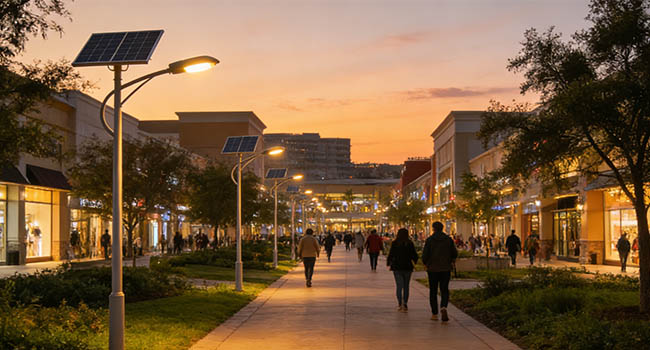
The key to achieve this goal is to optimize the street light distribution design, for example, by improving the structure of the reflector, the use of accurate lens refraction, etc., so that the light forms a uniform rectangular spot, accurate coverage of the road surface area, to reduce light scattering.
Controlling lighting intensity
There are differences in street lighting requirements in different areas, and excessive lighting wastes energy and exacerbates light pollution. The design needs to strictly follow the EU and other relevant road lighting standards, and specify the minimum lighting requirements for different scenes such as main roads, secondary roads, sidewalks, and roads in residential areas.
Under the premise of meeting the standards, through the lighting simulation tool to calculate the number of lamps and lanterns required and power, using the “minimum configuration” to achieve “adequate lighting”, for example, trunk roads due to high traffic flow, fast speeds need higher lighting intensity, residential roads only need to meet the safety of pedestrian Passage can be. At the same time, it is necessary to control the actual lighting intensity within the range of 100%-120% of the minimum standard, taking into account the lighting effect and pollution prevention needs.
Reduce the use of cold light
Spectral characteristics of street lights directly affect the degree of light pollution, the core correlation factor is the color temperature, the blue light content of light of different color temperatures and the degree of interference with biological rhythms varies significantly.
Warm light can take into account the demand for road lighting and reduce blue light interference, while amber light has the lowest blue light content, which is suitable for ecologically sensitive areas, suburban roads and other scenarios. In addition, some countries have introduced control policies, such as the Czech Republic, which requires that the percentage of light radiation below 500nm be less than 10%, and Chile, which is even stricter, and can provide compliance references for the spectral design of street lights.
Application of lighting control system
With the popularization of solid state lighting technology, intelligent lighting control has become an important means of street light pollution control. Its core value is to minimize ineffective light emission without affecting traffic safety by adjusting the lighting intensity on demand, and at the same time realizing energy saving and consumption reduction. Currently the mainstream intelligent control program is mainly divided into the following three categories:
Timer dimming
No additional external controller, only in the LED driver power supply preset dimming curve, the street light can be automatically adjusted according to the use of different hours of the night demand for output power. For example, after 0:00 a.m., the road traffic and pedestrian flow is greatly reduced, the system automatically reduces the brightness of the street light, effectively reducing the intensity of the sky glow and reducing light pollution.
Constant lumen output
Customizes the exclusive dimming scheme through TM21 curve for the characteristic of LED light source luminous flux decaying with the usage time. During the use of street lights, the driver power supply will automatically adjust the output current to compensate for the luminous flux decay, avoiding the initial over-illumination caused by the selection of high-power lamps to cope with the later decay, and reducing light pollution from the source.
Motion sensor
Detects the activity status of people and vehicles in the street light coverage area in real time through the sensor. When detecting people or vehicles passing by, the street light immediately switches to 100% brightness output to ensure the safety of passage; when there is no active target in the area, the street light automatically dims to a low-brightness or off state. This solution is especially suitable for sidewalks, residential paths and other traffic fluctuations in the scene, energy saving and pollution reduction effect is remarkable.
By optimizing the installation angle of street lights, improving light utilization, precisely controlling lighting intensity, preferring spectral types and applying intelligent control systems, “on-demand lighting” can be effectively realized to curb the spread of light pollution at source. In the future, urban lighting upgrading needs to be eco-friendly as the core orientation, integrating scientific street light design into urban planning, safeguarding traffic safety while guarding the clear night sky and ecological balance, and promoting the symbiosis and co-prosperity between urban nightscape and sustainable development.
related
-
 Off-Grid Road Safety: The Cost-Benefit Analysis of Solar Road Studs in Provincial ProjectsJun. 24, 2026
 -
 The Ultimate Checklist for Inspecting Road Studs Before Installation in Infrastructure ProjectsJun. 04, 2026
 -
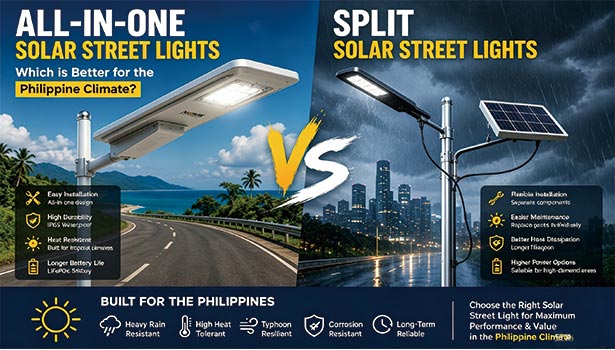 All-in-One vs. Split Solar Street Lights: Which is Better for the Philippine Climate?May. 26, 2026