Solar-Powered Road Studs vs. Traditional Road Studs: A Cost Comparison
Nov 28, 2025
As critical infrastructure guiding vehicle trajectories and reducing nighttime accidents, road studs now face a choice between solar-powered and traditional reflective options. For municipal engineering and road construction enterprises, cost investment remains the core consideration in decision-making. This article analyzes the cost differences between the two options based on the latest 2025 industry data, examining three core dimensions: initial procurement, installation and construction, and long-term maintenance. It also incorporates policy support and added-value analysis to provide professional guidance for project selection.
Initial Procurement Cost
The initial procurement cost is the most obvious difference between solar-powered and traditional road studs, directly impacting the project's preliminary budget allocation. Traditional studs, characterized by simple structures and mature technology, generally have lower unit prices. Solar-powered studs, integrating multiple intelligent components, require relatively higher initial investment.
Traditional Stud Procurement Costs
Traditional studs are predominantly reflective, made from materials like plastic, fiberglass, or cast aluminum, spanning various price ranges. Overall procurement barriers are low. Standard plastic reflective studs offer exceptionally low unit prices and outstanding cost-effectiveness, making them suitable for temporary roads or secondary sections. Cast aluminum reflective studs offer moderate pricing with robust durability, suitable for regular roads with higher traffic volumes.
Premium reflective film studs command slightly higher prices but deliver superior reflectivity, making them ideal for sections requiring enhanced visibility. Leveraging their cost advantages, various traditional stud types remain common choices for short-term projects with limited budgets.
Solar-Powered Road Stud Procurement Costs
Solar-powered road studs integrate multiple core components—solar panels, LED light sources, energy storage batteries, and smart controllers—resulting in significantly higher technical complexity and consequently higher initial procurement costs compared to traditional studs. However, with domestic self-sufficiency in photovoltaic components exceeding 90%, the industry's economies of scale have become pronounced. Between 2023 and 2025, the unit price of standard solar-powered road studs is projected to decrease by 15%.
Installation and Construction Costs
Installation and construction costs are often overlooked yet significantly impact total project expenses. Traditional markers carry hidden expenses, whereas solar markers leverage their cable-free design to offer greater competitiveness in construction efficiency and cost control.
Traditional Stud Installation
While seemingly straightforward, installing traditional reflective studs involves multiple hidden costs. Cumulatively, overall construction expenses remain substantial. Additional equipment rental fees arise, and the high precision required for positioning necessitates repeated manual corrections for alignment errors. This significantly extends construction time and increases labor costs. Certain specialized traditional stud models also demand additional piping installation, further complicating the process and elevating overall expenses.
Solar Road Stud Installation
Solar road studs offer core advantages of pipeline-free construction and plug-and-play functionality, substantially reducing installation costs and operational complexity. Installation requires only four sequential steps: drilling and positioning, base fixation, stud insertion, and system activation. Using specialized hollow drill bits, drilling depth is controlled at approximately 8cm. After injecting epoxy resin anchorage agent, a 3-minute curing period secures the stud, streamlining the process. Bulk installation of solar road studs incurs only a 5% higher unit construction cost than traditional studs, while boosting construction efficiency by a substantial 30%.
Long-Term Maintenance Costs
Long-term maintenance costs are the core factor determining the overall cost-effectiveness of both options. The long-term operational nature of road infrastructure means that lifespan and maintenance cycles directly impact total life cycle costs, where solar road studs hold a significant advantage.
Traditional Road Stud Maintenance
Traditional reflective road studs suffer from dual impacts of material wear and environmental corrosion, with an extremely short lifespan of just 1-2 years and maintenance cycles as short as 6 months. Regular personnel must be organized to replace worn glass components and aged reflective parts. Frequent replacements not only incur substantial material procurement costs but also require closing lanes for construction during each maintenance session. This indirectly increases traffic diversion expenses and additional labor costs for nighttime construction, leading to persistently high overall maintenance costs over the long term.
Solar Road Stud Maintenance
Solar road studs offer absolute advantages in service life, energy expenditure, and maintenance frequency, delivering greater cost-effectiveness over extended use. Taking the market-leading NOKIN solar road stud as an example, its use of enhanced high-efficiency solar panels and LED technology achieves a service life of up to 5 years. Energy consumption utilizes monocrystalline silicon solar panels with a photovoltaic conversion efficiency of 23.5%.
Solar road studs require only 6 hours of daily sunlight to fully charge, achieving zero energy costs with no electricity bills year-round. Installing solar road studs per kilometer of road reduces annual carbon emissions by approximately 2 tons—equivalent to planting 100 trees—aligning with green infrastructure development goals. Additionally, they qualify for local environmental project subsidies, further lowering actual investment costs.
Total Life Cycle Cost Comparison Table (10-Year Cycle)
|
Road Stud Type |
Service Life (Years) |
Maintenance Cycle (Months) |
Annual Overall Cost Level |
Long-Term Cost Advantage |
|
Traditional Reflective Road Stud |
1–2 |
6 |
High |
None |
|
Standard Solar Road Stud |
5 |
12 |
Low |
Significant |
|
High-End Smart Solar Road Stud |
5 |
60 |
Medium–Low |
Strong |
The Hidden Advantages of Solar Road Studs Further Amplified
Beyond direct economic costs, the intangible value derived from policy support and additional functionalities further tilts the cost comparison in favor of solar road studs. Their compatibility with smart transportation development holds greater long-term value.
Solar Road Studs Reap Multiple Benefits
National policy direction provides robust support for the promotion and application of solar road studs, effectively reducing actual project investment costs. As a key product integrating smart transportation with green energy, solar road studs qualify for inclusion in green infrastructure projects. This enables them to benefit from tax reduction policies and apply for special fund subsidies, further lowering project procurement and construction costs.
Solar Road Studs Meet Smart Transportation Demands
Solar road studs significantly surpass traditional studs in intelligence, substantially enhancing driving safety while reducing hidden road operation costs. Their LED light source is visible up to 300 meters—over three times farther than conventional reflective studs. During low-visibility conditions like rain or fog, they automatically increase flashing frequency. Field tests on actual road sections demonstrate a 55% reduction in severe weather accident rates.
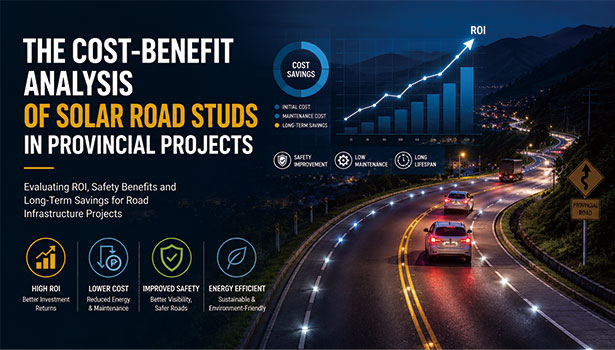
When comparing the costs of solar road studs versus traditional ones, the analysis should not be limited to initial investment. Traditional studs offer lower single-purchase costs, making them suitable for short-term emergency needs or small-scale road projects with limited budgets. While solar road studs require higher upfront investment, their advantages—including extended lifespan, low maintenance, zero energy consumption, and policy incentives—make them far more cost-effective overall for long-term applications such as highways, urban main roads, and remote sections.
related
-
 Off-Grid Road Safety: The Cost-Benefit Analysis of Solar Road Studs in Provincial ProjectsJun. 24, 2026
 -
 The Ultimate Checklist for Inspecting Road Studs Before Installation in Infrastructure ProjectsJun. 04, 2026
 -
 All-in-One vs. Split Solar Street Lights: Which is Better for the Philippine Climate?May. 26, 2026