Solar Street Lights: A Practical and Eco-Friendly Road Lighting Solution
Feb 24, 2026
In today's era where green and low-carbon practices dominate, solar street lights have gained widespread adoption across urban and rural roads, scenic areas, and parks due to their energy efficiency, reliability, and ease of installation. They represent a superior alternative to conventional mains-powered street lighting. Utilising solar power generation, energy storage, and automated illumination without requiring connection to the grid, they reduce long-term operational costs while contributing to energy conservation and emissions reduction. This makes them ideal for sustained use in various outdoor lighting projects. This article provides a comprehensive overview of solar street lights, covering their advantages, installation and maintenance, application scenarios, and development trends.

Core Advantages of Solar Street Lights
Energy Efficiency and Low Carbon Footprint
Powered by sunlight, solar street lights charge during daylight hours and illuminate at night without consuming mains electricity, delivering substantial savings on electricity bills. Over extended usage, they significantly reduce energy consumption and carbon emissions compared to conventional street lights, aligning with green and low-carbon development requirements. For large-scale lighting applications in rural areas, scenic spots, and industrial parks, the long-term economic benefits are pronounced. A single installation yields years of operation, offering far superior overall value for money than conventional lighting products.
Simple Installation
Available in integrated or modular designs, solar street lights eliminate complex wiring, trenching, and electrical distribution works. Installation is swift with minimal labour costs. They are particularly suited for remote areas, mountainous regions, and rural roads beyond grid coverage, as well as rapid-deployment projects like urban refurbishments, temporary lighting schemes, and new park developments. Installation requirements are flexible with low site constraints; stable operation is assured wherever sunlight is unobstructed, greatly enhancing project feasibility and applicability.
Stable and Durable
Premium solar street lights incorporate high-efficiency photovoltaic panels, long-life batteries, and high-brightness LED light sources, delivering an overall lifespan spanning several years. The equipment features robust waterproofing, dust proofing, and lightning protection, ensuring reliable operation in challenging conditions including rainfall, extreme temperatures, and sandstorms. Paired with intelligent controllers, they provide overcharge, over-discharge, and overload protection, enhancing system safety and stability while reducing faults. This delivers more dependable and hassle-free outdoor lighting.
Intelligent Control
Modern solar street lights commonly support light sensing, time scheduling, motion detection, or brightness adjustment functions. They automatically illuminate at dusk and switch off at dawn, eliminating manual operation. Some intelligent models offer remote monitoring and fault alerts, enabling managers to track operational status in real-time and swiftly identify issues. Their high automation significantly reduces routine inspection and maintenance workloads, lowering labour costs and making them particularly suitable for large-scale, dispersed lighting projects.
Key Points for Solar Street Light Installation and Maintenance
Installation Considerations
When installing solar street lights, ensure the photovoltaic panels are correctly oriented and unobstructed to receive sufficient daily sunlight, thereby enhancing charging efficiency. The lamppost foundation must be robust, with embedded components and concrete pouring meeting standards to prevent tilting or swaying during high winds. Wiring must be standardised, with positive and negative terminals correctly connected. Joints should be waterproofed and insulated to prevent short circuits or ageing issues during prolonged use. Conduct a charging test after installation before commencing formal illumination to ensure stable system startup.
Routine Maintenance Methods
Regularly clean obstructions such as dust, fallen leaves, and bird droppings from the photovoltaic panel surface. Typically, quarterly cleaning is sufficient, though frequency may be increased in areas with poor sunlight or high dust levels. Inspect the lamp post, brackets, and screws for looseness, and check wiring for ageing or damage. Tighten or replace components promptly upon discovery of issues. Monitor battery performance; if significant reductions in illumination duration or charging efficiency occur, investigate causes immediately to prevent minor issues escalating and affecting overall functionality.
Troubleshooting Common Issues
Should solar street lights fail to illuminate or exhibit insufficient brightness, prioritise inspecting whether the photovoltaic panels are obstructed or if wiring contacts are faulty. Subsequently, examine battery charge levels and assess potential light source damage. Reduced illumination duration typically stems from battery degradation or inadequate charging. Initially, improve lighting conditions; replace batteries if necessary. During prolonged overcast periods with insufficient runtime, adjust illumination duration or power output appropriately. Opt for higher-capacity battery configurations to enhance resilience during inclement weather.
Primary Application Scenarios for Solar Street Lights
Rural Road Lighting
Rural roads, characterised by limited grid access, lengthy wiring, and high electricity costs, are ideally suited for solar street lighting. Requiring no mains connection, these lights offer swift installation and minimal maintenance, significantly enhancing night-time safety for villagers while improving the overall village environment. Flexible deployment across main roads, alleyways, cultural squares, and village entrances fulfils illumination needs without imposing long-term electricity costs on the community, making them a common foundational infrastructure in rural revitalisation.
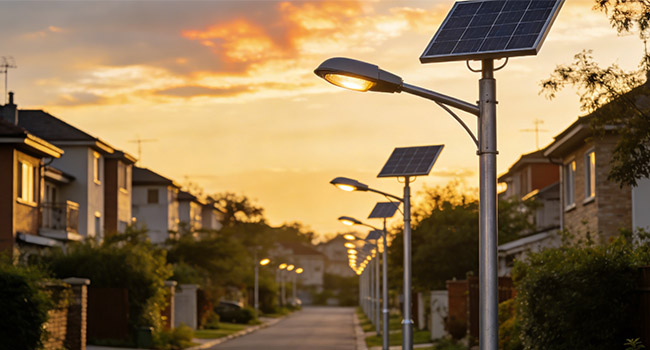
Urban Municipal and Park Lighting
In urban side streets, residential roads, parks, squares, and car parks, solar street lights reduce grid load and lower municipal operational costs. Many cities integrate them with landscape design, enhancing aesthetics while ensuring illumination to create green, low-carbon neighbourhoods. Some smart solar lights incorporate surveillance, public address, and alarm functions, elevating urban management standards and supporting smart city and green city development.
Scenic Area and Park Lighting
Locations such as scenic spots, industrial parks, factory premises, campuses, and wellness retreats demand high lighting stability and aesthetic appeal. Solar street lights can be customised to match environmental styles, achieving harmonious integration of illumination and landscape. Their deployment in factory and park areas significantly reduces night-time lighting expenditure while enhancing night-time security management. For attractions, trails, and mountainous parks distant from the grid, solar street lights represent an ideal lighting solution.
Illumination for Remote and Off-Grid Areas
Traditional street lights struggle to reach mountainous regions, islands, remote construction sites, pastures, and outposts where grid access is impractical. Solar street lights, with their independent power supply and freedom from wiring constraints, swiftly resolve basic lighting needs, ensuring safe movement and activities. Their straightforward installation and flexible deployment enable rapid illumination, providing stable and reliable night-time lighting for remote areas and improving living and working conditions.
Industry Trends for Solar Street Lighting
Continuous Technological Advancement
Future solar street lights will evolve towards higher efficiency, extended lifespan, and enhanced intelligence. Photovoltaic conversion rates will steadily increase, while batteries will feature greater energy density and longer cycle lifespans, resulting in more stable and reliable systems. Light source technology is also advancing, delivering higher brightness, slower light decay, and lower energy consumption. This enables stronger illumination at equivalent power levels, further improving user experience and cost-effectiveness.
Smart Integration and Multifunctionality
Smart integration represents a key industry trend. Solar street lights will increasingly incorporate IoT connectivity, sensors, and remote management platforms to enable automatic brightness adjustment, data monitoring, fault reporting, and centralised administration. Certain products will integrate surveillance cameras, emergency call systems, environmental monitoring, and charging points, achieving ‘multifunctional utility poles’. This enhances equipment utilisation and project value, meeting the requirements for smart communities, smart campuses, and smart city development.
Market Demand Continues To Expand
Driven by advancing environmental policies, accelerated rural revitalisation, and growing overseas infrastructure demand, the solar street lighting market will continue to expand. Both domestic and international markets exhibit robust demand for low-cost, green energy-saving lighting solutions, with particularly notable growth in areas such as off-grid regions, old road renovations, and new development zones. Mature supply chains and widespread technology adoption have made product pricing more reasonable, further accelerating adoption rates. Future application scenarios will become increasingly diverse.
Service Systems Become More Comprehensive
Industry competition will shift from purely price-based to encompassing product quality, solution design, installation guidance, and post-installation maintenance. Specialist manufacturers will offer more complete solutions, recommending suitable solar street light configurations for different scenarios to enhance project success rates. Simultaneously, faster after-sales response and more convenient maintenance will give users peace of mind in both purchase and usage, driving the entire industry towards standardisation and higher quality.
Solar street lights, with their multiple advantages including energy efficiency, environmental friendliness, ease of installation, and low maintenance requirements, have become the mainstream choice in outdoor lighting. Whether for rural road illumination, urban municipal infrastructure, or scenic area lighting, suitable application solutions can be found. As technology continues to mature and market demand expands, solar street lights will play an increasingly significant role in more scenarios, continuously contributing value to green, low-carbon lighting and infrastructure development.
related
-
Off-Grid Road Safety: The Cost-Benefit Analysis of Solar Road Studs in Provincial ProjectsJun. 24, 2026
-
 The Ultimate Checklist for Inspecting Road Studs Before Installation in Infrastructure ProjectsJun. 04, 2026
 -
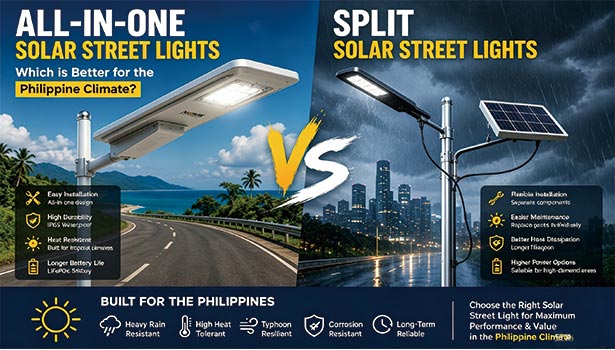 All-in-One vs. Split Solar Street Lights: Which is Better for the Philippine Climate?May. 26, 2026