How to Evaluate the Brightness and Luminous Efficiency of LED Solar Street Lights?
Feb 22, 2026
In outdoor lighting project procurement and selection, the brightness and luminous efficiency of LED solar street lights are core evaluation metrics, yet they are also the most commonly misunderstood aspects. Many buyers directly equate wattage with actual brightness, overlooking the importance of luminous efficiency. This often leads to poor lighting effects, high energy consumption, and insufficient runtime. Drawing on industry standards and engineering practice, this article provides a practical method for evaluating the brightness and luminous efficacy of LED solar street lights. This approach facilitates precise selection, helping achieve procurement goals of adequate brightness, excellent luminous efficacy, and reasonable costs.
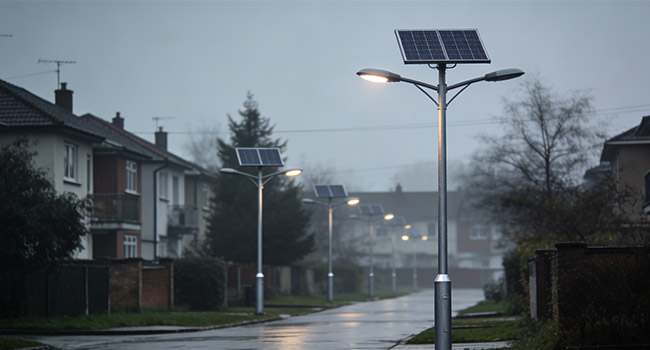
Brightness ≠ Luminous Efficacy
The foundation of evaluation lies in distinguishing brightness from luminous efficacy. These represent the luminaire's light output capability and energy utilization efficiency, respectively, and require different professional metrics for assessment—they must not be confused. Only by thoroughly understanding these fundamental metrics can one make accurate judgments during subsequent solar street light selection, avoiding misguidance from non-standard parameter claims.
Core Metrics for Measuring Brightness
Brightness determines the actual illumination effect of solar street lights, directly impacting safety and visibility in roadways, campuses, and similar settings. It is primarily assessed through lumen, lux, illuminance uniformity, and light color quality. Lumen represent the total light output of a fixture, indicating its luminous intensity. Lux, however, measures the actual brightness reaching the ground surface, providing a more accurate reflection of real-world performance.
Illuminance uniformity ensures smooth, even lighting across road surfaces, preventing localized over-brightness or shadows. Meanwhile, color temperature and color rendering index (CRI) directly impact nighttime visual comfort and object recognition clarity, requiring tailored light color parameters for different scenarios.
Core Metrics for Evaluating Luminous Efficiency
Luminous efficacy determines the energy utilization rate of LED solar street lights, directly impacting endurance, battery lifespan, and operating costs. Key factors include luminous efficacy (lm/W), system efficiency, and lumen maintenance rate. Higher efficacy means more light output per unit of energy, resulting in greater energy savings.
System efficiency reflects the overall energy conversion level of the entire system, influenced by components like controllers, batteries, and solar panels. A high-quality system significantly reduces energy loss. Lumen maintenance rate reflects the luminaire's brightness stability over extended use, serving as a crucial indicator for assessing product lifespan and durability.
Brightness and Luminous Efficiency Core Evaluation Metrics
Brightness and luminous efficiency metrics adhere to clear industry reference standards. Mastering these standards enables rapid assessment of solar street light compliance and provides a unified benchmark for comparing products across manufacturers. These standards, derived from extensive engineering practice, effectively ensure lighting quality and operational stability.
Brightness-Related Metrics and Industry Standards
Luminous flux must be matched to the area and lighting requirements of the application. A key requirement is that third-party measured values must not fall below 90% of the manufacturer's rated value, preventing inflated specifications. Lux levels vary significantly across different scenarios: urban roads typically require 20–50 lux, while residential areas and sidewalks generally require 5–20 lux. On-site measurements must be the definitive reference.
Illuminance uniformity must not fall below 0.4 for roadways and 0.3 for residential areas to ensure lighting comfort and safety. Roadways commonly use cool white light at 5000K–6500K, while residential areas prefer warm white light at 3000K–4000K. The color rendering index (CRI) should not be lower than 60 for standard scenarios, with 70 recommended for commercial and high-traffic zones.
Light Efficiency Metrics and Industry Standards
Light efficiency directly determines energy savings and operational endurance. Standard LED solar street lights achieve at least 100 lm/W, while mid-to-high-end products reach 120 lm/W or higher. Models designed for urban main roads can attain 130–150 lm/W. System efficiency is determined by core components. MPPT controllers demonstrate significantly higher efficiency than PWM controllers. High-quality complete systems can achieve over 90% efficiency, maximizing solar energy utilization.The industry minimum standard for lumen maintenance (L70) is no less than 10,000 hours. High-quality products can achieve over 30,000 hours while controlling annual light decay within 5%, ensuring no noticeable dimming during long-term use.
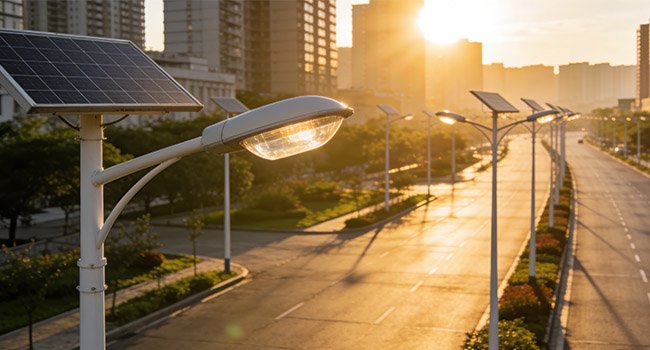
Evaluation Process for Brightness and Luminous Efficiency of LED Solar Street Lights
Step 1: Verify Manufacturer Specifications
Do not rely solely on the manufacturer's advertised parameter list. Always request third-party authoritative photometric test reports and LM-80 lumen depreciation test reports. Focus on verifying key metrics such as lumen, luminous efficacy, color temperature, and L70. Confirm that data complies with international and domestic industry standards like CIE and IES. Eliminate factory self-testing or falsified data to ensure the authenticity and reliability of solar street light parameters from the source.
Step 2: Calculate Required Core Parameters Based on Scenario
Determine the total lumen required by multiplying the actual illuminated area by the target illuminance level. The standard formula is: Total Lumen = Illuminated Area × Target Illuminance. For example, a 300㎡ urban road with a target illuminance of 50lx requires a total light output of 15,000lm. Combining this with a luminous efficacy of 120lm/W, a solar street light of approximately 125W is sufficient to meet the demand. This avoids the waste of costs and energy consumption caused by blindly selecting high-power products.
Step 3: On-site Testing to Verify Actual Illumination and Energy Efficiency
Upon delivery, equipment must undergo field testing in the actual installation environment—a critical step to assess whether the solar street light's brightness and luminous efficacy meet standards. Measure illuminance at the center, edges, and corners of the illuminated area using an illuminance meter to determine compliance with illuminance and uniformity requirements. Simultaneously, verify the rationality of the optical distribution design, prioritizing batwing distribution for road lighting. Additionally, test the runtime under full charge conditions and simulate 3–5 consecutive rainy days to validate system efficiency and battery compatibility.
Step 4: Assess Long-Term Reliability
The brightness and luminous efficacy of LED solar street lights degrade over time, with long-term reliability directly impacting maintenance costs and service life. Prioritize reviewing manufacturer-provided aging test data to confirm L70 lumen maintenance meets industry standards. Simultaneously inspect the luminaire's thermal management structure, including heat sinks, housing materials, and design. Effective heat dissipation significantly mitigates lumen depreciation, ensuring stable illumination performance over extended service life.
Brightness and Luminous Efficiency Standards for Different Applications
The brightness and luminous efficacy of LED solar street lights must be selected based on the specific application scenario, as different environments have distinct standards and cannot be addressed with uniform parameters. Reasonable scenario-based configuration ensures lighting safety while enhancing comfort and economic efficiency, serving as a key principle for project selection.
Urban Roads / Highways
Urban roads and highways demand the highest standards for lighting clarity, safety, and uniformity. Visual blind spots must be eliminated during vehicle operation, and glare control must be appropriately managed. Illuminance is typically set at 20–50 lux, with uniformity not less than 0.4. A color temperature of 5000K–6500K cool white light is used to enhance nighttime visual clarity. Light efficiency should prioritize high-performance products rated at 130–150 lm/W, paired with MPPT controllers and staggered installation, suitable for roadways wider than 12 meters.
Residential Communities / Sidewalks
Residential communities and sidewalks prioritize pedestrian lighting, emphasizing soft, glare-free illumination with high comfort while balancing energy efficiency and endurance. Illuminance is generally controlled at 5–20 lux, with uniformity not less than 0.3. Warm white light at 3000K–4000K creates a tranquil and comfortable community environment. Luminous efficacy of 120–140 lm/W is sufficient, with support for intelligent dimming functionality. This automatically reduces brightness during low-traffic nighttime hours, extending battery life while minimizing light pollution.
Parking Lots / Commercial Complexes
Parking lots and commercial complexes require balanced illumination for both vehicular traffic and pedestrian activity, demanding high standards for coverage, uniformity, and object recognition. Illuminance should be set at 10–30 lux, with uniformity no less than 0.35 and a Color Rendering Index (Ra) of at least 70 to ensure clear identification of vehicles, signage, and people. Luminous efficacy must not fall below 120 lm/W. Wide-angle distribution design minimizes dark spots, adapting to complex environments with multiple corners and parking spaces to enhance overall safety.
Common Misconceptions When Evaluating Solar Street Light Brightness and Luminous Efficiency
In actual solar street light procurement, many fall into pitfalls due to misunderstandings, leading to subpar project outcomes and cost overruns. The following three misconceptions are prevalent in the industry. Understanding them can effectively prevent unnecessary losses and enable more professional and rational selection.
Misconception 1: High Wattage = High Brightness
Wattage indicates power consumption, not direct brightness. Two 80W fixtures can differ by over 50% in actual lumen output due to variations in LED chip quality, luminous efficacy, and optical design. Low-quality street lights may have high wattage but low luminous efficacy, resulting in poor illumination.
Misconception 2: Full Brightness All Night = Superior Performance
Many believe that keeping lights at maximum brightness throughout the night indicates high quality and strong performance. In reality, this mode consumes significant power, drastically reducing battery life during cloudy or rainy days while accelerating battery degradation and shortening overall lifespan. High-quality LED solar street lights feature intelligent dimming. They maintain 100% brightness during evening peak hours for pedestrians and vehicles, then automatically reduce to an appropriate level during the late night. This ensures basic illumination while saving energy, reducing consumption, and extending overall lifespan.
Misconception 3: Whiter Light = Higher Efficiency
Many mistakenly believe that higher color temperature (whiter light) equates to better lighting efficiency. This is incorrect. Color temperature has no direct correlation with luminous efficacy. High-quality LED chips can achieve excellent luminous efficacy even within the warm white spectrum. Excessively high color temperatures produce intense glare, compromising visual comfort and potentially causing light pollution in surrounding areas. Conversely, overly low color temperatures may result in insufficient visual clarity. The correct approach is to select an appropriate color temperature based on the specific application, rather than blindly pursuing whiter or brighter light.
When evaluating the brightness and luminous efficacy of LED solar street lights, it is crucial to move beyond the wattage misconception. Focus instead on professional metrics such as lumens, lux, and luminous efficacy. Combine these with the specific requirements of the application, following a four-step selection process: parameter verification, scene calculation, on-site testing, and long-term reliability assessment. Brightness determines the lighting effect, while luminous efficacy determines operational efficiency. Balancing both ensures the selection of stable, energy-efficient, and durable solar street lights. Adhering to this scientific evaluation system effectively avoids common pitfalls, delivering reliable, economical, and long-lasting lighting solutions for outdoor illumination projects.
related
-
Off-Grid Road Safety: The Cost-Benefit Analysis of Solar Road Studs in Provincial ProjectsJun. 24, 2026
-
 The Ultimate Checklist for Inspecting Road Studs Before Installation in Infrastructure ProjectsJun. 04, 2026
 -
 All-in-One vs. Split Solar Street Lights: Which is Better for the Philippine Climate?May. 26, 2026