Types of Solar Street Lights: Which One Fits Your Needs?
Dec 02, 2025
Driven by global “dual carbon” goals, solar street lights continue to expand their market share due to their energy-saving and eco-friendly advantages. Behind this rapid growth lies a surge in demand for green lighting solutions. Solar street lights not only operate independently of the grid, significantly reducing long-term electricity costs, but also adapt to diverse settings like parks, rural roads, and municipal squares.
However, with a wide array of products available, selecting the right type is crucial to unlocking their full potential. This article begins with the technological evolution of solar street lights, providing a detailed analysis of the characteristics, parameters, and suitable applications for three core types. It also offers practical selection guidelines to help you find the product that best matches your requirements.
The Evolution of Solar Street Light Technology
Modular Design Pioneered by Split-Type Street Lights
Early solar street lights predominantly featured split-type designs, separating components like solar panels, batteries, and LED fixtures. While this design addressed the initial demand for “solar lighting,” it also presented significant limitations. At the time, solar panels primarily used polycrystalline silicon material, achieving only 12%-15% photovoltaic conversion efficiency. Paired with bulky, heavy lead-acid batteries, their cycle life lasted only about 3 years.
Additionally, the scattered components required extensive wiring, increasing installation labor and the risk of aging-related circuit failures. Exposed batteries and wiring were vulnerable to outdoor environmental corrosion, leading to high maintenance frequency. This type was primarily used in large-scale projects with extremely high customization requirements.
Market Demand Drives Integrated Street Lights
As application scenarios expanded, market demands shifted toward simpler installation, aesthetically pleasing designs, and cost control. This gave rise to semi-integrated and fully integrated types, marking a critical leap from “functional sufficiency” to “experience optimization.” Material-wise, monocrystalline silicon panels replaced polycrystalline silicon, boosting photovoltaic conversion efficiency to 18%-22%. Gel batteries and lithium batteries saw a 40% reduction in volume and 50% weight reduction, laying the foundation for component integration.
Structurally, semi-integrated lights combine batteries with luminaires, reducing outdoor wiring by 50% while lowering line losses and failure risks. Fully integrated designs achieve high component concentration, transforming products from “discrete part assemblies” into “holistic solutions.”
Current Trends: Intelligence and Long Lifespan Dominate
Solar street lights have now entered the “smart era.” Data indicates that 47% of current products feature smart connectivity, enabling human presence detection for dimming and remote monitoring via sensors. Long-life lithium iron phosphate batteries are gradually replacing traditional lead-acid batteries, further extending operational lifespan.
Smart control modules leverage IoT technology to enable remote monitoring of power generation and lighting status, while automatically adjusting output based on ambient light and foot traffic—boosting energy efficiency by over 30%. Lithium iron phosphate batteries offer over 2,000 charge cycles. Paired with Battery Management Systems (BMS), they prevent overcharging and over-discharging. LED luminaires now deliver luminous efficacy from 80lm/W to over 150lm/W, complemented by anti-glare designs that balance illumination with light pollution control.
Analysis of Three Core Solar Street Light Types
Different solar street light types exhibit significant variations in structure, performance, and suitability for specific scenarios. A comprehensive understanding of their characteristics is essential before selection.
Split Solar Street Lights
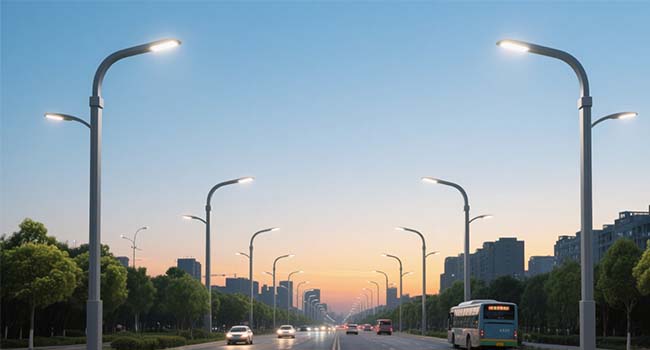
As the first-generation product, split solar street lights remain widely used in large-scale projects due to the flexibility of their modular design. Their structural features include independent components and flexible layout, with solar panels, batteries, and LED fixtures completely separated—akin to a “modular kitchen” where each part can be precisely tailored to the application.
Core technical specifications include solar panels typically made of monocrystalline silicon (higher conversion efficiency) ranging from 80W to 200W, batteries primarily 12V/24V lead-acid or gel batteries, and installation heights between 6 and 12 meters.
Advantages include highly customizable component layouts, convenient battery maintenance, flexible solar panel angle adjustment, and the ability to replace individual components. Disadvantages are complex installation, high initial costs, vulnerability of exposed components to theft, and numerous wiring connection points.
Suitable for large-scale municipal projects (e.g., urban thoroughfares, highway sides) and industrial parks demanding high “maintenance convenience” and “customization” in large-scale installations.
Semi-Integrated (All-in-Two) Solar Street Lights
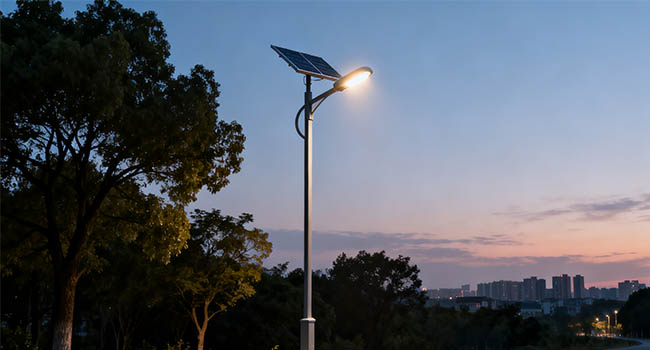
Semi-integrated street lights represent second-generation technology, integrating the battery with the LED luminaire while retaining a separate solar panel to balance flexibility and efficiency. Their structural feature is “light and power integrated + independent panel,” reducing component count without sacrificing lighting flexibility and offering a cleaner appearance.
Technical highlights include integrated LED and battery units, adjustable solar panel angles, optional 12V/24V lithium batteries (3-5 years longer lifespan than lead-acid batteries), and optional light sensors and timers on select models.
Core advantages include higher energy efficiency (15%-20% greater light utilization than split systems), moderate maintenance requirements, and broad adaptability for stable operation in hilly or other areas with variable sunlight.
Suitable applications include highway service areas, urban-rural fringe roads, and small-to-medium industrial parks where “energy efficiency” and “cost balance” are key considerations.
Fully Integrated (All-in-One) Solar Street Lights
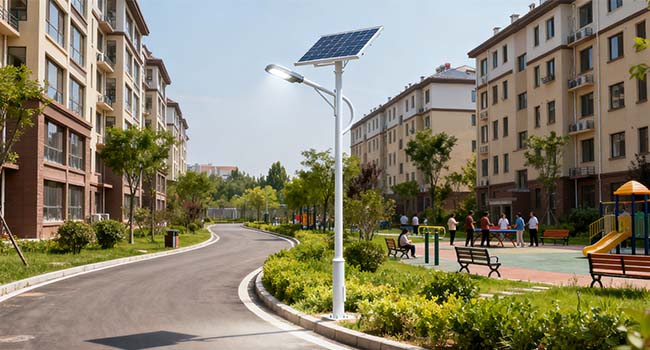
Fully integrated street lights represent the current mainstream product. They combine solar panels, batteries, LED fixtures, and controllers into a single unit mounted atop the light pole. This eliminates complex wiring, enabling plug-and-play installation that significantly streamlines the process.
Core technical specifications include lithium iron phosphate batteries (5-7 year lifespan), support for human motion sensing and remote monitoring, installation heights of 4-8 meters, and IP65 or higher protection ratings to withstand heavy rain and dust.
Key advantages include time-saving installation (60% faster than split-type systems), lower costs (30% reduction in transportation expenses), simplified maintenance, and aesthetically pleasing designs suitable for visually demanding settings.
Ideal for small-to-medium projects like urban streets, parks, residential communities, and scenic routes, these lights particularly excel in low-latitude regions with abundant sunlight.
Four Steps to Find Your Ideal Solar Street Light
Selecting solar street lights requires comprehensive evaluation of installation environments, project needs, and core parameters. Follow these four steps for precise selection:
Assess Installation Environment
Environment forms the foundation of selection, as different scenarios demand distinct lighting solutions. For light conditions:
Low-light areas (e.g., regions with frequent cloud cover or rainfall) prioritize split-type or semi-integrated models. Sun-drenched areas benefit most from fully integrated models for cost-effectiveness.
For geographic scenarios, remote areas without grid access require models with strong standalone operation capabilities. Urban areas prioritize aesthetics and smart features, favoring fully integrated designs. Regarding climate factors, regions with extreme heat/cold should select products equipped with high-temperature/low-temperature lithium batteries (semi-integrated or fully integrated). Areas prone to heavy rainfall or dust should choose products with an IP65 or higher protection rating.
Define Project Requirements
Project scale, budget, and functional needs directly determine the street light type selection. For large-scale projects (e.g., municipal thoroughfares), choose split-type systems to accommodate customization and maintenance requirements. For small-to-medium projects (e.g., residential roads, rural paths), opt for semi-integrated or fully integrated systems to reduce installation complexity and costs.
For budget planning, prioritize fully integrated units when short-term budgets are tight to minimize installation costs. For long-term considerations, select low-maintenance types (semi-integrated or fully integrated) featuring long-life lithium batteries to reduce replacement expenses. Regarding functional requirements, all three basic lighting categories can be chosen based on the environment. If smart features (e.g., remote monitoring, human motion sensing) are needed, prioritize fully integrated or semi-integrated units (most come equipped with smart control systems).
Key Performance Indicators
Critical metrics directly impact luminaire lifespan and operational efficiency. Prioritize battery lifespan, solar conversion efficiency, and protection rating. For battery lifespan, lithium iron phosphate batteries meeting 5-7 year standards are suitable for long-term outdoor use. Inferior lead-acid batteries often fail within 3 years, prone to swelling and leakage. For solar conversion efficiency, monocrystalline silicon panels must achieve 18%-22% efficiency to meet requirements. Low-efficiency polycrystalline silicon panels are prone to power outages during cloudy or rainy weather. Protection ratings must reach IP65 or higher for outdoor environments, with IP67 recommended in coastal areas for salt spray resistance. Substandard products with inadequate protection may short-circuit and fail due to rain exposure.
Selecting solar street lights requires balancing environmental factors, budget, and specific needs. Split-type systems suit large-scale custom projects, semi-integrated models balance energy efficiency and cost, while fully integrated units are ideal for scenarios prioritizing convenience and aesthetics. Future developments will focus on higher efficiency, greater intelligence, and broader application scenarios. For project planning, refer to the selection guide or consult for customized recommendations.
related
-
 Off-Grid Road Safety: The Cost-Benefit Analysis of Solar Road Studs in Provincial ProjectsJun. 24, 2026
 -
 The Ultimate Checklist for Inspecting Road Studs Before Installation in Infrastructure ProjectsJun. 04, 2026
 -
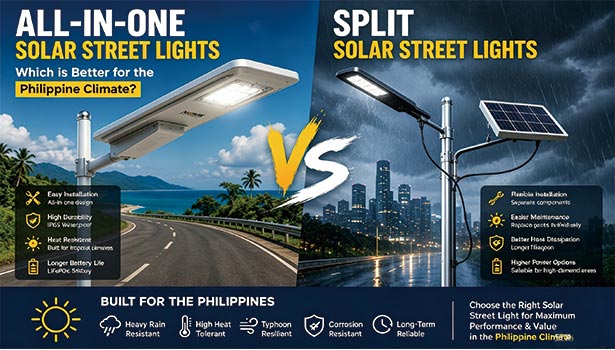 All-in-One vs. Split Solar Street Lights: Which is Better for the Philippine Climate?May. 26, 2026