Solar Street Lights: A Bright Path to Improving Quality of Life in the Community
Mar 19, 2026
As urbanization continues to accelerate, community lighting has become a critical infrastructure that impacts residents’ quality of life and safety. Traditional grid-powered street lights suffer from issues such as energy waste, aging wiring, and electrical leaks. Solar street lights, however, offer the advantages of independent power supply and green energy efficiency, making them an ideal choice for improving the community environment and enhancing residents’ quality of life. This article will provide a detailed discussion of the principles, advantages, community applications, and key usage points of solar street lights.
Solar Street Light Description
In community settings, solar street lights not only provide basic lighting but also fundamentally address issues such as excessive energy consumption and safety hazards associated with traditional street lights. They balance practicality with environmental sustainability, meeting the essential need for stable, round-the-clock lighting in communities while aligning with current green, low-carbon urban development concepts. This lays a solid technical and practical foundation for their large-scale promotion and application within communities.
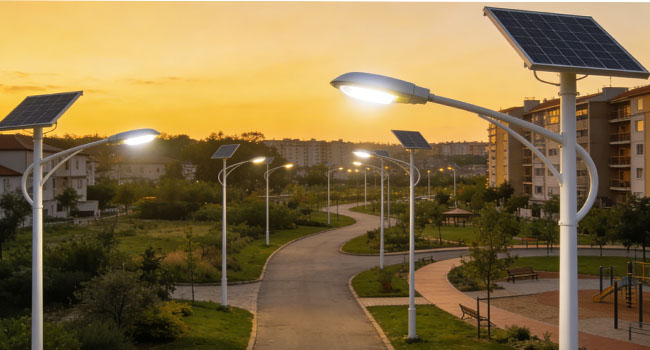
How the Energy Powering Solar Street Lights Is Generated
Core Conversion Logic
Solar street lights rely on natural solar energy to complete a closed-loop cycle; the entire process requires no external power input and does not depend on the consumption of fossil fuels. The core logic involves converting sunlight during the day into storable electrical energy, which is then released at night when light is insufficient to power the lighting. This conversion process is simple and environmentally friendly, meeting the requirements for sustainable community development and providing the foundation for long-term, stable operation of the equipment.
The generation and use of energy by solar street lights produce no pollutants such as carbon dioxide or sulfur compounds throughout the entire process, nor do they consume non-renewable energy sources like coal or natural gas. This stands in stark contrast to the model of traditional street lights, which rely on grid-supplied thermal power. When applied on a large scale in communities, they can effectively reduce regional carbon emissions, helping communities create a green, low-carbon living environment. At the same time, they align with the development requirements of the national “dual carbon” goals and possess outstanding ecological value.
Advantages of Solar Street Lights
Energy-Efficient and Environmentally Friendly
Solar street lights rely entirely on solar power for electricity, eliminating the need to draw on municipal grid resources. This significantly reduces a community’s overall electricity consumption and utility costs, thereby alleviating operational cost pressures on community property management. Additionally, the equipment operates with zero pollution and zero emissions, causing no negative impact on the community’s air quality or ecological environment. It continuously supports the community’s efforts to build a green, low-carbon living space, aligning with the development trends of modern urban ecological construction.
Safe and Reliable
The external power lines of traditional street lights are constantly exposed to outdoor environments, making them prone to safety issues such as aging, damage, and electrical leaks, which pose a threat to the safety of vulnerable groups like the elderly and children when they are out and about. Solar street lights, however, do not require the installation of complex power lines; safety hazards such as electrical leaks and short circuits are eliminated at the design level. When used in densely populated areas such as community walkways and recreational plazas, they create a safer environment for residents’ nighttime activities.
Easy Installation
Installing solar street lights does not require digging up the pavement to lay power cables, nor does it require connecting to the municipal power grid or modifying existing lines. The overall construction process is simple and convenient, with a construction cycle far shorter than that of traditional street lights. The installation process does not damage the community’s pavement structure, greenery, or overall landscape. Whether for supporting infrastructure in new communities or lighting upgrades in older neighborhoods, implementation can be carried out quickly, minimizing disruption to residents’ daily lives.
High Long-Term Cost-Effectiveness
Although the initial procurement and installation costs of solar street lights are slightly higher than those of traditional street lights, they completely eliminate electricity costs during operation. Furthermore, the equipment has a simple structure and a low failure rate, and both the operational difficulty and financial investment required for daily maintenance are low. For communities requiring uninterrupted lighting throughout the year, the long-term comprehensive cost is far lower than that of traditional street lights, saving community property management a significant amount of money on future operation and maintenance costs and improving overall operational efficiency.
Highly Adaptable
Solar street lights can flexibly adjust light intensity, illumination duration, and sensor modes to meet the lighting needs of various community settings. Additionally, the equipment features an independent power supply. Even in the event of a municipal power outage, the lights continue to function normally, ensuring uninterrupted nighttime lighting for the community. Whether it’s wide main thoroughfares, narrow sidewalks, recreational plazas, or underground parking garage entrances and exits, these lights provide tailored lighting solutions for every scenario.
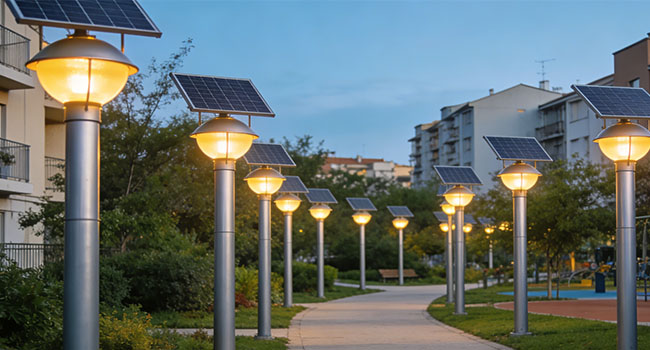
Application of 150W Solar Street Lights in Communities
Core Application Scenarios
The light intensity and coverage range of 150W solar street lights perfectly meet the lighting needs of various public areas in communities. They do not waste energy due to excessive brightness nor create lighting blind spots due to insufficient brightness. They are commonly used on community main roads to ensure the safety of vehicles and pedestrians, and on sidewalks to provide soft lighting for residents’ nighttime walks and leisure activities. They are also suitable for community recreational plazas, outdoor parking lots, and areas surrounding green belts, balancing lighting functionality with the community’s landscape aesthetics.
Enhancing Nighttime Safety and Community Activity
150W solar street lights provide comprehensive lighting coverage for community public areas, effectively eliminating blind spots on roads at night. They ensure adequate lighting for residents and vehicles, significantly reducing safety risks during nighttime travel. At the same time, a well-lit environment boosts nighttime community activity, encouraging residents to step outside for exercise, leisure, and other activities, enriching their nightlife and enhancing the community’s atmosphere.
In communities where the installation and retrofitting of 150W solar street lights have been completed, residents’ sense of safety and satisfaction with nighttime travel have significantly improved, and participation in nighttime recreational activities has notably increased. At the same time, electricity costs for community public lighting have dropped substantially, and the achievements in energy conservation and carbon reduction have been recognized by both residents and relevant management departments, truly realizing multiple benefits such as upgraded lighting quality, improved quality of life for residents, and reduced operating costs.
Precautions When Using Solar Street Lights
Solar Panel Installation Notes
The orientation and shading conditions of solar panels directly determine the system’s power generation efficiency. When installing panels in a community, they should be oriented toward the direction with the best sunlight conditions, typically due south. Additionally, obstacles such as community buildings and tall trees should be avoided to ensure that the panels can fully receive sunlight during the day, allowing the energy storage components to accumulate enough power to support lighting throughout the night and preventing insufficient lighting duration due to inadequate sunlight.
Key Points for Daily Maintenance
Community property management should establish a routine maintenance system for solar street lights, regularly cleaning the solar panels to remove accumulated dust, fallen leaves, debris, and other obstructions from the surface, thereby ensuring stable solar energy conversion efficiency. Additionally, the energy storage components’ performance should be tested periodically, and aged or damaged parts should be replaced promptly. Smart controllers should also be debugged and inspected, with charging and discharging parameters adjusted according to seasonal changes in daylight hours to ensure the entire system remains in optimal operating condition.
Precautions for Special Conditions
In special conditions such as prolonged rainy weather or low winter temperatures, the operation of solar street lights may be affected. Community operations and maintenance personnel should check the storage capacity of energy storage components in advance to ensure that basic lighting duration requirements are still met during rainy weather. In winter, snow on the panel surface should be cleared promptly to prevent it from blocking sunlight. At the same time, anti-freeze protection measures for the equipment should be checked to prevent low-temperature environments from damaging internal components, ensuring stable operation of the equipment in harsh weather.
Solar street lights combine eco-friendly design with practical lighting functionality, serving as vital infrastructure for enhancing community safety and improving residents’ quality of life. They help reduce community operating costs while supporting the development of green, low-carbon communities. As the demand for upgraded community lighting continues to grow, solar street lights will become more widely adopted in communities, consistently creating a safe and comfortable living environment for residents.
related
-
Off-Grid Road Safety: The Cost-Benefit Analysis of Solar Road Studs in Provincial ProjectsJun. 24, 2026
-
 The Ultimate Checklist for Inspecting Road Studs Before Installation in Infrastructure ProjectsJun. 04, 2026
 -
 All-in-One vs. Split Solar Street Lights: Which is Better for the Philippine Climate?May. 26, 2026