8 Ways to Extend Solar Street Light Time on Cloudy Days
Mar 02, 2026
Cloudy days pose the most common challenge for solar street lights. Insufficient sunlight drastically reduces solar panel charging efficiency, leading to shorter illumination times, dimmer brightness, or even complete failure to light up. This not only compromises road safety but also diminishes convenience in public areas, creating numerous headaches for property managers, municipal authorities, and other responsible parties. This article shares 8 practical, cost-effective methods to help extend solar street light runtime on cloudy days, address power supply shortfalls, and ensure stable operation under all weather conditions.
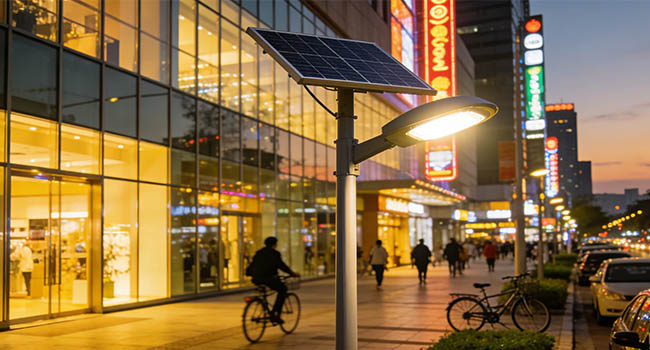
Core Reasons for Reduced Solar Street Light Illumination on Cloudy Days
Core Impact Logic
The primary issue during overcast conditions is low light intensity, which directly results in insufficient charging of solar panels. This prevents batteries from storing adequate energy. When battery levels fall below a certain threshold, the street light automatically reduces illumination duration or brightness, or even ceases operation entirely. During prolonged cloudy periods, this energy deficit is amplified. While a single overcast day may have limited impact, cumulative effects over multiple days can render solar street lights completely incapable of meeting nighttime lighting demands.
Simplified Analysis of Solar Street Light Operation
The operational flow of solar street lights can be simplified as follows: solar panels absorb light energy, controllers convert this energy into electricity and store it in batteries, and batteries power the light source. Among these components, the solar panel is central to the charging process and the most vulnerable to cloudy conditions. While diffuse light on cloudy days can be absorbed by solar panels, its conversion efficiency is significantly lower than on sunny days, resulting in insufficient charging to support normal street light illumination. The controller regulates charging/discharging logic, the battery handles energy storage, and the light source delivers final illumination. Any efficiency drop in these components is amplified during overcast conditions, impacting overall endurance.
8 Practical Methods: Extending Solar Street Light Illumination Time on Cloudy Days
Optimize Solar Panel Installation
The installation angle and environment of solar panels directly determine light absorption efficiency on cloudy days. This is the most fundamental and easily implemented optimization method, and a crucial step in enhancing solar street light endurance during overcast conditions. By reasonably adjusting the installation position and angle of solar panels, without increasing hardware costs, the utilization of scattered light can be significantly improved, allowing solar street lights to capture more charging energy even on cloudy days.
Orient panels due south, fine-tuning the angle based on local latitude (greater angles for higher latitudes). Avoid obstructions like buildings and trees. Adjust angles seasonally to prevent insufficient light absorption in winter. Regularly clean panels to maintain light transmission and maximize charging efficiency on cloudy days.
Selecting High-Efficiency Solar Panels
Opting for high-efficiency solar panels offers a long-term solution to address insufficient runtime during overcast conditions. Different panel types exhibit significant variations in overcast conversion efficiency, fundamentally enhancing the street light's low-light charging capability. Monocrystalline silicon panels boast high conversion efficiency and strong scattered light absorption, making them ideal for new projects and areas demanding extended solar street light runtime. Bifacial panels absorb light from both sides, delivering superior low-light performance and making them suitable for regions with frequent overcast conditions.
Multicrystalline panels offer lower costs but average conversion efficiency, making them more suitable for well-lit environments. Prioritize monocrystalline or double-glass bifacial panels, which feature rapid low-light activation and stable conversion. These ensure continuous battery charging during overcast periods, minimizing lighting interruptions and enhancing overall system reliability.
Upgrading Battery Capacity and Type
As the “energy reservoir” of solar street lights, the battery's capacity and performance directly determine the minimum endurance during overcast days. Upgrading the battery is the key solution to addressing insufficient energy storage in such conditions. Traditional lead-acid batteries suffer from low energy density, short lifespan, and significant performance degradation in low-temperature and low-charge environments, making them unsuitable for regions with frequent cloudy weather.
Lithium-ion batteries offer high energy density and superior charge/discharge performance, with a lifespan 2-3 times longer than lead-acid batteries. Even with insufficient charging during overcast days, they reliably power solar street lights. Their strong deep-discharge capability, combined with protection boards that prevent overcharging and over-discharging, reduces long-term replacement costs. Taking a 30W solar street light as an example, battery capacity can be selected based on local overcast frequency, with an additional 10%-20% reserve capacity to handle consecutive rainy days. This ensures stable illumination even during periods of insufficient sunlight.
Utilizing Smart Light Control and Dimming Technology
Many solar street lights suffer from insufficient runtime on cloudy days not due to inadequate charging, but excessive energy waste. Implementing smart light control and dimming technology effectively reduces inefficient energy consumption, extending illumination duration during overcast periods. Installing smart controllers with light sensing, time control, and dimming functions enables “on-demand power supply” for solar street lights. They activate at 100% brightness during evening peak foot traffic and automatically dim at night when foot traffic decreases, balancing illumination needs with energy savings.
Premium controllers also feature overcharge and over-discharge protection, stabilizing the charging/discharging process to prevent battery damage. They support customizable dimming modes for diverse road segments. Time-based dimming extends cloudy-day illumination by 2-3 hours without compromising core-time safety.
Adding a Backup Charging System
In regions with frequent consecutive overcast days, solar charging alone may struggle to meet normal power demands. Integrating a backup charging system effectively counters extreme weather, preventing lighting interruptions. Two common backup solutions exist:
AC Backup Charging Interface: Utilizes grid power for supplementary charging. This low-cost, easy-to-operate option suits municipal roads, residential communities, and other grid-connected areas, enabling rapid solar lamp recharge during prolonged cloudy periods.
The second is a wind-solar hybrid system paired with a small wind turbine. This utilizes wind energy for auxiliary charging during overcast periods without requiring grid power, offering an eco-friendly and energy-efficient solution for remote areas without grid coverage. It achieves complementary power from solar and wind sources, ensuring stable solar street light operation even during prolonged cloudy periods.
Optimizing Light Sources
Light source power consumption directly impacts solar street light illumination duration. Optimizing light sources reduces power consumption while maintaining brightness, extending the operational lifespan of solar street lights during overcast periods. Prioritize high-efficiency, low-power LED light sources. At equivalent brightness levels, their power consumption is significantly lower than conventional LEDs and high-pressure sodium lamps, offering longer lifespans. They represent the optimal light source choice for solar street lights, providing distinct advantages for extended overcast operation.
Warm white light (3000K-4000K) is recommended, offering superior visual effects while consuming 5%-10% less power than cool white light. Moreover, high-efficiency LEDs maintain stable operation even at low battery levels, enabling solar street lights to sustain illumination longer with limited power reserves and further alleviating supply pressure during overcast periods.
Regular Maintenance and Inspection
Routine maintenance and inspection are crucial to prevent minor faults from exacerbating overcast-day performance issues. This ensures all components function properly and minimizes unnecessary power loss. Follow a fixed schedule for routine maintenance: clean the solar panel surface and check for obstructions every 1-2 months to maintain optimal light absorption efficiency.
Every 3-6 months, inspect the battery's charge/discharge performance and the controller's operational status to prevent energy waste caused by battery degradation or controller malfunctions. Annually check the light source brightness and wiring connections to prevent issues like electrical leakage or light decay. Consistent daily maintenance keeps solar street lights in optimal condition, ensuring stable charging and reliable illumination even during overcast periods.
Customize Configurations Based On Local Weather Conditions
Regions vary significantly in overcast frequency and sunlight intensity. Blindly configuring solar street lights may result in either “under-configuration leading to short battery life” or “over-configuration causing cost waste.” Tailoring configurations to local weather achieves the optimal balance between solar street light endurance and cost.
Customization requires first compiling local annual data on overcast frequency and average sunlight intensity, then determining the minimum lighting requirements for the solar street lights. Communicate with the manufacturer to customize the optimal combination of solar panel power, battery capacity, and light source power. Regions with frequent overcast days may require appropriately increased solar panel power and battery capacity. Post-installation, fine-tune the dimming mode and solar panel angle based on the actual performance during cloudy days. This ensures the lights are perfectly adapted to the local climate, prevents resource wastage, and enhances operational stability during overcast periods.
Extending the illumination time of solar street lights during overcast conditions requires more than just “increasing battery capacity.” It demands a comprehensive approach combining “module optimization + intelligent control + routine maintenance.” For existing installations, prioritize low-cost improvements such as optimizing mounting angles, cleaning solar panels, setting dimming modes, and performing regular maintenance. For new projects, select high-efficiency modules and customized configurations to address overcast endurance issues at their root.
related
-
Off-Grid Road Safety: The Cost-Benefit Analysis of Solar Road Studs in Provincial ProjectsJun. 24, 2026
-
 The Ultimate Checklist for Inspecting Road Studs Before Installation in Infrastructure ProjectsJun. 04, 2026
 -
 All-in-One vs. Split Solar Street Lights: Which is Better for the Philippine Climate?May. 26, 2026